The 3,100-Mile Race on a Half-Mile Block in NYC: Insanity or the Ultimate Test of Endurance?
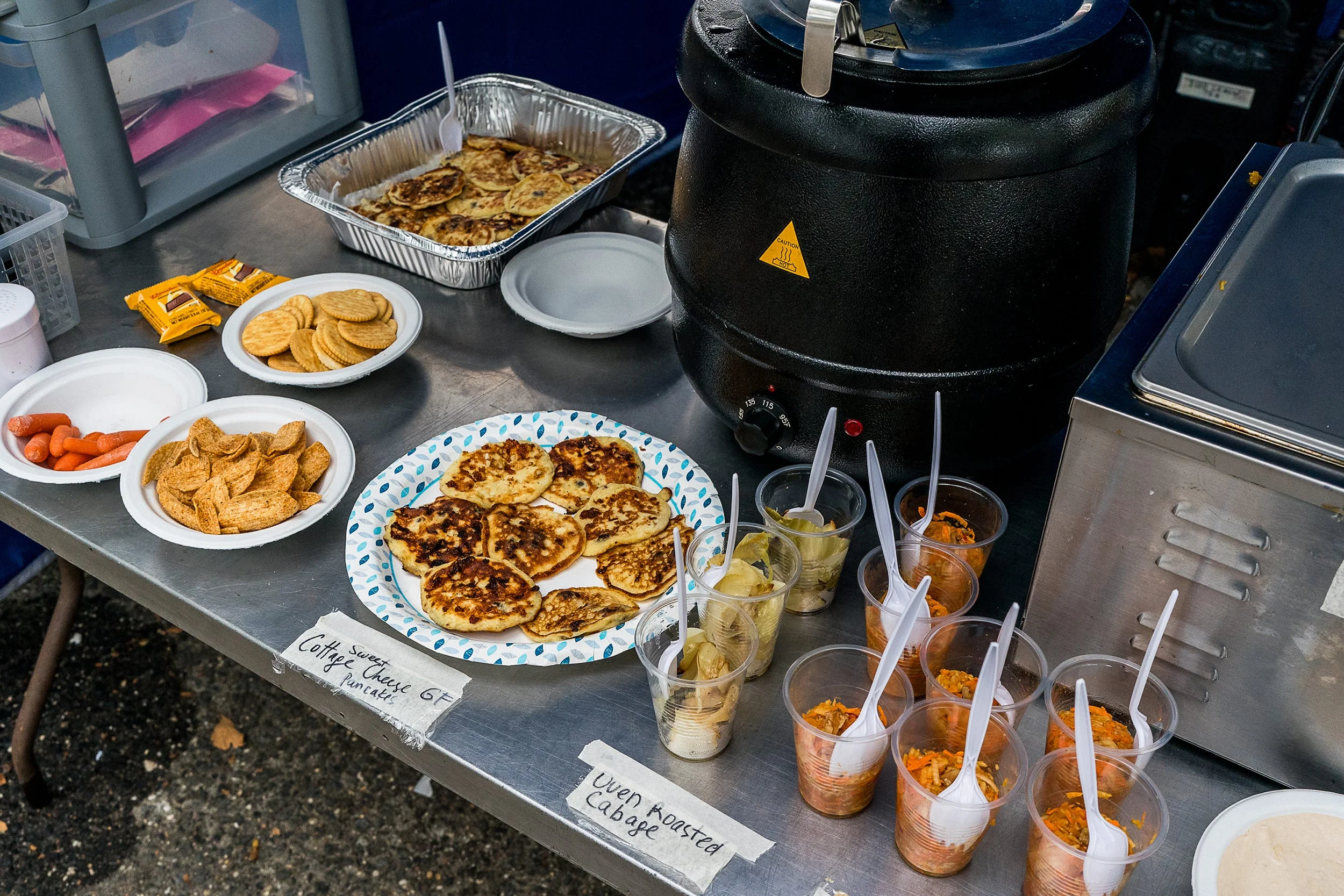
It’s a few minutes after noon on Saturday, August 30, 2025, and the sidewalk outside Thomas Edison Career and Technical Education High School in Jamaica, Queens, feels less like the starting line of the world’s most grueling footrace and more like an annual neighborhood potluck serving a vegetarian-only menu.
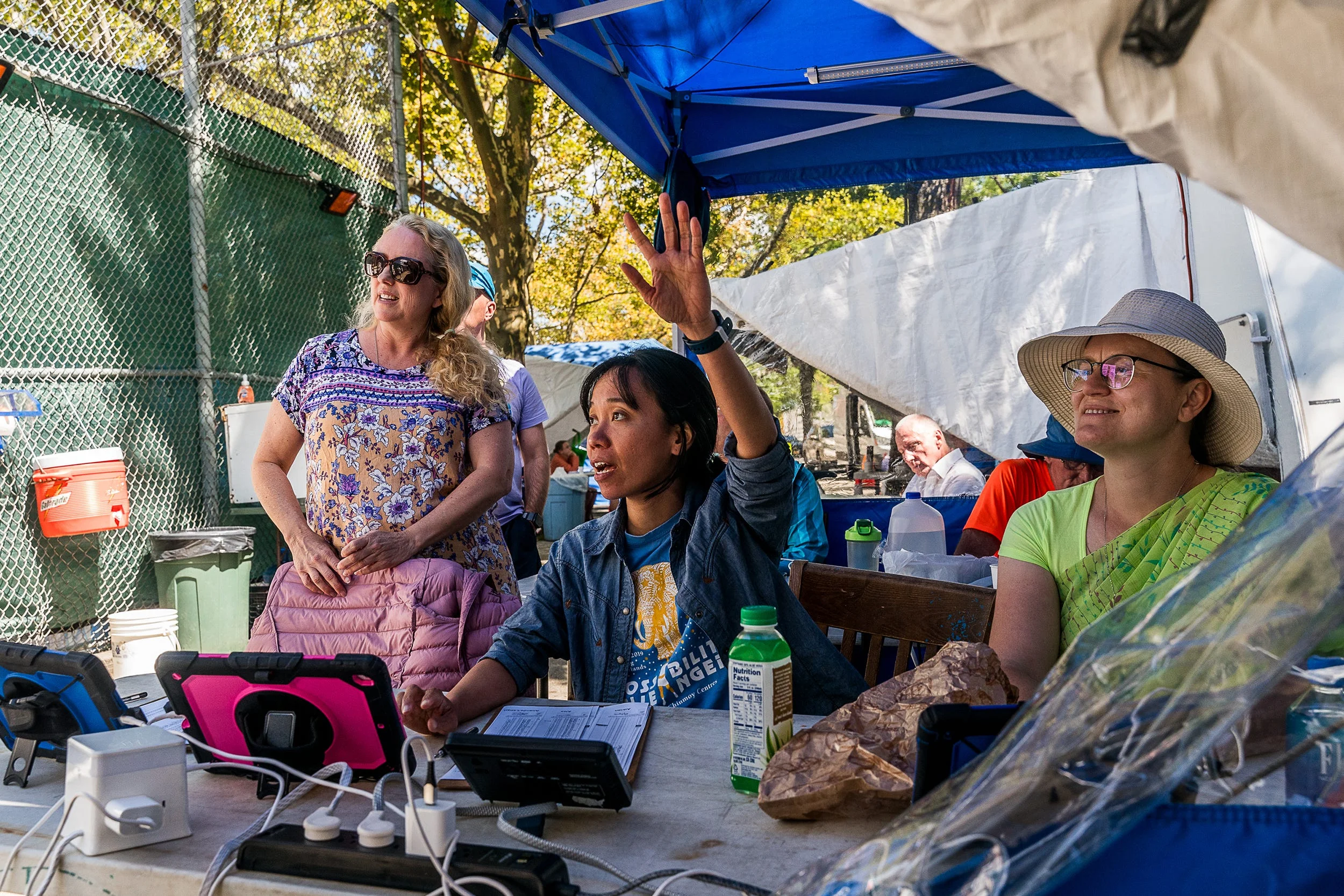
At the race command center on the sidewalk outside the school—with a few tents and trailers, a cluster of folding tables, plastic coolers, and a row of blue porta-potties—the mood is downright gleeful. It’s a gorgeous late-summer day, 75 degrees and sunny, the smell of bean stew in the air. A man is riffing on an electric guitar at one corner of the block, while a woman plays an accordion at the other end. In the background, the rhythmic thwack-thwack of a handball tournament echoes from the courts at 164th Place and Grand Central Parkway.
This is what the first day of the 29th Annual Sri Chinmoy Self-Transcendence 3100 Mile Race looks like.
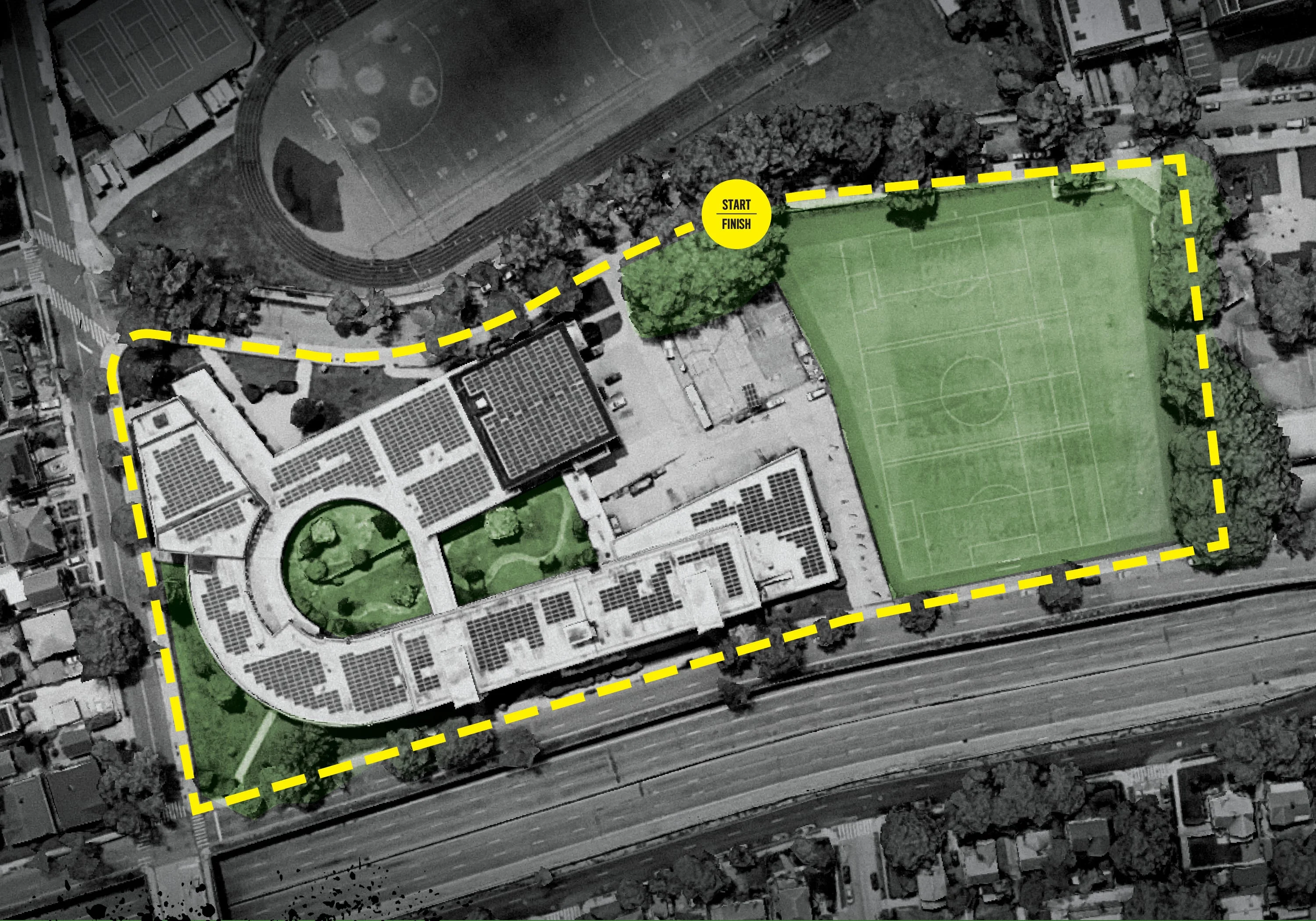
Ten runners circle the high school campus, a sports field, and a playground—a single city block. That’s the racecourse, a roughly 0.55-mile (900-meter) loop that will be the participants’ entire world for the next seven and a half weeks. They’ve been running since the starting gun sounded at 6 a.m. To complete the race, they will have to run the loop 5,653 times before the cutoff of 52 days, averaging 59.6 miles—more than two marathons per day. The course opens at 6 a.m. and closes at midnight. A little more than a quarter of the loop borders the freeway, a constant river of traffic and exhaust.
To the casual observer driving by, the runners—eight men and two women—look like locals out for a particularly long stroll or a casual afternoon run. But they are engaged in what the New York Times once called “the Mount Everest of ultramarathons.” This is the longest certified road race in the world. As the crow flies, it’s the distance between New York City and Cork, Ireland.
The roster includes 43-year-old Andrea Marcato from Dolo, Italy, who has won the last five races. (Only one runner, nine-time champion Ashprihanal Aalto of Finland, has won more iterations.) Marcato comes up in nearly every conversation with organizers and volunteers—his capacity for endurance and pain stretches beyond explanation. Unlike other runners, who take regular breaks to regroup and recover, he runs pretty much all day, taking advantage of the full 18 hours the course is open, rarely stopping and hardly ever walking. He almost never naps during the day. He’ll sprint the last lap before midnight just to get it in before the clock stops.
There’s Vasu Duzhiy, a 59-year-old foreman for a lumber company in St. Petersburg, Russia, and three-time champion who is running his 13th edition; Alex Ramsey, a 40-year-old first-timer from Ohio, is known as “Shoeless Alex” in the ultrarunning world, although he’s wearing shoes for this race; Lucong Geng, an experienced ultrarunner from China, is also running his first 3100; Daniela Bojila from Romania, and Harita Davies, a dual citizen of New Zealand and the U.S., are the two women in the race; and there is Milan Javornický of the Czech Republic, Mahasatya Janczak of Poland, Adrian Papuc of Romania, and Ananda-Lahari Zuscin of Slovakia.
(An 11th participant, an Australian woman, dropped out of the race before it began—she hadn’t been feeling well, and the morning of the first day, she decided to volunteer instead, turning the race trip into a quasi-vacation.)
For the next seven weeks, this group will run through the humid death-rattle of the late New York summer and into the crispness of October. Their bodies will transform—literally—on this sidewalk. They will run clockwise one day and counterclockwise the next, a small concession to the skeletal imbalances caused by turning the same street corners thousands of times. They will wear through a half dozen or so pairs of shoes each, shed significant body weight, and consume thousands of calories per day.
As I pace around the course taking in the first day of the race, the question that brought me here, the question that has been wiggling in my mind like a loose tooth since I first heard about it, comes back with a vengeance.
Why?
Why are they doing this? Why here? Why this block? Why Queens? Why not run across the continent? Why not a trail through the Appalachian Mountains or a path along the Pacific?
The late guru Sri Chinmoy’s philosophy was all about achieving spiritual enlightenment by going to extremes and pushing oneself beyond one’s perceived limits. And if running 5,653 short identical loops in Queens isn’t the very definition of extreme, I don’t know what is.
I came out to Queens expecting to find something strange, amusing, and, frankly, a little insane.
This is what I found instead.
To understand the race, you have to understand its founder, Sri Chinmoy.
Chinmoy was born in 1931 in what is now Bangladesh and lived in an ashram from age 12. He picked up running early on and idolized U.S. Olympic track star Jesse Owens. In 1964, Chinmoy moved to New York City and worked as a clerk at the Indian consulate, later opening a meditation center in Puerto Rico, then another one in Jamaica, Queens, on the site of clay tennis courts called the Aspiration-Ground.
He was a musician, an artist, and a weightlifter, who centered his life around endurance training. He drew national attention by power-lifting pickup trucks and public figures like Muhammad Ali, Sting, Nelson Mandela, Eddie Murphy, Yoko Ono, Richard Gere, and Susan Sarandon. He called Olympic sprinter Carl Lewis a friend.
Over the years, Chinmoy developed a devoted following of some 7,000 disciples, many of whom moved from all around the world to live near his home on 149th Street in Queens.
It wasn’t so much a religion that Chinmoy created, but a spiritual philosophy built around celibacy, meditation, dedication, vegetarianism, and endurance. Much of his teaching focused on the idea of “self-transcendence,” the notion that extreme physical activity—including running, swimming, and weight training—could help achieve spiritual enlightenment.
In Chinmoy’s worldview, pushing beyond your perceived limits wasn’t only athletic. It was devotional.
Ultramarathons were Chinmoy’s preferred method of supporting his followers in their own journey to self-transcendence, according to Sanjay Rawal, a member of the Sri Chinmoy Marathon Team who made the 2018 documentary 3100: Run and Become about the race. It began with a six-day race, followed by a 10-day race, and then a 700-miler, 1,000-miler, and 1,300-miler. The number 13 was meaningful to Chinmoy because he arrived in the U.S. on April 13.
Chinmoy had a tendency to give important dates in his life significance. In 1996, he hosted a 2,700-mile race—the distance chosen because his birthday was August 27. During the award ceremony, he proposed increasing the distances to 3,100 miles to honor his birth year, 1931. (Originally, the race rules mandated completing 50 miles per day, but eventually, the Sri Chinmoy Marathon Team implemented a 52-day time limit—after years of observation, they believed that cutoff was achievable.) As for the particular area of Queens chosen for the race, it’s where Chinmoy did his daily runs (and also because the group was denied permits to hold it in more idyllic parts of the city).
Chinmoy was 66 and no longer running at the time of the first 3,100-mile race, though each year he came to watch, bring snacks, and perform music at the race site. He died of a heart attack in 2007 at age 76, but his presence in Jamaica, Queens, is still palpable. His meditation center is only a few blocks from the course. His followers live in the surrounding houses and run businesses nearby, such as vegan restaurants. Each year, many of them, along with out-of-town followers, come to the city for the race to volunteer and cheer on runners.

Getting into the 3100 is not as simple as paying an entry fee. There is an opaque, almost political deliberation system. You must prove yourself in the Sri Chinmoy 10-Day Race, held each year in Flushing Meadows, Queens, and you must possess the right temperament. Race organizers are looking for runners with a positive attitude who can prove they’re able to handle adversity.
“The 3100 is a team sport, as strange as that sounds—people push each other forward based on their own positive frame of mind,” Rawal says. “But they can also pull the field back if they have a difficult time internalizing the difficulties they face. We feel like enthusiasm and cheerfulness are not only keys to individual performance but are essential to ensuring that everyone has the best chance of success.”
Although there is no hard cap, 14 or 15 runners is about all organizers can manage with the limited resources they have. Runners are responsible for their own housing; most rent rooms or small apartments from locals—often Sri Chinmoy followers—at discounted rates. Rawal estimates that each runner will spend about $5,000 to do this race: “That’s less than $100 a day for nearly two months in N.Y.C. What a deal!”
Alex Ramsey is one runner that organizers decided had the right temperament for the race. As he approaches the start/finish line midway through Day One, he’s wearing Topo Athletic Atmos shoes, a violet Sri Chinmoy T-shirt with an outline of the sun and a large 3100 across its front, and shorts made of denim-looking material that resemble something Andre Agassi would wear in the 1980s. Before beginning his 53rd lap, he grabs a croissant plastered with butter, a large, infectious smile spread across his face. He’s barely broken a sweat.
The 40-year-old programmer, with a lean physique, shoulder-length dreadlocks, and a few tattoos, first heard about the 3100 in 2015, when he was participating in the Race Across USA, which went from California to the White House. Ever since, the 3100 has been one of his ambitions. He managed to arrange a leave of absence from his employer, Risepoint, an education technology company, through a combination of banked vacation days and unpaid leave.
As he passes the set of folding tables where volunteers are keeping track of laps and time, someone shouts, “Three laps till your 50K!”
Ramsey nods, takes a bite of the croissant, and starts walking. I join him, and as we take a slow lap around the course, he gives me some insights into his strategy. He plans to break the race into segments, focusing on six-hour blocks including three hours of running, then eating, walking, and resting, pacing himself for the long haul. He’s staying in a room he rented nearby at $500 for around eight weeks and uses a bicycle to travel the half mile to his minimalist sleeping quarters.
“It’s easier to have little goals through the day,” Ramsey says. “The focus is ‘Be in the lap.’ That’s where the miles will come. That’s when the inspiration will come.”
After our half mile together, I watch Ramsey disappear around the corner of the school, with almost 50K in his legs already and still nearly a full marathon left to run today. One thing that strikes me about Ramsey is how at ease he seems about the race and his approach to it. If he has any concerns about the fact that today is just the first day of this grueling endeavor, he shows no sign of it.
A week after opening day, I return to the course, but this time I’m not just observing. I’ve volunteered to count laps during the 10 a.m. to 3 p.m. shift. Three other volunteers are doing the same, all Sri Chinmoy followers.
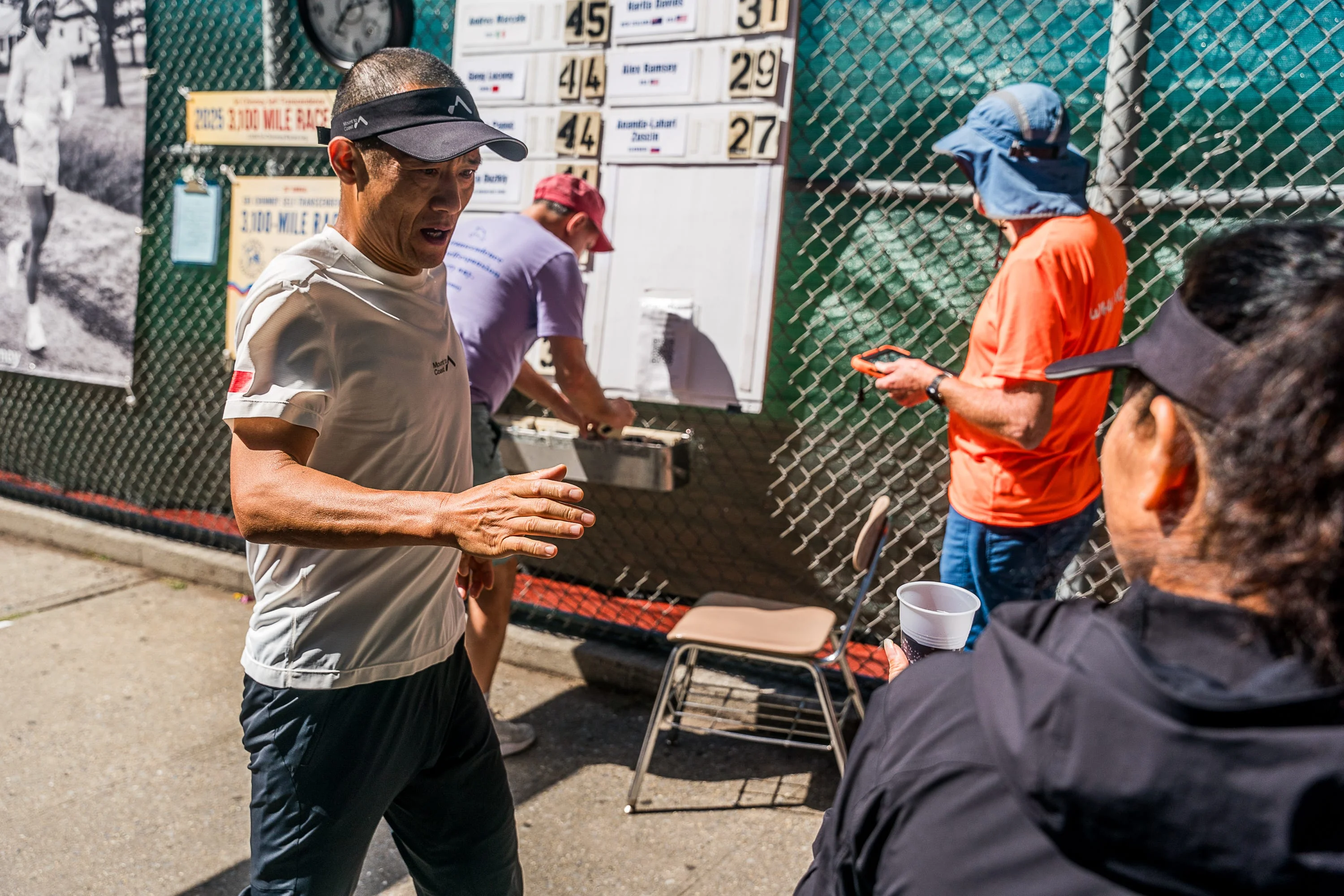
We are each assigned a group of runners, tracking their laps on a printed-out sheet and also inputting them into an iPad. When our runners cross the starting line—every eight or nine minutes on average—we shout their name, the number of laps they’ve completed, and any notable milestones. This, I’m told, is to help keep their spirits up—so they know they’re making progress.
This is my first clue about the utility of hosting this grueling race on a single loop. In a point-to-point race, no matter how short or long, a runner’s brain is constantly processing new stimuli: a hill, a bend in the road, a water station, the next street. On this course, the stimuli never change: the same bend, the same park bench, the same row of blue porta-potties. The runners know every crack in the sidewalk. Running the race, therefore, becomes an exercise in subdivision: seven weeks divided into days, into hours, into laps, into this and that part of the block.
One afternoon, I sit with a group of volunteers and hear a story from Arpan DeAngelo, Andrea Marcato’s “handler,” a volunteer who helps with all of the runner’s basic needs throughout the race. Arpan (his spiritual name) is 73, a devotee of Sri Chinmoy since he was a teenager and a lifelong runner who ran the 3100 race in his 50s.
“From the outer point of view, the rational-logic point of view, it’s kind of crazy,” he says of running in circles for weeks on end. “But the experience of it for the helpers, as well as for the runners, of course, brings you to a different perspective on reality. You’re part of a group, kind of like a family.”
As a young student, Arpan had an epiphany about running in circles. Struggling to complete a long run one evening, he looked up at the moon and the stars and thought: The moon has been going around the Earth for billions and billions of years, in circles. The Earth has been going around the sun for billions and billions of years… To him, circling a single city block in Queens is merely connecting with the universe. “This is practical, in a sense it achieves something that you can’t achieve by doing something straight… you’re going to get a different perception and experience of who you are.”
I start to notice the loops in my own life, the patterns: The route to and from work, the run from my current apartment to the one I’m soon moving to, and back. And when I do, I start to see things I don’t normally see, little details that had remained hidden until I paid attention: a particularly beautiful tree, an immaculately curated outdoor garden, a small church. There’s indeed something meditative about moving in circles; I’d just never thought about it until now.
Spiritual element aside, the human body isn’t designed to run 60 miles a day on concrete for nearly two months. Throughout the race, but especially in the middle and later stages, runners are in a state of permanent physiological crisis. They burn upwards of 10,000 calories a day, and most finish the race 20 or so pounds lighter than they were at the start. Their bodies simply cannot metabolize fuel fast enough to keep up with the demand. The race becomes, in part, a desperate struggle to ingest enough calories to keep going.
You won’t see much of the typical race fuels, like gels or energy chews, here. In this environment, nutrition stops being about optimization and becomes about survival. Some runners favor an “alkaline” approach—avocados, quinoa, brown rice—trying to minimize inflammation and keep the gut calm. Others top off their glycogen stores in any way they can, living the “any food is fuel” motto. During one of the previous years, Marcato received a family-size pizza every day. I see runners eat Japanese
Kit Kats and slices of cake, and one of the European runners drinks a bottle of beer in the middle of the afternoon.
As the race goes on, blisters and calluses become a constant source of agitation. The runners burn through five, 10, 15 pairs of shoes during the course of the race. A Japanese finisher in a previous race reportedly went through 19 of them, and his feet swelled so severely that he cut through the toebox of his shoes to relieve pressure and keep moving.
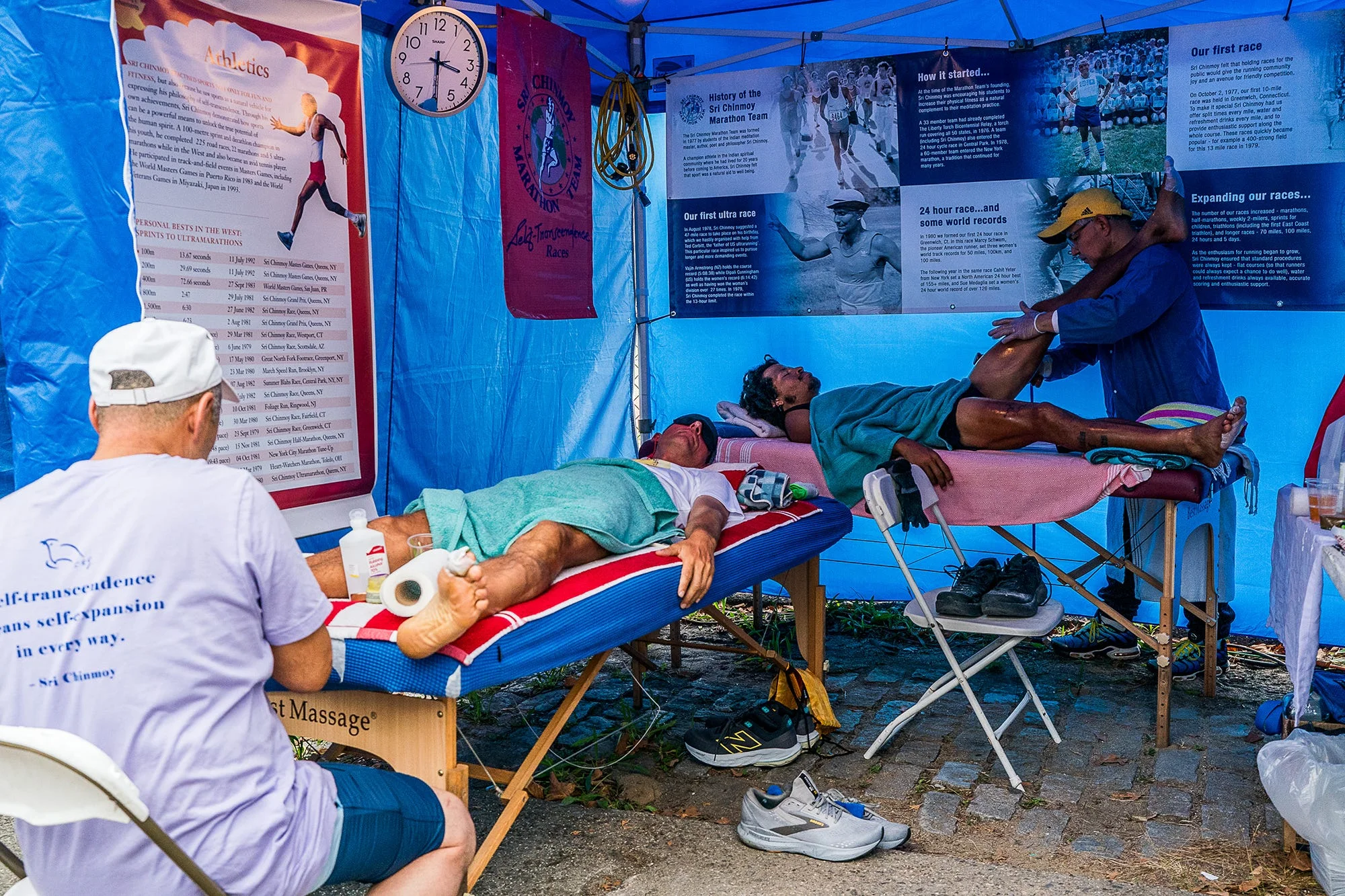
A volunteer doctor shows up from time to time to take a look at the runners. Volunteers tape blisters and offer massages in a tent set up near the porta-potties. “Remember, the trick of this race…is that you just gotta keep moving. So you don’t want to get too comfortable [in the massage tent],” Ramsey says.
While each runner deals with their own physical issues, Lucong Geng is clearly suffering more than the others. He’s a veteran runner and has brought with him a handler from China, herself an ultrarunner who hopes to qualify for the 3100 next year.
His body is falling apart.
From the beginning, Geng has suffered from a food-related stomach ailment that caused him to lose weight. Then he developed a hip pain that led to “the dreaded lean,” causing him to favor one side while he runs. As he keeps going, he risks exacerbating the injury or triggering a cascade of others.
In the later stages of the race, I see Geng struggling down the sidewalk, somewhere between a hobbled walk and a tortured jog. His face is gaunt and colorless, and he looks like he’s aged 15 years in just the last few weeks. I overhear a group of volunteers so concerned about his health that one of them suggests forcing him to quit.
Somehow, though, Geng runs on. He drops in the standings, but by October 4, Day 36, he’s completed 2,221 miles. He’s still on pace to finish.
I’m volunteering again that day, and I’ve been assigned to track Geng’s laps. Every time he crosses the start/finish line, I call out his name and tell him how many laps he’s finished. Each time, he looks at me, half-smiles, and nods in recognition, heading off on another lap. I’m amazed that he’s still going. He looks to be in incredible pain, but he also seems to embody the very perseverance that Chinmoy championed—transcending the limitations of his body right before our eyes.
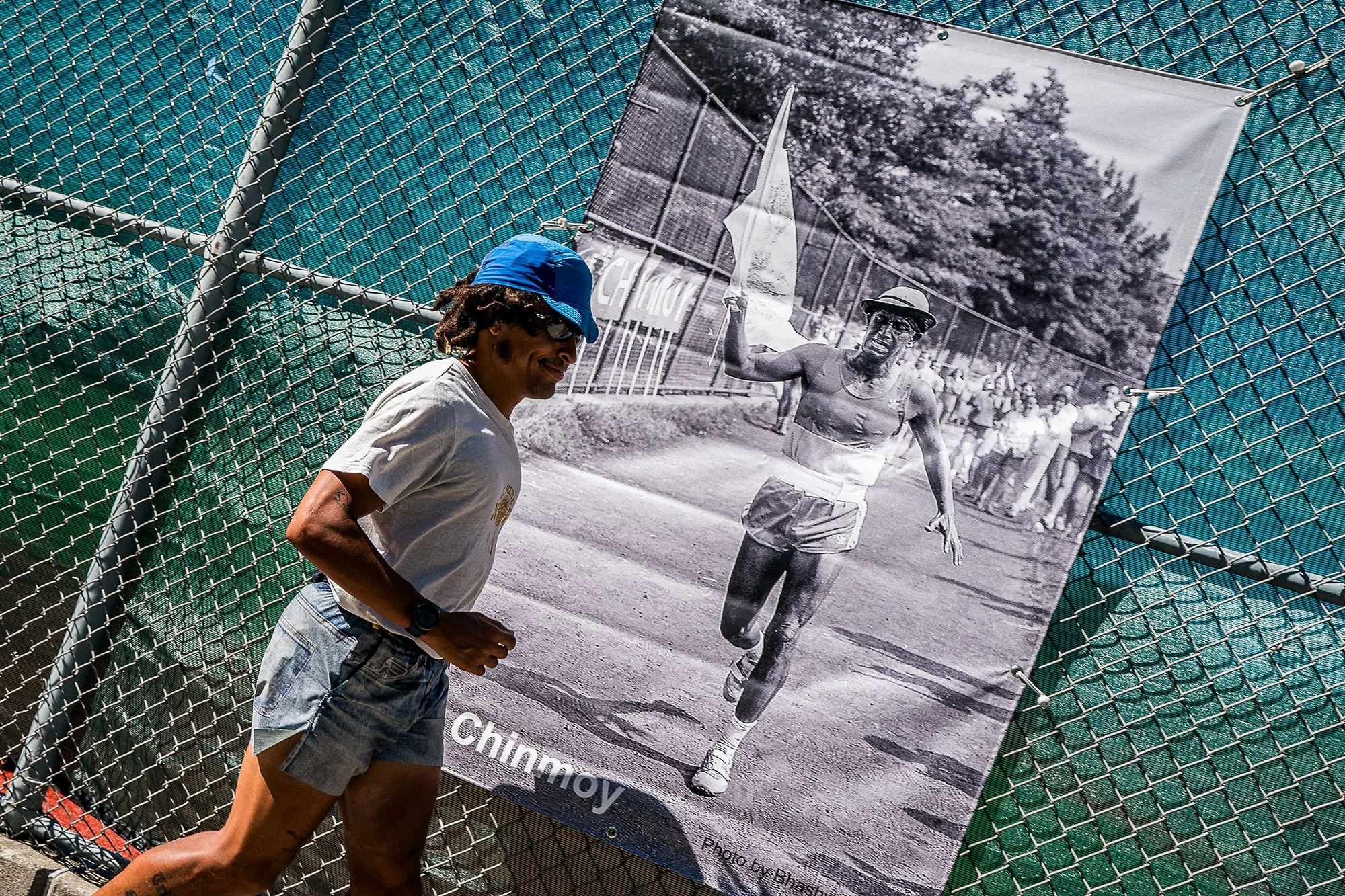
Alex Ramsey is holding up much better. The American’s strategy of pacing himself from beginning to end appears to be paying off—he’s moved up from eighth to fourth place over the last few weeks. He tells me he’s been using gratitude practice—for being there, for the other runners, the volunteers, Sri Chinmoy—to distract his mind from running the numbers of miles left or thinking about physical ailments, although he admits it doesn’t always work.
Ramsey doesn’t have a single handler. He has a rotating cast of friends and family who show up to support him. One of them is Sean Gavor, an ultrarunner from New Jersey who works as a mail carrier and has ambitions to run the 3100 himself—hopefully next year. One weekend, he describes to me what he calls “the lifestyle” of an ultramarathon runner: He wakes up at 4 a.m., does an hour of weights and calisthenics, runs for one hour, and then walks all day long at work. “By 7 in the morning, I’m at 15,000 steps,” he says. By the end of the day, he reaches 35,000—about 15 miles or so—and he’s usually in bed by 7:30 p.m. Gavor seems to possess exactly what the organizers are looking for, although he has no clue if he will actually be invited.
That afternoon, I walk with Ramsey on a counterclockwise lap along Grand Central Parkway. Ramsey is catching me up on the state of the race when Russian Vasu Duzhiy pulls up beside us—he wants to share his experiences running this race, his 13th time.
I ask Duzhiy why he keeps coming back. It’s difficult to understand what he’s saying through his accent and the hum of the freeway beside us, but I do catch a few things. “It’s paradise, really,” he says. “I love it.” He describes the runners as family. Many of them have run the race several times and know each other well. “We show that if we’re from different countries, we can be together and love,” he says.
Just then, Duzhiy begins to weep. Words are caught in his throat. Ramsey puts his hands over his shoulders.
“We feel each other’s pain and suffering, both physical and mental,” Ramsey says. “Vasu is very special in that not only has he helped me really develop a practice that I can take outside of this race, that will help me continue spiritual growth, but also physically, as I’m going through the rigors of getting all the mileage—he’ll stop, ‘Alex, do we need to stretch? Alex, do we need to do calisthenics?’ He takes time away from his race to help me out.”
It’s moving to see the connection between these runners from two countries often at odds with each other, and it reminds me of something Arpan told me about the nature of the race: The repetition and short length of the loop allows for bonds to form between all involved—the runners, the organizers, the volunteers, even the neighbors and school kids who watch and interact with the runners each day.
As time goes on, I, too, feel like I’m a part of the whole thing. I come back to volunteer several more times and show up at least once a week for the duration of the race. Throughout any given day, whether I was logging on for work, grabbing a drink with friends, watching a movie with my wife, or out for a run myself, I’d suddenly remember the participants increasing their loop count that very moment. I’d wake in the morning and think: They’re already up and running. And as I’d get ready for bed: They’re still out there.
On October 15, Day 47, at around 10 p.m., Andrea Marcato crosses the finish line, carrying the Italian flag and the yellow and white Sri Chinmoy flag with a lotus shape and 3100 inscription, winning his sixth consecutive Sri Chinmoy Self-Transcendence 3100 Mile Race. A sizable crowd gathers to celebrate his achievement.
Two days later, Vasu Duzhiy and Mahasatya Janczak finish within 10 hours of each other.
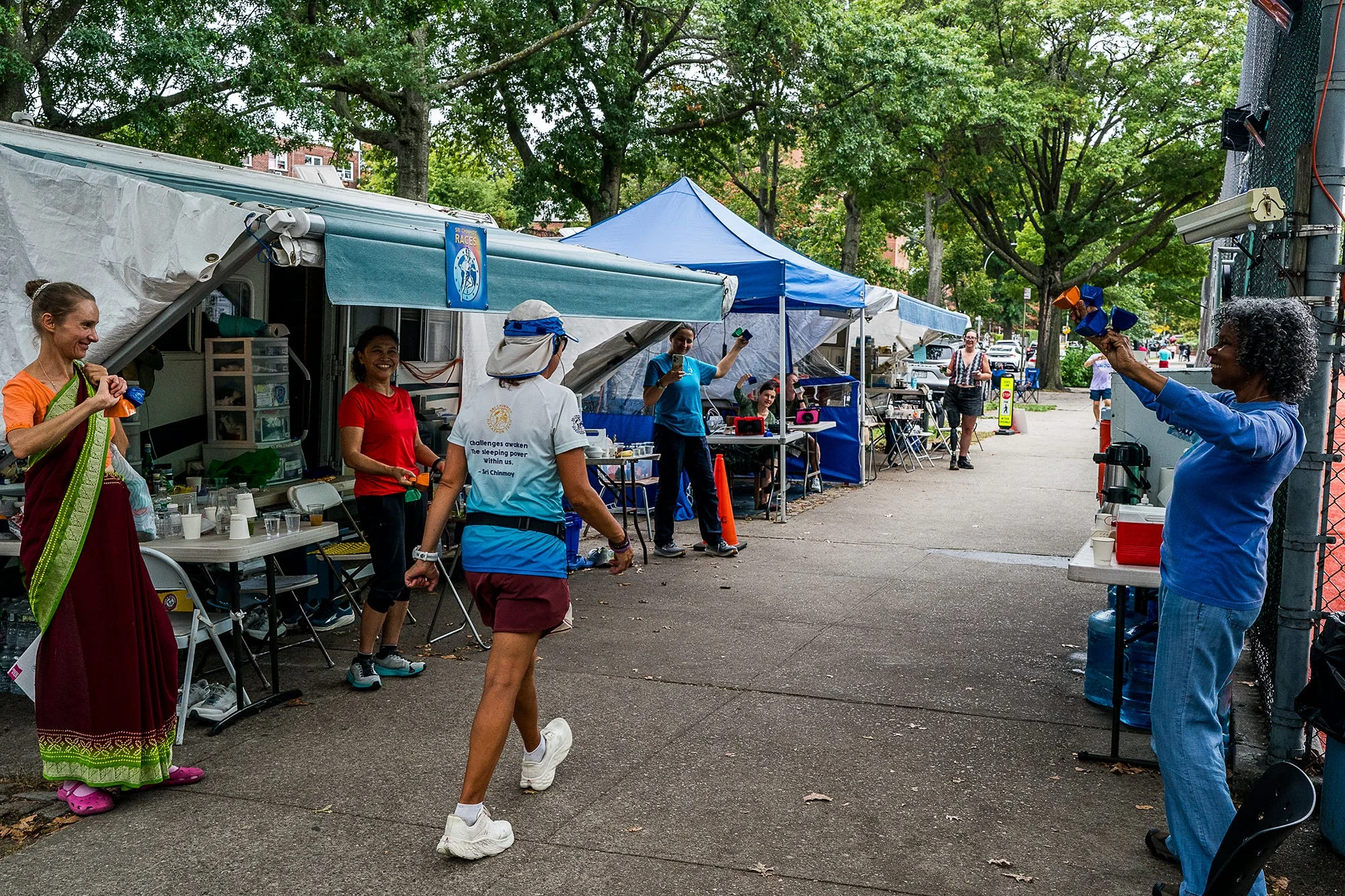
On October 19, the 51st day of the race, just before 4 p.m., Alex Ramsey’s sister and fiancée watch him become the fourth finisher this year and only the third U.S. man to ever complete the 3,100 miles. The crowd cheers, and the Sri Chinmoy choir, the Enthusiasm Awakeners, consisting of female singers, perform as he crosses the line with a beaming smile, carrying the Sri Chinmoy and the U.S. flags. Arpan blows a conch. Someone presses a bouquet into his arms, and Ramsey laughs and cries at the same time.
(In the end, eight runners finished before the 52nd day was over, Geng among them. Two ran right till the end but came up a little short.)
After he finishes, Ramsey sits down in a chair, the bouquet in his lap, a framed photo of Sri Chinmoy in front of him, and tries to put words to what he has just accomplished. “With deep gratitude, I go into my heart, and I want to speak from that place and bring forth my deepest gratitude and thankfulness to the Sri Chinmoy marathon team and to the disciples who have unendingly and relentlessly been able to support us runners.”
He calls the loop a “beautiful oasis” and “a chunk of heaven,” to a few chuckles in the crowd, though he doesn’t seem to be joking. He thanks the marathon team and gives a particular shout-out to Duzhiy.
“Vasu Duzhiy, very early on in the race, really made it important for me to realize that this is a physical race on the surface but a spiritual race underneath.”
This is something I also discovered during the seven weeks I followed and volunteered at the race. The entire thing—the course, the distance, and the repetitive nature of the race—are not bugs but features. According to those who run it and organize it, the race is less a physical challenge—although, undoubtedly, it is a huge one—than it is a spiritual one. “People call it runner’s high; we call it the soulful dimension of the race,” says Bipin Larkin, a race organizer and longtime disciple of its founder. “You just get in a zone, where it’s something more than the physical, something more than the mind. It doesn’t stay that way the whole time. That’s the battle.”
As the race wraps up, I find myself inspired by not just the perseverance but the unyielding positive spirit. Every time I see Ramsey, he has a smile on his face and a boundless enthusiasm for what he’s doing. It’s infectious and, in what at times can seem like a deeply cynical world, refreshing. And when I see others like Lucong Geng, who never quits despite his body’s protests, I see what Sri Chinmoy meant when he talked about “self-transcendence.” If these runners can complete the 3,100-mile race, surely I could do whatever task is before me.
The day after he finishes the race, Ramsey and his fiancée make a trip to Manhattan as tourists. Despite his Zen nature, Ramsey considers himself “kind of a hype beast,” and wants to hit up a few stores—A Bathing Ape, ICECREAM.
But the day after that, he’s back at the course. He’ll stick around till the end of the race to take part in the closing celebration. To avoid stiffening up, Duzhiy encourages him to keep moving. So, along with the other runners who have already completed the race, Ramsey laces up and gets back on the loop, running in circles around his little chunk of heaven.