‘I Ran My Fastest Marathon at 53 and Broke 3:15. Here’s How I Did It.’
I was really active growing up. I did dance, gymnastics, horseback riding, and skiing, and I was on my high school volleyball and basketball teams. When I went away to college, it was the first time I wasn’t involved in an organized sport or activity. I was really missing that outlet and feeling a little lonely, so I decided to check out my school’s gym.
I’d never been a runner, but I suddenly got the appeal. I could do it inside (a bonus during the winter in Evanston, Illinois). I loved how simple it was—all you really needed was a pair of shoes and a willingness to get started.
I started running regularly to cope with stress and stay active, but I quickly realized that I actually enjoyed it.
I ran my first marathon after graduation in 1995, another period of transition and uncertainty for me. I’d returned to my hometown in Colorado, but when you leave and come back, things always feel a little different. I was also trying to figure out what I wanted to do career-wise. I was like, “I don’t really know what I’m doing. Let’s run a race.”
Somehow, doing something physically hard made all my other challenges seem less daunting. I figured that if I could successfully complete a marathon, I could manage the other difficult aspects of my life.
I signed up for what was then called the Colorado Marathon. It was the ‘90s, so runners didn’t have access to the same kind of information and resources we have now. I honestly can’t remember much about my training program. I know it wasn’t great. I think the longest distance I ran was 17 miles. I didn’t know anything about midrun fueling. I think I maybe drank some Gatorade during the marathon. Yet, I finished the race, which had been my only goal. I don’t think I broke four hours, but just crossing the finish line felt like a huge accomplishment.
I was happy with my performance and figured I’d probably keep running recreationally, dropping into a local 5K or 10K here and there. But at that time, running didn’t grab me the way it does now. I knew it was there waiting for me—I never completely let it go—but I don’t think I had the confidence to really dedicate myself to better training. It never occurred to me that I could actually get better.
How My Relationship With Running Changed Over the Years
Since that first marathon, my relationship to running has waxed and waned as I navigated major life events, like becoming a mother, attending medical school, becoming a physician, and changing jobs. Sometimes I was into it, other times I wasn’t. There were long stretches of time when I was happy to squeeze in a race every year or two.
In 2008, when I was still in medical school, I ran the New York City Marathon, finishing in 4:10:48. I ran my first Chicago Marathon in 2009 (also while still in medical school) and finished with a new PR of 4:07:53.
After that, I ran a handful of half marathons, but I planned to return to marathon racing in 2020 when I thought my schedule would allow for training. I registered for the Chicago Marathon, along with my husband. Of course, that’s when the COVID-19 pandemic hit, and we had to defer our entries.
But in 2021, my then-18-year-old daughter developed a very serious eating disorder. At that time, my top priority was to support her as she underwent treatment, which included partial hospitalization and residential programs. It was a very challenging time for the whole family (I also have an adult son who lives with us at home), and I stopped exercising completely.
Building a More Consistent Training Schedule
By 2023, I finally felt ready to return to running once again. But this time, I had a whole new perspective and a new level of confidence that comes with doing really hard things. We were on the other side of my daughter’s recovery, and by that time I’d started to figure out how to run again while balancing her needs. (Compulsive exercise was something she’d dealt with as part of her illness.)
I was also in the midst of building a comprehensive cancer program at Christus St. Vincent Regional Medical Center, the hospital where I work. When I accepted the position, it was just me. But within a few years, I’d brought on 13 providers, and we’d begun conducting clinical trials. I’d proved to myself that I had the perseverance to keep going, even when it seemed impossible. That belief in myself and my capabilities—that I could keep improving in the face of adversity—carried over into my running.
I committed to running more consistently, aiming for five days a week, but also giving myself grace whenever life got in the way. I work long hours and often don’t get home until 8:30 p.m., so a lot of my training happens at night on the treadmill. (I’ve tried to be a morning exerciser before—it just doesn’t happen.) Of course, at the end of a long day, I’d rather just relax. But pushing through the stress and fatigue and just getting it done has helped me develop that necessary grit to stay consistent. It’s almost like muscle memory. My brain and body know how to keep going even when I don’t want to do it.
Having a supportive partner helps, too. My husband makes dinner for me every night so I can eat after I run and go to bed. He also helps me plan out my training. After working 70 hours a week, I just don’t have the time and energy to thoughtfully program my workouts. That said, I am pretty good at doing what I’m told.
He uses McMillan Training to schedule my runs for me. He also created a spreadsheet showing how I’ve increased my overall weekly mileage. I used to be in the 40-mile range, but now my average is up in the 50s.
On those nights when I don’t think I can do it, he encourages me just to put on my running shoes and get started. “If it sucks, you can stop,” he says. I almost never do.
Along with consistency, I’ve also introduced more quality into my training. For the first time, I’m doing speed and hillwork about once a week. I’m also trying to do weekly strength training, which I’ve never been very good about. I can’t say I like any of this stuff, but I think it’s helped with injury prevention and performance.
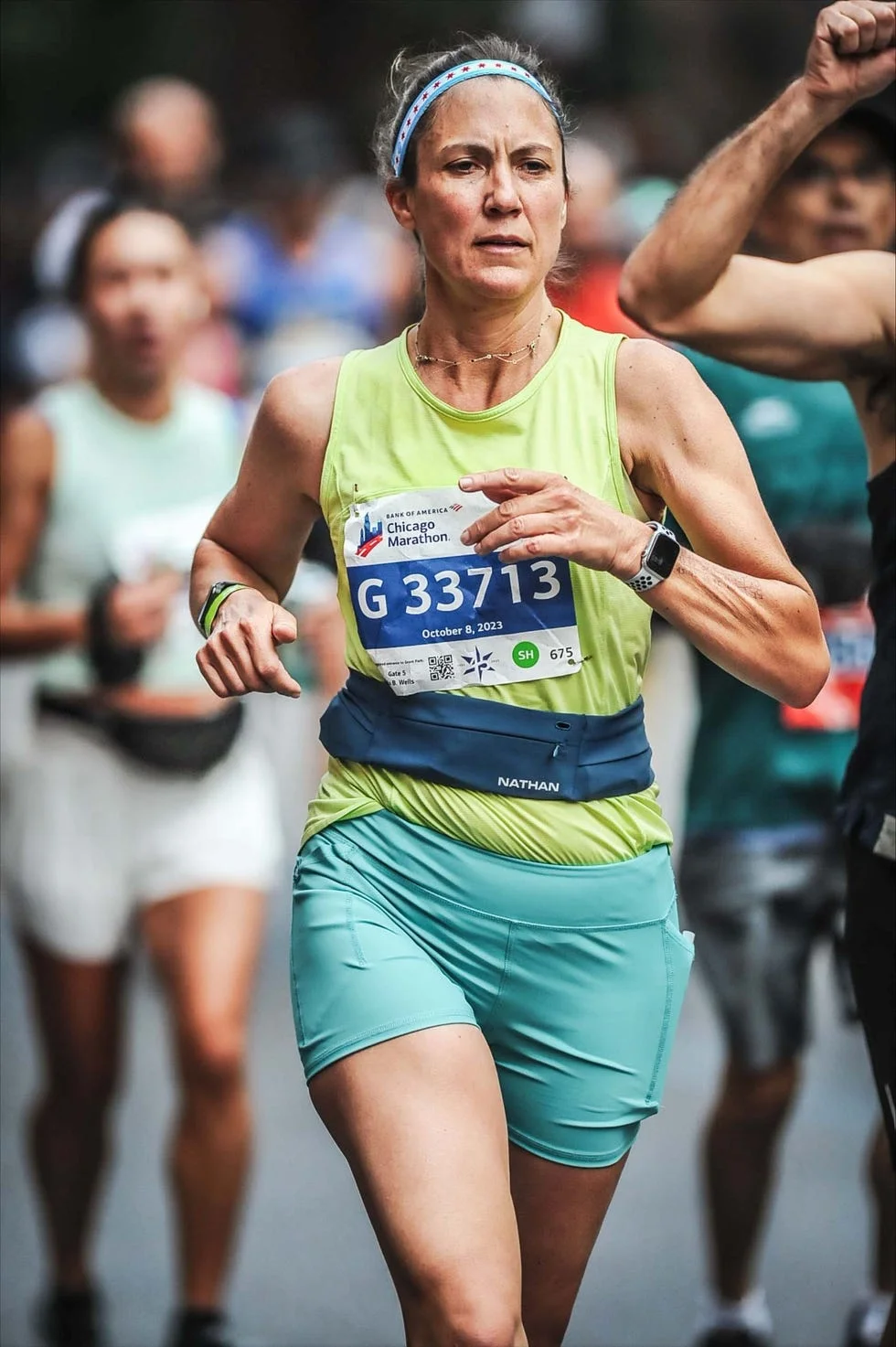
I’m faster now at 53 than I’ve ever been. At the 2026 London Marathon, I ran a personal record, finishing in 3:13:20 and placing 27th in my age group. It was such an incredible experience. My husband and my son were there to cheer me on, along with the crowds, which were so energizing. I definitely fed off their excitement.
More than anything, I credit my consistency in my training for my performance. Having the grit and determination to show up for myself day after day shifted everything, both physically and mentally.
I used a pacer for the first time. My goal was to finish in 3:15, so I stayed with that group for as long as I could. But there were so many runners, and the streets are narrow in London, so I eventually ran ahead of the pacer and tried to make sure he didn’t pass me. I crossed the finish line feeling strong, beating my goal by more than a minute. In my next marathon, I’m going to see if I can break 3:10.
It’s fun to see my performance improve, but my running is about so much more than that. I want to stay as fit and healthy as I possibly can so that I can fully experience and enjoy my life.
Unfortunately, as a doctor, I see people dying of cancer every day. It can happen to anybody at any point, and it’s mostly just due to bad luck. You never know what the future holds. Time is the most precious commodity, and I plan to use mine doing the things that bring me joy. That means going on adventures, like the upcoming hut-to-hut trek through the French Alps I planned with my daughter. I want to ski, and ride my horse, and travel, which is my absolute favorite thing to do. And, of course, I want to keep getting faster.
3 Tips for Getting Faster in Your 50s
Don’t Wait for Things to Be Perfect
I sometimes wonder about how much better a runner I’d be if I had more time to train. Or if I wasn’t an insomniac and slept more than four hours a night. Or if I ate better. (I’ve been known to subsist on mostly coffee and gummy bears.)
The reality: Even though I’m in my 50s and my kids are older, I’m not any less busy than I was 20 years ago. My job is stressful, my workday is demanding, and I often don’t finish my runs (almost all of which happen on the treadmill) until 10 p.m.
If you want to get faster, start now and figure it out as you go. Don’t wait for perfect conditions, or you’ll be waiting forever. Get over that inertia, then try to improve a little bit every day.
Change Your Definition of “Success” as Needed
As my relationship with running has evolved, so has my definition of success. When I first started running, finishing a marathon was the ultimate goal. During medical school and when my kids were younger, I was content just to get a race on the calendar every year or two.
Now, I have specific time goals, and I’m striving to be consistent and intentional with my training.
If you’re lucky enough to run for three decades, your relationship to the sport will likely shift. Embrace the change; don’t hold yourself accountable to outdated standards. That could mean giving yourself grace during periods of chaos and busyness or setting new standards that challenge you in unprecedented ways.
Stop Comparing Yourself to Others
It’s easy to start comparing your journey to other runners’. I’ve definitely shown up to race expos and been hit with imposter syndrome. I’ve looked around at all the other runners in their fancy shoes and fancy clothes and felt like, “Well, they all look great, and I don’t belong here.” But the truth is, everyone’s journey looks different. We’re all on our own path, and we’ll eventually get to where we’re going on our own time.