The Unexpected Ways Hyrox Training Made Me Stronger for Marathon Training
Runners have no trouble rounding the same looped route every day for a year. They’ll stare at a blank wall during their treadmill workouts all winter long. Some will forgo music and entertain only their thoughts—and the gentle pat pat pat of their steps—for close to four hours. But strength training for runners? Bor-ing.
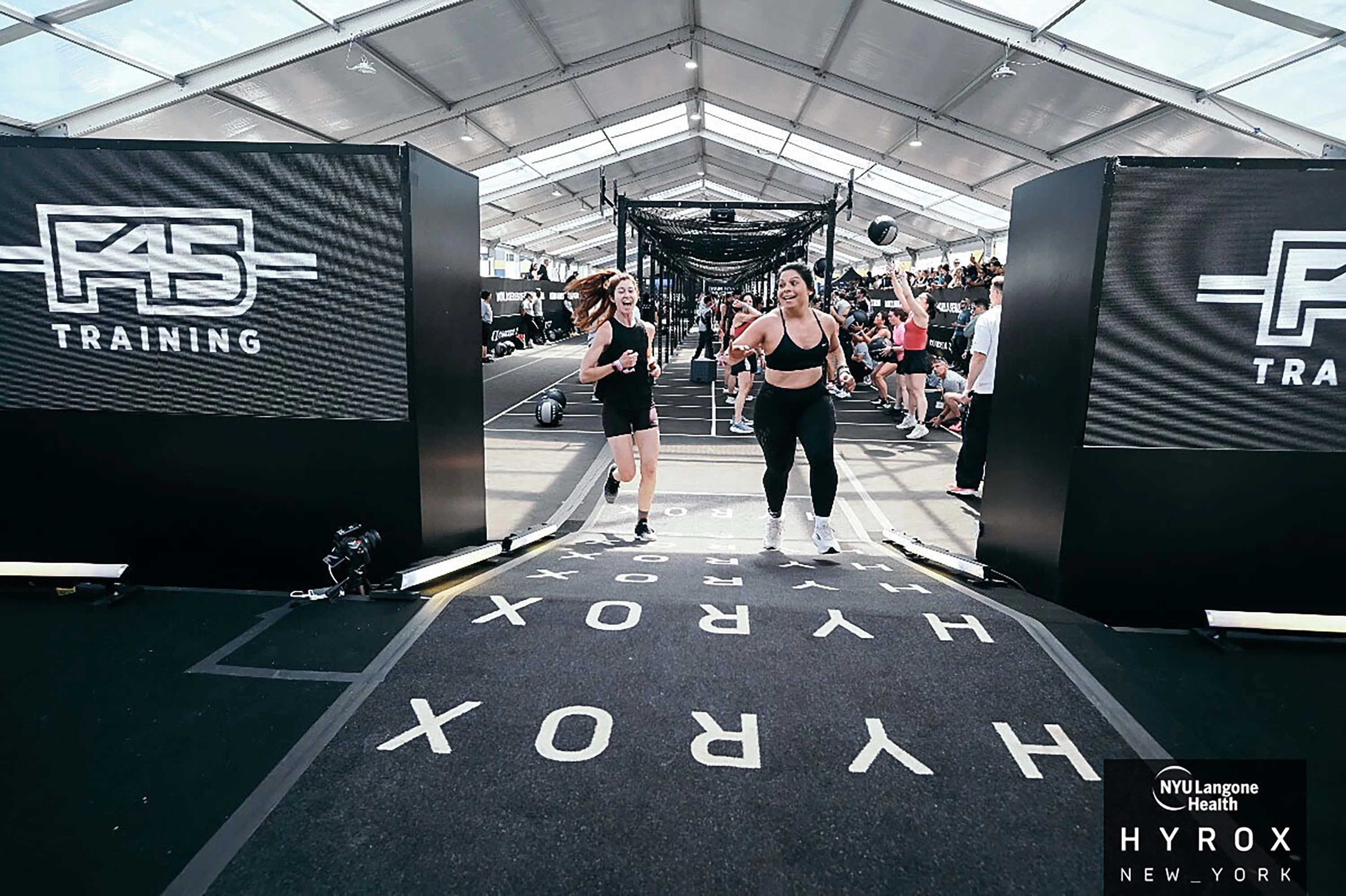
That’s partially why I signed up for a Hyrox competition in my marathon offseason. Hyrox is a global fitness event meant to test both your endurance and strength—the “Hy” is for “hybrid”—through eight cross-training stations, each preceded by a kilometer run (8K total, which is about five miles).
There were two selling points for me: forced strength training and a high-energy event that engaged my runner brain. (We love having a competition on the calendar.)
But the deeper I fell into the Hyrox rabbit hole, the more I realized training for the event had upsides beyond the benefits of lifting alone. By the time I finished training for my first Hyrox, I felt faster and stronger going into my marathon training block, for reasons I didn’t expect.
First, a Few Things About the Hyrox Competition
Remember what I just said about hybrid training, or combining strength and cardio? It’s a little misleading: Hyrox leans heavily on the endurance side. Nearly 60 percent of the race is dedicated to running, according to the Hyrox Sports Science Report 2025.
On top of that, many of the stations are cardiovascular in nature. Take a look at them:
- SkiErg (1,000 meters)
- Sled push (50 meters)
- Sled pull (50 meters)
- Burpee broad jump (80 meters)
- Rowing (1,000 meters)
- Farmer’s carry (200 meters)
- Sandbag lunge (100 meters)
- Wall ball (100 reps)
Contrary to popular belief, the Hyrox competition isn’t about lifting heavy. It’s about maintaining form through fatigue. This translates pretty well to running.
Why Hyrox Training Makes You a Stronger Runner

“Hyrox repeatedly exposes athletes to situations where they must regain control of their breathing, re-establish their rhythm, and continue running effectively despite significant physical fatigue,” says Jake Dearden, a Hyrox master trainer and a sub-2:30 marathoner. “In the latter stages of a marathon, maintaining form and efficiency is often as important as fitness itself.”
The thing that gives out later in the marathon isn’t your cardio, agrees Adam Storey, PhD, senior research fellow at AUT University and a member of the Hyrox Sports Science Advisory Council. “It’s more a case of a breakdown of muscular function,” also known as peripheral fatigue, which reduces running economy.
Hyrox training helps with this because it creates a continuous demand on the lower legs. “As you repeatedly train under load and fatigue, your neuromuscular system adapts, tendons become stronger and more responsive and muscles learn to coordinate more efficiently,” Storey says. Ultimately, “Hyrox-style training focuses on developing the durability of athletes, which can have a crossover benefit to the later stages of a marathon.”
You also gain benefits from the movements themselves:
Sleds: “Sleds are a fantastic exercise for runners to develop that horizontal force component,” Storey says. “During running, we need to apply force into the ground in a way that propels the body forward.” Sled training recruits your glutes, hamstrings, and calves in that same horizontal motion, making you better at pushing forward.
Farmer’s carry: Another movement that directly transfers to running mechanics. “Farmer’s carries help improve posture and core strength, which become increasingly important as fatigue accumulates,” says Dearden.
Wall balls and walking lunges: You’ll naturally improve your mobility by working on your deep squat for the wall balls (hips need to drop below the knees) and full extension on the lunge (each knee must touch the floor).
“These movements improve ankle, hip, and thoracic spine mobility, which are all key areas for efficient running mechanics,” says Dearden. “When runners have better mobility, they’re able to achieve a more natural stride and more efficient movement, and maintain better posture as fatigue sets in.”
Even now that my Hyrox event is over, I’m keeping up with many of these exercises—in part for my next Hyrox (yes, I caught the bug), but also because I feel like I’m bringing more power to my stride, with less tightness in my hips. This could be because of the increased hip mobility from working on deep squats and lunges, which work your glutes, or the explosive movements in the burpee broad jumps—or all of the above, which is part of the point.
It’s not that any single exercise is making you faster, Dearden says, but the mobility and strength needed to perform them well can help you move better overall.
How to Use Hyrox to Become a Better Endurance Runner
Gaining the benefits of Hyrox as a runner depends on how well and wisely you train. I, for one, aggravated my knee taking off into a full sprint after a super-heavy squat session in the name of “compromised running,” or running on fatigued legs, a common Hyrox preparation technique.
That wasn’t wise—and it turns out, it’s completely unnecessary. I quickly dialed it back and instead added these sprints after circuit training at a lighter weight, which served me well on race day. I felt both fresh and fast, and I transitioned into marathon training without feeling sapped.
“The key message I’m trying to get across is you need to really be intentional with your training,” Storey says. Here’s what that means in practice.
Build Your Strength Base First
Storey says heavier resistance training is the best for both improving running economy and training for a Hyrox. This translates to a weight that feels heavy for four to five sets of four reps, about 90 percent of your one-rep max, he says.
Focus on building this strength base for six to eight weeks before you move into your compromised runs. A good sign you’re ready to move on: You don’t feel sore in between strength sessions.
“A lot of coaches are falling into the trap that they want to make sessions really hard and jam sessions together for compromised running,” Storey says, noting that this could set you up for injury. (See: my aggravated knee.) “The early phases of buildup are your opportunity to work on maximum strength.” So run as a separate workout. (You can double up on the same day if you’re advanced, Storey says, but keep the workouts four to six hours apart.)
Once you’ve built your base, then you can introduce those compromised runs into your plan, mimicking the exercises you’ll do in the Hyrox. “Typically, the compromised runs in a Hyrox setting involve performing the stations, or versions of the stations, prior to a run,” Storey says. For example, you could do 30 meters of the sled push at race weight, then run a kilometer, he says, or 30 wall balls at race weight, then run a kilometer. (Weights vary depending on division—Open or Pro—and male or female.)
This is notably different from running after a heavy lift, like I did earlier in my training; it’s strength endurance, Storey says, meaning your prerun lifts are at a lighter weight for 20 or more reps.
Make Time for Mobility
“One of the biggest challenges for runners transitioning into Hyrox is the mechanics of the movements themselves,” Dearden says. “Most have a strong aerobic engine, but often lack the mobility and strength needed for lunges and wall balls.”
He notes that there’s a dedicated Hyrox Hub on Pliability, a mobility-focused exercise platform he works with. You can also try this 15-minute mobility workout for runners.
Space Your Competitions Out Strategically
“Marathons and Hyrox can complement each other very effectively when structured correctly,” Dearden says. “The main consideration is avoiding attempts to peak for both events simultaneously.”
He says to leave eight to 12 weeks between a Hyrox and a marathon. “You can use the strength you've developed during Hyrox training as a solid foundation before transitioning into a more running-specific marathon build,” he says. “Prioritizing one event, while maintaining the other, usually leads to better performance and lowers the risk of overtraining or injury.”