Working to Get Faster? This Overlooked Muscle Group Could Be the Reason You End Up Sidelined.
Quick test: How long can you hold a side plank? Now, can you pick up your bottom leg, bring the knee toward your chest, and still hold it?
If you just tried the move—called the Copenhagen plank—and realized it’s a struggle to hold the position for even five seconds, take note: Most runners should ideally be able to hold that position for 30 seconds per side, according to James Chung, PT, DPT, a sports performance physical therapist in New York City. The move essentially tests and strengthens the adductors, which are inner thigh/groin muscles that enable you to move your legs inward and help with balance and stability.
Chung says that very few people actually work these muscles, and that especially as endurance runners start getting faster and/or incorporating sprinting, groin injuries can occur. Indeed, a 2021 study in the International Journal of Sports Physical Therapy found that the Copenhagen plank increases eccentric hip adductor and abductor (including your glute muscles and TFL, a small muscle toward the front and outside of the hip) strength in male soccer players, which the authors note may reduce adductor muscle and groin injuries.
For runners, not only is working the Copenhagen plank into your routine a good way to prevent injuries, but doing so may also indirectly help with your stride mechanics. Here’s how to easily sprinkle the move into your training routine, as well as modifications and alternate moves to try to strengthen the inner thighs.
Why Is Adductor Strength So Important for Runners?
When you run, your legs come toward your midline, which is adduction, Chung says. “What people don’t realize is when your knee comes in front of you—so you’re in hip flexion—your adductors actually contribute to some of that motion, too,” he says. “When people talk about push-off or hip extension or getting your glutes involved to really drive your hips forward, your adductors are also involved.”
For this reason, building groin strength could potentially help with stride mechanics, especially as you get faster. “As your pace kicks up, those muscles are going to have to be able to tolerate more stress, especially if you’re running longer and longer distances at faster and faster paces,” Chung says. “When groin muscles are weak or can’t handle the stress of gait—especially during strides, sprinting, or speedwork—they tend to be at higher risk of strain or injury,” as well as extra soreness in the groin area after a workout.
While Chung says that adductor/groin injuries aren’t super common in endurance runners, he has seen them (specifically adductor-related tendinopathy or an irritated groin tendon, as well as hernias) in patients who either recently added sprinting to their training routine and/or those who continuously PR in races, which can be a surprising injury risk factor. That’s because the adductors are more stressed when you work at a faster pace, he says.
“Nowadays people are using artificial intelligence apps that introduce speedwork and sometimes it can be introduced to people who might overestimate their goals,” Chung says, meaning they run faster than they’re ready to run. This can lead to groin injuries, he explains.
What’s more, Chung says, is that this type of injury is tricky to manage, so prevention is key. “Once injured, groin injuries can be very painful, feel extremely limiting to athletic movement, and become easily irritated, especially for faster athletes who feel irritation more in lengthened or stretched positions,” Chung says, adding that recurring groin strains can be particularly challenging long-term if you don’t adjust training to prevent repeated irritation. That’s where the Copenhagen plank comes in.
How to Do the Copenhagen Plank
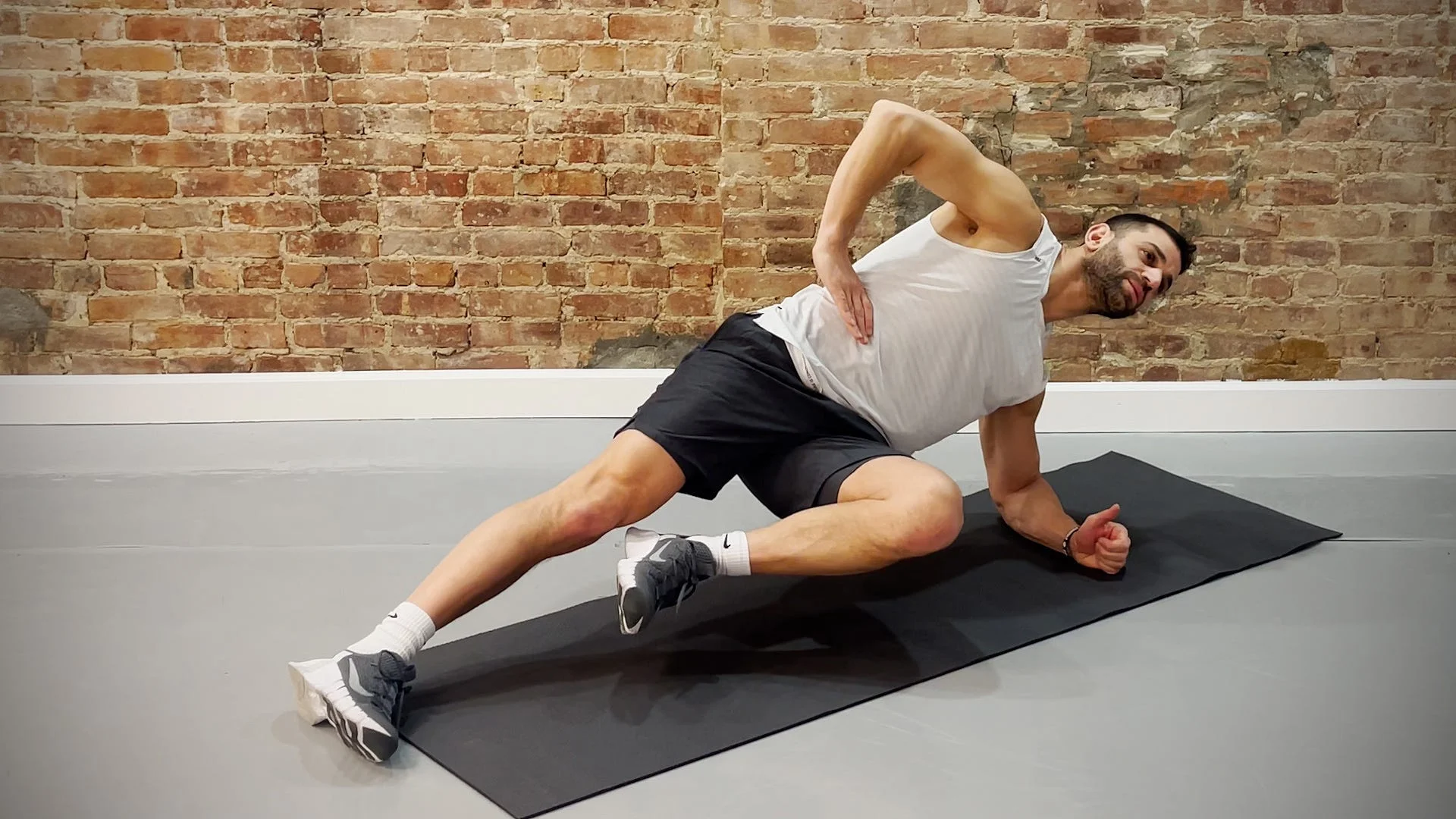
Typically, a Copenhagen plank is done with your top leg elevated on a bench, and your bottom leg driving into the bottom of the bench, but Chung likes the floor version because it’s easy and accessible to set up.
Here’s how to do it:
- Start in a side plank position with one foot in front of the other on the ground.
- Lift the bottom leg up, knee toward the chest, hip at about a 90-degree angle.
- To reduce the intensity, rest the bottom leg on the ground with a bent knee, but engage the groin muscles as if you were trying to lift the leg up.
- To up the intensity, hold a dumbbell in the top arm at side.
- Hold for up to 30 seconds.
- Then switch sides.
If you can’t hold the plank for 30 seconds, Chung says to first go for your max hold. For future workouts, cut the time in half, and that’s how long to hold for reps. For example, if you can hold it for 10 seconds, do two five-second reps to start. You can add five seconds at a time, working up to 30-second holds. “If you notice soreness the following day, repeat the same rep-set scheme,” he says, adding time only when you no longer feel sore the next day.
Chung recommends sprinkling this exercise in small doses frequently, like one to three sets most days of the week (versus doing more sets once or twice a week), as long as you’re not sore. “It’s meant to be exposure therapy so it builds up over the week, but it’s not enough to impact your ability to participate in other workouts,” he says. “You can do it as many times per week as you want. The only limiting factor is going to be your soreness.”
You can do one or two shorter holds before an easy run as part of your warmup, but if you’re going for longer holds or more reps (relative to your ability) do it separately from runs, Chung says.
Other Ways to Protect Your Lower Half
Chung likes the Copenhagen plank for runners in particular because it’s a touch more specific to the running position (almost as if you’re in a running stance on your side), but an alternative is the adductor machine at the gym.
Load up the weight so you can lift the stack just an inch off the base and hold for up to 30 seconds at a time. “The amount of work you can accumulate with isometrics [holding a position with muscles under tension] tends to be a little bit higher than if you were to just do those concentric/eccentrics [like moving the legs in and out],” he says.
Another option: “An adductor squeeze using a yoga block can be a strong alternative,” Chung says, if you don’t have access to the machine. Simply lie on the ground with knees bent and a yoga block between the thighs and squeeze the block with your adductors for up to 30 seconds.
Finally, lengthening the adductors with a stretch like frog stretch can be helpful, too. Try this sequence:
- Copenhagen plank: hold for up to 30 seconds per side, depending on ability
- Frog stretch: hold for 30–45 seconds
- Repeat for 2–3 rounds
That combo is super effective for quickly improving strength and range of motion, Chung says. “Strengthening and lengthening is important and even small amounts can go a long way,” he adds.