A Tumor Caused This Pro Runner to Retire at 25. Now, She’s Back on the Start Line
Katie Rainsberger found herself on a marathon starting line late last year among thousands of people in a place far from home.
To some, that fact alone would have seemed outrageous.
Just a few years earlier, as a professional track and field athlete with Olympic-qualifying potential in the 3,000-meter women’s steeplechase, the marathon was the farthest thing from Rainsberger’s mind.
But to anyone who understood what she had gone through in the year prior—from her mysterious running struggles to a life-changing surgery—maybe it all made sense.
By September 2025, when the 27-year-old approached the Berlin Marathon after just five weeks’ training, she’d already left her old life as a pro athlete behind and a new one as a PhD candidate for the Technical University of Munich (Germany) had emerged.
Suddenly, before she could even think, Rainsberger’s relationship to the sport had changed. And the surprising part? She was loving every minute of it.
“I wasn’t at the U.S. Olympic Trials on the track,” she said. “I was surrounded by 40,000 people who were trying to do this crazy thing. I thought to myself, ‘This is incredible.’”
A Family History
Rainsberger’s mother (whose maiden name is Lisa Larsen-Weidenbach) won the 1985 Boston Marathon, so from an early age Katie understood her family’s history pretty plainly—how it was tied to her own success.

Rainsberger eventually ran past it, first winning a national cross-country title as a prodigious high school athlete in Colorado, then as a 13-time All-American in college split across years with the University of Oregon and the University of Washington. Next, in 2022, Rainsberger signed with New Balance and joined Team Boss, the professional training group in Boulder, Colorado. Her first professional season ended with a fifth-place finish in the women’s steeplechase at the U.S. Outdoor Championships in Eugene in a time of 9:29.77.
Her career looked locked and loaded for potential World Championship and Olympic teams down the road.
Everything seemed perfect, until, of course, it wasn’t.
The Inflection Point
Slowly, but then more consistently, Rainsberger’s training began to slip. At first, it was a rough workout. Then, she couldn’t get close to recovering. “I specifically remember this moment where I turned to my teammate and said, ‘Are your joints really achy? Do you have pain in your joints? Is it from lifting?’” Rainsberger remembered. “They looked at me like I was crazy.”
Rainsberger went to a doctor, then a series of them. She eventually was given a diagnosis—Relative Energy Deficiency in Sport (RED-S)—which prompted a full reset. That gave short-term answers, though in time it didn’t make sense when Rainsberger was fueling just fine and struggling to run a nine-minute mile without her heart rate jumping dramatically. “Emotionally, it was getting difficult for her,” said Gabbi Jennings, one of Rainsberger’s former teammates at Team Boss. “She would tell me, ‘I’m doing everything right. I don’t understand why things aren’t clicking.’”
Then one routine night, while watching a movie with her roommate Aaliyah Miller, Rainsberger found her resting heart rate at 180. “I think I might be having a heart attack,” she remembered. A trip to the emergency room followed before a chest scan revealed she had an enlarged tumor deep in her mediastinum that “needed to be looked at immediately,” she said.
Rainsberger gave a huge sigh. “In that moment, there was such relief that I wasn’t crazy,” she said.
Next came thymectomy surgery in September 2024 to remove a benign tumor that had grown to 11 centimeters. By then, Rainsberger’s dreams of returning to the sport were beginning to dim. “The last thing I wanted to do was force my body into something I couldn’t do,” she said. “I needed to take a second and figure out what it was I wanted to do and find out what my body was willing to give back to me.”
To continue as a pro? In some ways, that seemed out of Rainsberger’s control. But her continued pursuit in the lab wasn’t.
In 2021, during her final year at Washington, she added an honors thesis on top of her bachelor of science in human evolutionary biology, which put her in the lab “for the first time,” she said. A year later, after finishing her first year with Team Boss, Rainsberger did another unexpected thing: she spent her offseason in the classroom working toward her master’s in physiology from the University of Colorado, Colorado Springs.
When Rainsberger experienced all these mysterious issues surrounding her health and recovery, it only spurred more questions. By the end, she said, the only way she was going to find out answers was if she continued her dogged pursuit of women’s health research.
Beyond running, anyway, that’s what felt most familiar to her. “I always knew I wanted to go back to school,” she said. “I always knew I wanted to do my PhD. The timeline just looked different.”
A New Land of Opportunity
Germany may have seemed like an unlikely place for someone like Rainsberger to land, but in truth it wasn’t. She studied the language in high school and even spent four weeks in a small town outside Munich when she was in the eighth grade. Rainsberger didn’t care where the doctoral program would be based, as long as it meant it was the right program and built on the central thesis driving her forward: exercise physiology focusing on women’s menstrual health, athletic performance, and recovery.
So, Rainsberger cold-emailed Karsten Köhler, an expert in human physiology at TUM. She explained, “my question and the project, what I was interested in, and who I was as an athlete and a researcher” and ended with a heck of a kicker: “Can you take me on as a PhD student?”
Köhler effectively responded, “Sure, but we don’t have the money.”
Fortunately, Rainsberger was persistent.
After surgery in 2024, beta blockers prevented her from dialing her running back in, so she focused all her energy on figuring out how to get funded: She sent hundreds of emails to foundations and companies across the U.S. and Europe, including to Walmart, Nike, and even tampon companies.
Then came a connection with Stef Strack, the founder of Voice in Sport (VIS), a mentorship and advocacy organization for women and young girls in sports. Strack said she couldn’t fund Rainsberger up front, but did help with her fundraising goals, starting a GoFundMe and briefing corporate partners.
By the end of 2025, Rainsberger and the VIS Foundation raised a total of $100,000 to fund her PhD candidacy. “So many people in the community were so happy and keen to help,” said Rainsberger, who is now a VIS mentor. “I think women in general, they want more information about their bodies that isn’t coming from Instagram or TikTok.”
Research Time
Rainsberger arrived in Munich in July 2025 to begin her doctoral program. Central to her research is a participant study with women focusing on recovery during the menstrual cycle. Previously, Rainsberger said, prior research has focused on “one day, maximal all-out effort between menstrual cycle phases.”
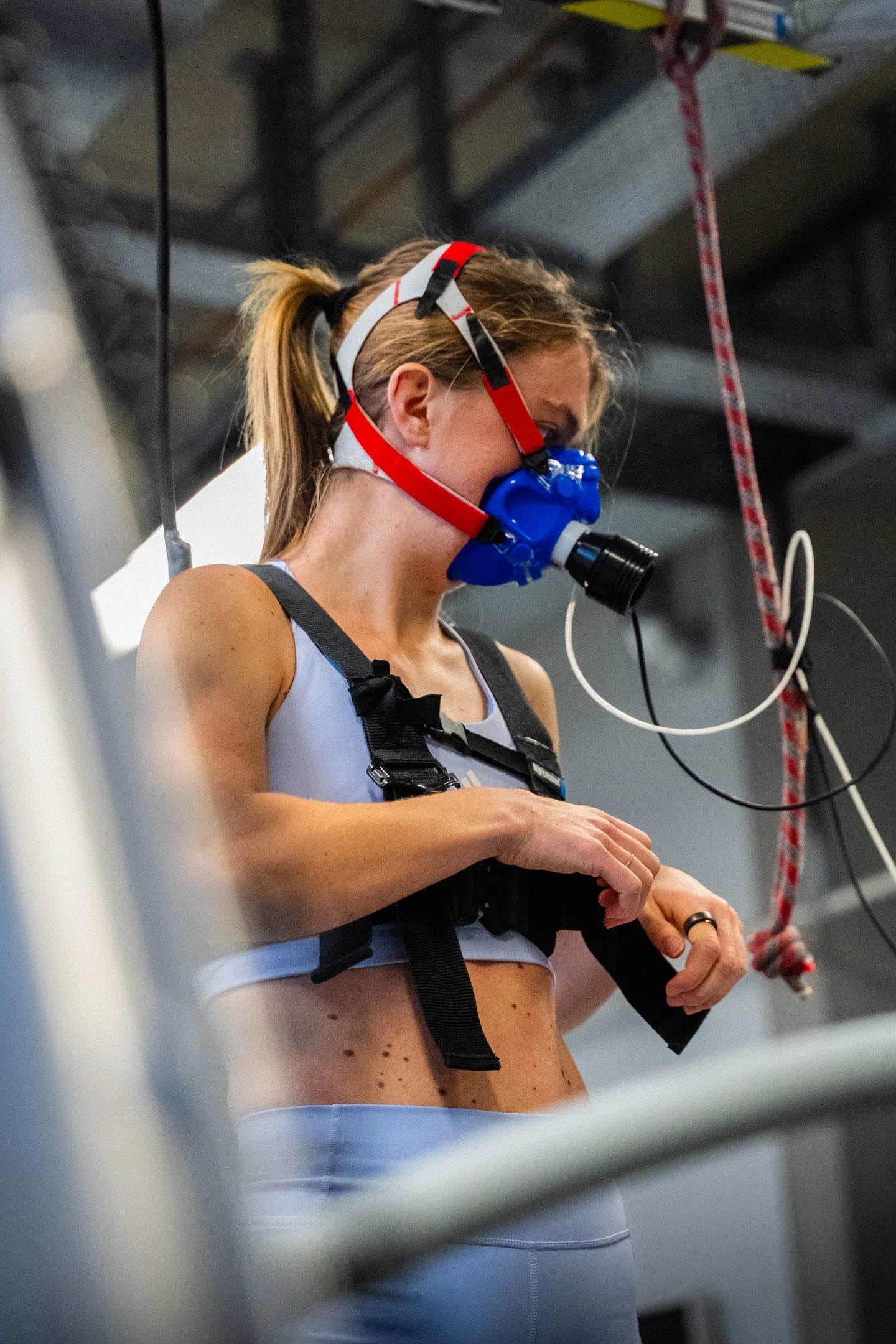
Rainsberger’s work will look at whether there are differentiations between days in the menstrual cycle. She hopes it can eventually be guiding information and translatable for women across all sports. “As an athlete who’s competed over the years, I learned that it’s rarely one workout that makes you a world champion. It’s three months of workouts. And if we can’t recover on the same timeline as males, then are we adapting to training as well? Are we putting ourselves at risk?”
For Rainsberger, this work alone is important because such a small percentage of global studies are focused on female athletes. “Only 6 percent of sports science research is done on women,” she said. “And less than 20 percent of those studies have lead investigators that are women. It’s not just that we aren’t studying women, it’s that women aren’t asking the questions, either.”
Right now, Rainsberger is in the middle of data collection and will have a total of 24 participants over five months. She’ll have access to each participant 25 times over that period. From there, a dissertation will be written and a defense of her study will be conducted around the summer of 2028—right in time for the Los Angeles Olympics.
“She’s so smart and super brave to come back from this giant medical fiasco and relearn German and move across the damn ocean,” Jennings said. “She has a way of being totally immersed in it.”
A Changing Relationship
When Rainsberger arrived in Germany, she was running sparingly. The days were here and there, she says. Maybe a total of 20 miles over a good week.
In between, she balanced the high demands of her doctoral program with the idea of running on her own terms. “In my mind, if you want to run well, you have to live the lifestyle,” she said. “I started having these thoughts that didn’t match. I’m grateful to be here. I’m running well. I want to set goals. But how do I set goals in this new relationship to running?”
Then a few months into her stay, she saw a promotion for a mile race on a nearby track. She signed up, with the intention of using the time to also scope out some potential participants for her study. Her race registration included a raffle for a free entry into the Berlin Marathon.
Rainsberger won. “So five weeks later is the Berlin Marathon,” she said. Every fiber in her body knew five weeks wasn’t enough time to get prepared for 26.2 miles. But Rainsberger also wasn’t a pro anymore—which meant she could do what she wanted.
She completed two long runs, then stepped to the line a few weeks later. On race day, she was consumed by joy. By a community that was purely bought into the idea of tackling this “monumental task.”
“I cried on the starting line,” she said. “When you’ve been running since you were 12 and you experience something you’ve never experienced before, I kind of just fell in love with it.
“For me to go and love it the way that I did, it was so special. It was my one-year post surgery. I ran the Berlin Marathon, and I had the time of my life.”
Oh yeah, and Rainsberger broke three hours, too.

Cory Mull is a reporter and editor living in Austin, Texas. He’s run three marathons, completed a 50K, and has a beer mile best somewhere in the nine-minute range. His work has appeared in Forbes, FloTrack, MileSplit, and Runner’s World.