He Was Diagnosed With Parkinson’s at Age 65. Now He’s Running 100 Marathons—in 100 Days
Every day for the past 78 days, Larry Grogin has woken up in a new hotel, warmed up on a treadmill, eaten a hotel breakfast, and hit the road to complete his daily marathon, as he makes his way from northern New Jersey, where he lives, to Los Angeles, where soon he’ll complete 100 marathons over the course of 100 days.
It’s all in an effort to raise awareness around Parkinson’s disease, which Grogin was diagnosed with in 2019, and to raise money for the Davis Phinney Foundation, which is focused on helping people with Parkinson’s live well. “This run is not about saying ‘Larry is so strong and mentally tough,’” he says. “It’s about people who feel defeated realizing that if a 71-year-old can do this, they can do anything.”
Grogin was already a many-time marathoner and Ironman in 2019, when he first planned a cross-country run. When his diagnosis came, he pivoted, logging long runs in locations across the country in a way that his family felt was safer.
As Grogin’s Parkinson’s progressed, his relationship to running—and life—shifted. “Up until that point in time, I was able to muscle through life, and fight to succeed at things,” he says. “Parkinson’s taught me a very different lesson of learning how to live with it, not beat it.” He likes to quote Abraham Lincoln, who said that he destroyed his enemies by making them his friends.
But the dream of a cross-country run never died. The idea of doing it in the form of 100 marathons in 100 days? “It just rolls off the tongue easily,” he says. In March, Grogin started his journey on his 71st birthday, after many months of planning and training. His training regimen included strength training, swimming, and biking, in addition to running, plus pickleball, which he doesn’t consider a physical exercise but a mental one that helps with his reflexes. (“No insult meant to the enthusiasts,” he says.)
Early on, Grogin struggled with blisters and tired muscles. “But I’m getting more comfortable every day,” he says. “The blisters became calluses, the sunburn became a suntan, and the muscles became conditioned.” These days, his biggest complaint is about the hotel breakfast he eats every day. “If I died and went to purgatory, they’re going to serve me waffles,” he says.
Grogin has learned that, prior to that breakfast, he needs to do a very long, slow warmup on the treadmill. “That’s something that’s not well understood in the Parkinson’s community,” he says. “With a normal body, you can warm up in a couple of minutes, but it’s hours for a Parkinson’s patient. Once you understand that, it’s a secret passcode.”
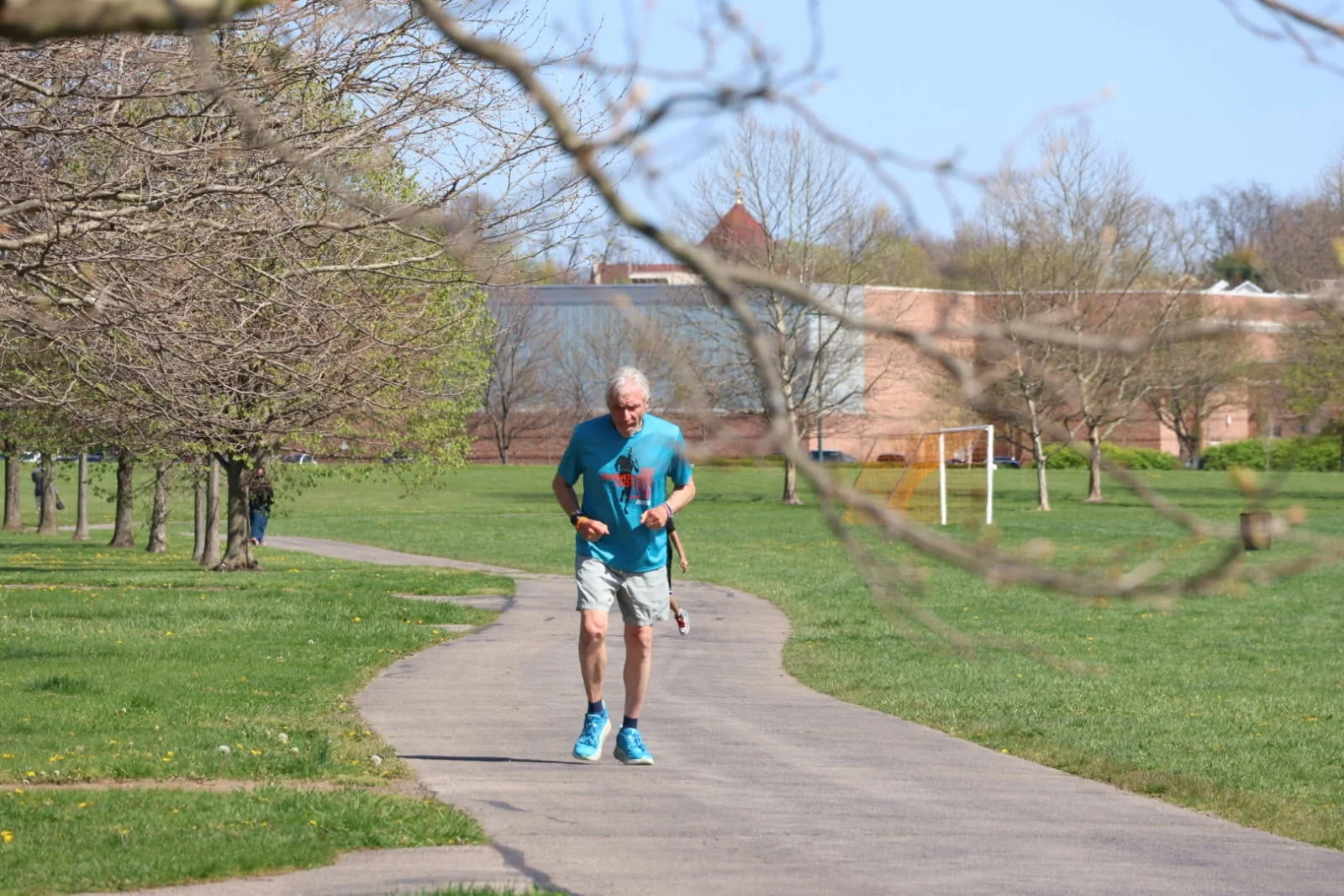
Grogin often logs up to a half marathon on the treadmill, which he counts toward his daily marathon distance. Early in the day, his gait is strained. “But we’ve been posting on social media the last mile every day, and I get emotional when it looks normal,” he says.
As he’s made his way across the country, word has spread about the 71-year-old with Parkinson’s running a marathon every day. He’s often greeted by “Run Larry Run” as he passes through towns, from a quiet street in Kansas to a group of railroad workers in Colorado. In Dayton, Ohio, he was invited to be the guest of honor at a party where hundreds of people celebrated him. Fellow Parkinson’s patients have “come out of the woodwork,” he says. “I’ve had people meet me on mountaintops and trails and the oddest of places. I think the message is getting through, that they’re the primary catalyst in their healing, and they’re the ones who can make a difference.”
He’s currently raised around $160,000 for the Davis Phinney Foundation, and is confident he’ll meet his $250,000 goal. That money will go toward things like helping Parkinson’s patients who’ve lost their ability to drive get to the gym—“things that some of us are lucky to take for granted,” he says. “It’s such a tough illness, and there’s a kind of relief when people feel that they’re not powerless in the face of it, and that is gratifying.”
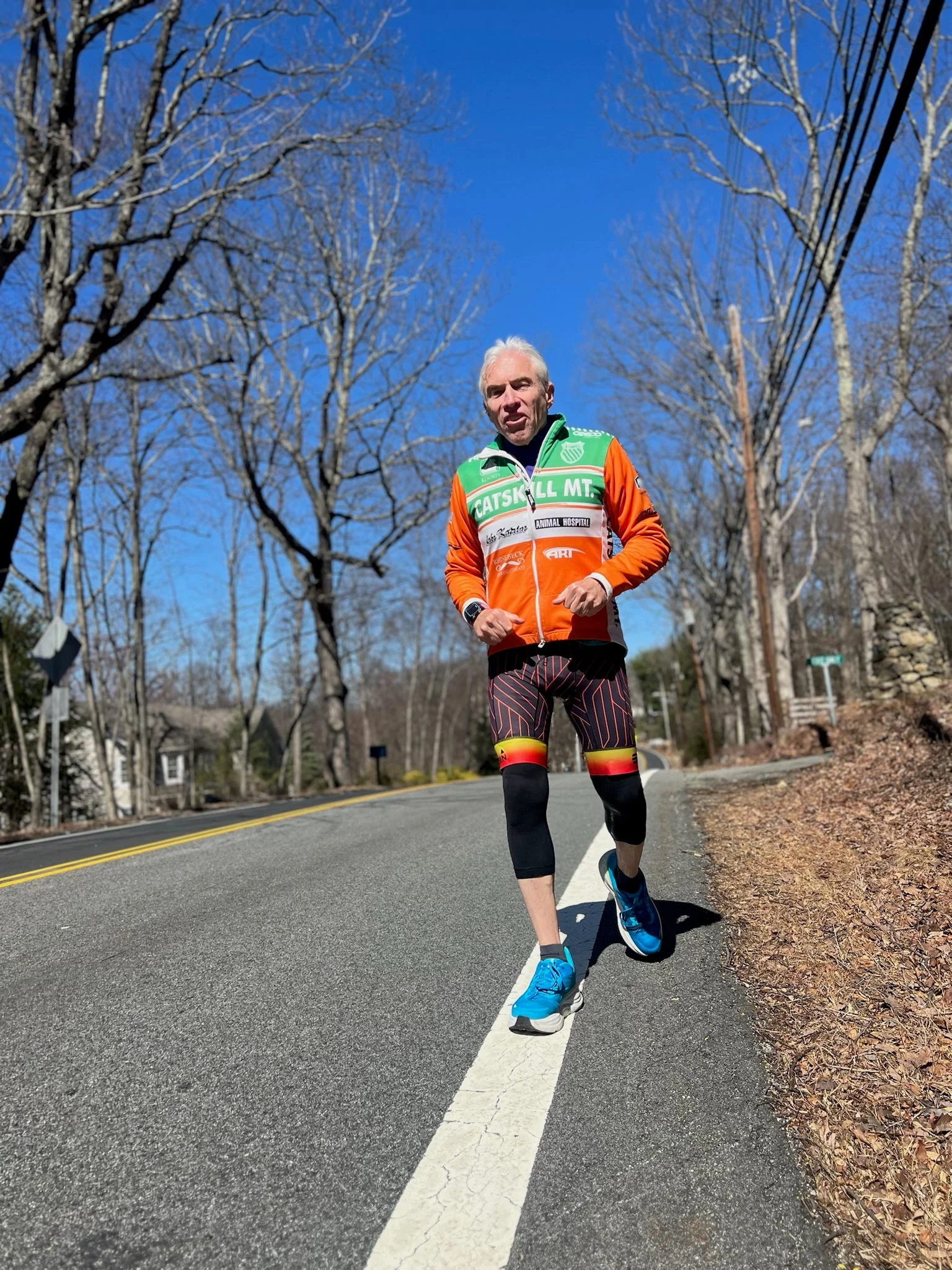
As a chiropractor and acupuncturist by trade, Grogin has his own theories about Parkinson’s. Though he says experts often recommend short, explosive movement, like boxing, he swears by the benefits of his long, slow runs. His advice for others with Parkinson’s? “If people around you don’t think you’re doing too much, then you’re not doing enough,” he says. “Movement is medicine and is the best thing in the world for Parkinson’s patients.”
Grogin is looking forward to having something other than hotel waffles for breakfast in a few weeks, but at this point, it’s hard for him to imagine a day without a marathon. “If I didn’t do a marathon tomorrow, I would be squirming in my seat, wondering what to do with myself,” he says. “What’s been most special has been the smiles and the people waving from their cars, but I haven’t quite cracked the code of why so many people have said they are inspired. It’s pretty neat, but I’ll never understand it—it’s just running.”
Lauren Wingenroth is a freelance writer covering fitness, running, sports, the performing arts, and more. A former editor of Dance Magazine, her work has appeared in The New York Times, GQ, Outside, SELF, PS, ESPN, Well+ Good, Playbill, American Theater, and other outlets. She is a graduate of Barnard College, Columbia University, a marathoner, and a North Carolinian.