A 16-Week Strength-Training Plan for Marathon Runners
Marathon training has a way of taking over your calendar. Between building midweek mileage and speed and logging hours on your feet during weekend long runs, it can feel like every spare minute of your life is already spoken for.
So the idea of adding more training to your week might sound unrealistic. However, the right strength training plan doesn’t compete with your miles; it actually helps you handle them better.
A smart, runner-specific routine builds durability, improves efficiency, and keeps you feeling strong through even the toughest stretches of your training cycle so you arrive at the starting line ready to conquer your race.
And this 16-week strength plan, designed specifically for marathoners, will help you do all that!
If you need more convincing on why strength workouts should be on your marathon plan, we asked experts to explain all the benefits, as well as ideas for moves to work into your routine and how to adjust your loads and reps each week for the biggest benefits in training and on race day.
Want follow-along workouts? Check out
Race-Ready Strength, our progressive four-week training program.
The Case for Strength Training
“Marathon training can feel overwhelming, and fitting in strength training on top of your weekly runs can add to the overwhelm,” says Matt Jones, personal trainer, running coach, and founder of Run Strong Academy.
Working in resistance sessions, however, is super-important, he says. It can help minimize your chances of getting seriously hurt (by strengthening your joints and bone density and improving muscular imbalances, which could cause compensations in your gait). It can also help you bounce back from minor aches and pains.
“More importantly,” Jones says, “it’ll help you enjoy running more because you’re going to be a more efficient—and less beat-up—runner.”
The science about whether lifting weights translates to fewer injuries is mixed. A randomized control trial, published in the British Journal of Sports Medicine in 2024, found that the group who performed exercises targeting the hips and core had a lower incidence of lower-body injuries compared to a control group that only did static stretching. Weekly prevalence of overuse injuries were also 39 percent lower, and substantial overuse injuries was 52 percent lower in the hip and core group. But an ankle exercise-focused group did not see reduced risk.
Weak muscles have been linked to running injuries and of course, strength training will help you build up those weak spots. For example, a systematic review of 13 studies published in 2016 revealed a correlation between impaired gluteus medius activation and runners with Achilles tendinopathy (pain or swelling in the Achilles tendon) and patellofemoral pain syndrome, a.k.a. “runner’s knee.”
In another study published in the journal Sports Health in 2020, researchers followed runners prepping for the New York City Marathon and found that dropping out of the race due to an overuse injury happened to 7.1 percent of those who lifted weights versus 7.3 percent of runners who didn’t lift. So the injury-busting benefits were negligible.
There is data to suggest that strength training can make you a stronger runner, though. A meta-analysis published in 2024 found that strength training can improve running economy—or how well you use oxygen at a given speed, a measure of your efficiency. The researchers pointed to lifting heavy weights for lower reps and plyometrics as the standout types of strength training for improving performance.
Also, middle- and long-distance runners who took up a strength-training routine (either heavy resistance, explosive resistance, or plyometrics) two to three times a week for at least four weeks improved their running economy, time trial performance, and anaerobic speed compared with people who only ran in a systematic review published in the journal Sports Medicine in 2017.
“Strength-training boosts your economy because the more power you have, the more distance you cover—in less time and with less energy,” says Meg Takacs, NASM-CPT, a run coach and founder of the Movement & Miles app.
Similarly, says Jones, your additional power from that time in the weight room (or home gym) can help enhance how long you can run comfortably. “You’re also going to have a stronger base to ‘spring’ from, which can help with power and endurance,” he says. “This, in turn, helps your ability to apply force to the ground—meaning every single stride you make is going to become more effective and more efficient.”
Now that you know the benefits, it’s time to put a strength-training plan into action as you start training for your 26.2-mile race. We tapped these two coaches for advice about how to approach resistance training throughout the marathon-training season so it will best complement your running.
Your 16-Week Strength Plan
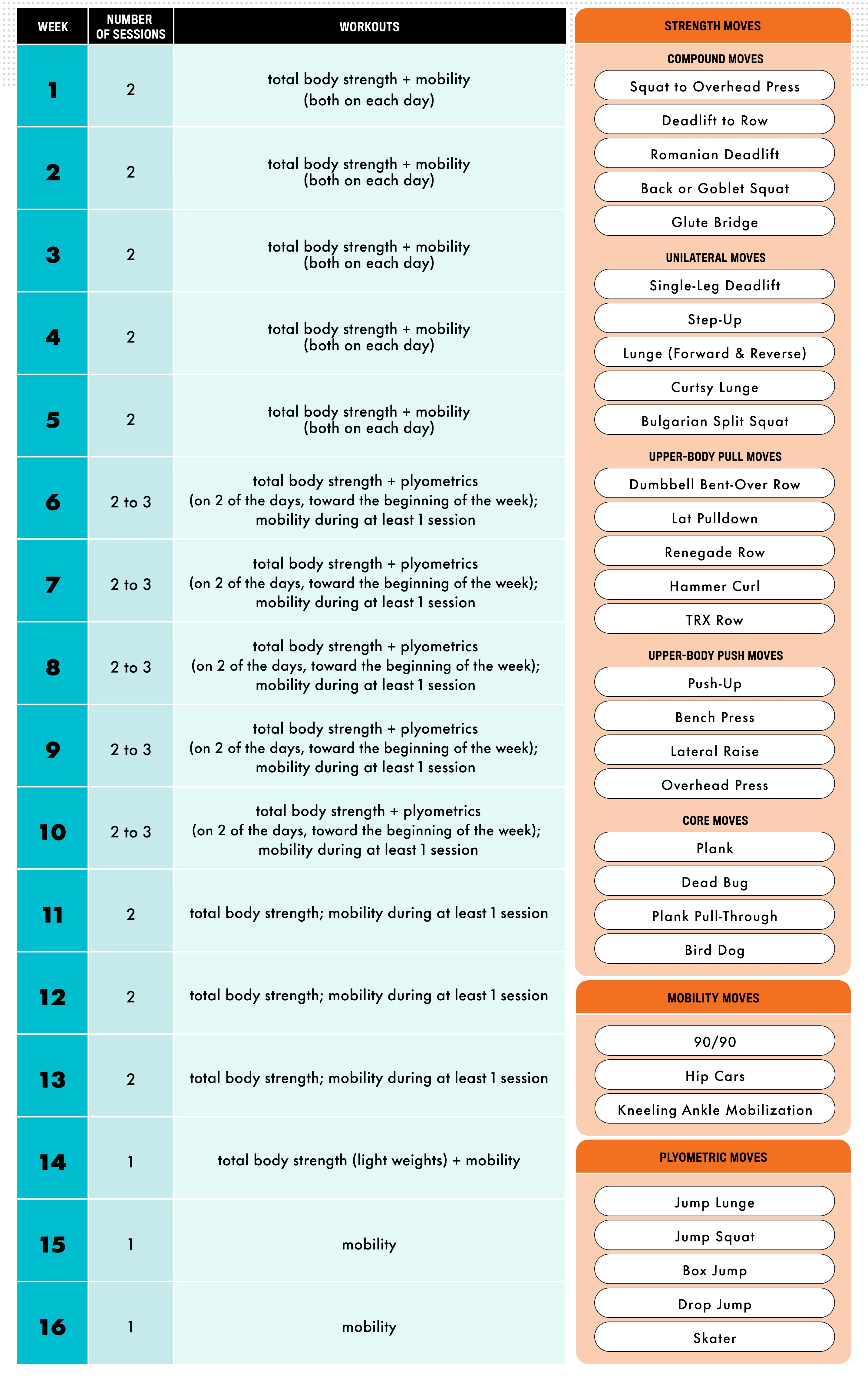
Save Plan for Mobile Download PDF to Print
How to Use the Plan
Just as you don’t run the same number of miles or do the same types of workouts every week throughout your marathon-training cycle, you shouldn’t stick to the same strength moves and weights through those 16 weeks either. “As running mileage increases through your marathon training block, your strength focus should adjust to complement that,” says Jones.
Here’s how to adjust over those 16 weeks, broken into four blocks. Keep in mind that these workouts don’t have to cut a lot of time out of your day. Doing a handful of moves for just 20 to 30 minutes is all it takes, says Takacs.
To learn how to do moves with solid form, check out the Runner’s World Guide to Strength Training program.
🗓️ Weeks 1–5: Build a Strength Base
For this plan, you’ll spend the first five or so weeks building your strength base. Aim for two strength workouts a week, each consisting of at least four to six exercises, suggests Jones; Takacs likes to do nine exercises (broken into three circuits of three moves each). Try to hit most major muscle groups in each session.
You can start with bodyweight moves, but work up to lifting heavier weights and lower reps (like five sets of five reps).
START HERE IF YOU’RE NEW TO STRENGTH
Ideally, you’ll do your strength workouts on non-running days, says Jones, but it’s okay to tackle on the same day as a run if necessary for your schedule; just try to space out the two workouts by several hours.
Don’t do a strength session within 24 hours of a long run, says Jones, as it’ll leave your legs too wiped. “Side note: If you’re starting strength training for the first time,” he adds, “you’re more likely to accumulate fatigue—so don’t lift for 48 hours around the long run.”
During this block, you’ll also work on your mobility. “Runners often skip out on mobility, but if you want to progress to heavier weights and prevent restrictions in your range of motion, opening up your movement capacity is key to optimizing performance,” says Takacs. She advises concentrating on hip mobility specifically, as limited range of motion here can lead to compensations in gait and imbalances all the way down to your feet.
What to Do:
🗓️ Weeks 6–10: Build Muscular Endurance and Power
The next five weeks feature higher reps (think three to four sets of eight to 12 reps) and slightly less load to improve your muscular endurance, plus plyometrics to enhance your force and stability, as well as runner-specific exercises (such as step-ups) and mobility at least once a week.
“This is the period where your body starts to respond to intentional, running-specific stimuli,” says Takacs. “The strength in these movements, and in this training period, translates directly to the efficiency of your running mechanics.”
As for the moves you choose, you can focus on lower body one workout and upper body/core the next or make every session total body. The latter is Jones’s preference, because, “that way, even if you can’t get a second or third session in one week, you’ll still be hitting every muscle group.”
Schedule strength workouts on the days that make the most sense for your schedule, says Jones, making sure to space them several hours from your runs (especially the long run—and especially if your legs are feeling heavy or tired). For the plyometrics, feel free to do them at the start of your strength workouts, he says, or before an easy run or speedwork as well.
What to Do:
🗓️ Weeks 11–13: Build Strength and Power
The third phase is a combo: Do lower reps/heavier weights (five sets of five reps each) for compound movements (see: squats, deadlifts) which will help you build strength, and focus on higher reps/lower weights (three to four sets of eight to 12 reps) for unilateral and quick movements (such as jump lunges) to build stability and power. Plus, maintain a focus on mobility at least once a week.
Again, feel free to schedule strength workouts on the days that make the most sense for your schedule, ideally spacing them several hours from your runs (especially the long run—and especially if your legs are feeling heavy or tired). And do the breakdown that works best for you: total body in each strength session, or dividing it up between lower body and upper/core.
What to Do:
🗓️ Weeks 14–16: Taper Your Strength
Finally, just as you’re tapering your mileage during the last few weeks leading up to race day, you should pull back from strength moves, too. This time is for dialing back the intensity and “putting the focus back on recovery and maintenance,” says Takacs, who loves to zero in on mobility again during the taper. “Look at this period of strength training as less intense but still intentional to your specific body,” she says.
What to Do:
Strength Moves
Aim for at least one exercise from each category during your total-body workouts. (If you need to break it up into workout splits, make sure you hit all major muscle groups each week.)
Compound Moves:
Unilateral Moves
- Single-Leg Deadlift
- Step-Up
- Reverse Step-Up
- Lunge (Forward and Reverse)
- Curtsy Lunge
- Bulgarian Split Squat
Upper-Body Pull Moves:
- Dumbbell Bent-Over Row
- Lat Pulldown
- Renegade Row
- Hammer Curl
- TRX Row
Upper-Body Push Moves:
- Push-Up
- Bench Press
- Lateral Raise
- Overhead Press
Core Moves:
Mobility & Plyometrics Moves
Focus on hip and ankle mobility in your workouts, aiming for two- to three-second holds and five to 10 reps of each move. For plyometrics, go for eight to 10 reps or about 30 seconds of each move.
Mobility
Plyometrics
- Jump Lunge
- Jump Squat
- Box Jump
- Drop Jump
- Skater