‘After Years of Ignoring My Health, I Ran My First Marathon at 44. Here’s How I Worked My Way Up to Going Sub-3 at 47.’
I spent most of my 20s and 30s burning the candle at both ends. After I graduated from business school, I worked for 15 years as an executive in the consumer goods and retail space. It was really stressful, and I had a lot of people to manage, so my health took a backseat to my career.
At 38, I went in for my annual physical 40 pounds heavier than I am now. My doctor made it clear that my weight, especially considering my family history of diabetes, was a problem. He said, “You’re still young enough to easily make changes, but you need to start doing it now. It’s going to be a lot harder to make progress in five or 10 years.”
How I Started Running and Racing
I didn’t have an athletic background. Schoolwork, not sports, was the priority growing up. But despite having zero experience with running, I started jogging a couple of miles on the treadmill at the gym before and after work. Over the next few years, the extra weight gradually came off, and my health improved.
The year I turned 40, I decided I wanted to do something big in honor of my milestone birthday. Because I had developed a regular running habit and was in reasonably good shape, I registered for the Hamptons Half Marathon. I figured I’d do this one race as part of a fun weekend trip, and that would be it for my road racing career.
I downloaded a beginner training program from Hal Higdon’s website and taped it to my fridge. I didn’t know about zone 2 running or speed intervals or tempo runs; I did every workout at the same pace, and I think my longest run was 10 miles. But, I ended up finishing that first race in 1:37:02.
I was surprised by how well it went, which made me reconsider my “one and done” approach to competing. I started thinking about doing other races and how I could combine running with my love of travel.
I ran my second half, the 2019 Rapa Nui Half Marathon on Easter Island in Chile, in 1:35:17.
During my trip, I met more seasoned runners who told me about all the fun races they’d done around the world. Those conversations made me feel that I actually might have talent to build on if I stayed consistent.
Inspired, I set a new goal to run a half marathon on every continent. I managed to hit six out of seven in just over four years (flying to Antarctica is crazy expensive and I did count a half in Queenstown, New Zealand as Australia).
After that, I switched my focus to full marathons.
My Marathon Journey
For years, running 26.2 miles was out of the question. Frankly, I was scared of the distance, and I wasn’t sure I could train for a marathon while working full-time at my very demanding job. But a friend convinced me to just enter the lottery for the 2022 Berlin Marathon and worry about the rest later. According to him, I only had a 15 percent chance of getting in, so I figured I was safe.
When I got the notification that I’d made it in, I was like, Well, I guess I actually have to do this! Again, I went to Hal Higdon's website and downloaded a beginner plan.
During that training cycle, I did my first and only 20-mile run—my longest ever—and thought I was going to die. But, overall, the training was effective. I finished in 3:16:42. Someone pointed out to me that my time was a BQ for my age group. I had no idea what they were talking about.
My second marathon was the 2023 London Marathon. The course is fast and flat, and the huge crowds along the sidelines generate a ton of energy. I finished with a new PR of 3:11:54.
By then, I fully understood what it meant to BQ. I was also starting to comprehend and appreciate the significance of the World Marathon Majors. The way those events bring runners together from all over the world, and the chance to experience the power of that community firsthand, made me fall in love with the sport.
With two majors complete and an entry to Boston, I was almost halfway to collecting my six stars. (I’d eventually do my final major in my hometown at the 2024 New York City Marathon.) I decided I needed to keep going. I was officially hooked on running marathons.
My first Boston Marathon experience in 2024 was humbling. I’d run the Tokyo Marathon five or six weeks prior and hadn’t prioritized Boston. It was hot, I wasn’t prepared for the hills, and I started out too fast. I ended up overheating and couldn’t get any gels down. I finished in 3:13:14, which is a good time, but I collapsed in the medical tent.
The experience was disappointing, to say the least. Especially because I’d been steadily fine-tuning my training—adding more weekly mileage, incorporating strength training and mobility, developing a fueling strategy—and seeing incremental improvements with every race up until that point.
Set on redemption, I went back to Boston in 2025. I felt great until the halfway marker when my right leg cramped up. (I think my electrolytes were depleted, and my legs still weren’t strong enough.) From that point, it felt like a death march to the end. Again, my time of 3:08:18 was respectable, but I didn’t finish strong. I knew I had a better, faster race in me.
I’d return to Boston again in 2026, but not before tackling another big goal: a sub-three finish at the 2025 Valencia Marathon.
The closest I’d come to a sub-three was in Berlin in 2024. I finished in 3:04:05, an exciting new PR that also felt really far off from a sub-three. As an average, everyday runner in his mid-40s, I knew I’d have to push myself extra hard and train more strategically to shave off those five minutes.
The Changes That Led Me to Faster Times
I did begin working with a run coach, Brendon O’Leary, in May 2024. He helped me adjust my training in ways that proved to be game-changing for Berlin and beyond.
For the first time, I did four 20-plus-mile runs in a single training cycle. I’ve never been a high-mileage runner, so this helped build up my endurance. And on long runs, I started doing at least 10 miles at my marathon pace, which gave me a boost in confidence.
I also got more consistent with strength training, lifting twice a week with a focus on single-leg exercises, such as glute bridges and Romanian deadlifts. I think having stronger legs helped improve my running economy and endurance.
A sweat analysis through Precision Hydration revealed that I wasn’t taking in enough sodium and I needed to hydrate more to prevent gut issues and cramping. I switched to Precision Hydration products, which my stomach tolerates well. I’m able to down five or six gels over the course of a race; I used to be able to stomach four at best.
I also found race shoes that worked better for me. I used to run in the Nike Vaporfly 3, but I switched to the Puma Fast-R Nitro Elite 3.
I’d be lying if I said I didn’t have my doubts going into the Valencia Marathon. I hadn’t been able to take off as much time as I would have liked. I sing in the chorus of the Boston Symphony Orchestra, and we were in the middle of a very busy performance season. Also, this was the first marathon where my spouse wasn’t able to be there to cheer me on, so I didn’t have the same kind of race-day support I was accustomed to. It almost felt like I was there on business, like I had a job to do.
Valencia is a notoriously flat course, so my strategy was to run even efforts and splits. Thankfully, I felt good and was able to execute my plan. The moment I knew I had it was at the 42K mark when I caught a glimpse of the big blue carpet leading up to the finish line. I crossed at 2:59:08.
It was the most special marathon finish I’ve ever had. I had achieved a big, scary goal and learned so many lessons about taking calculated risks, being resilient, and believing in my athleticism, which is so far removed from anything I’d ever been praised or rewarded for in the past.
Triumphant finish aside, I still had unfinished business in Boston. At this point, I knew the Newton Hills a lot better and was actually able to practice running them while visiting Boston in the months leading up to the marathon. I learned that you have to survive, not attack, the hills so you can turn up the intensity during the last five miles.
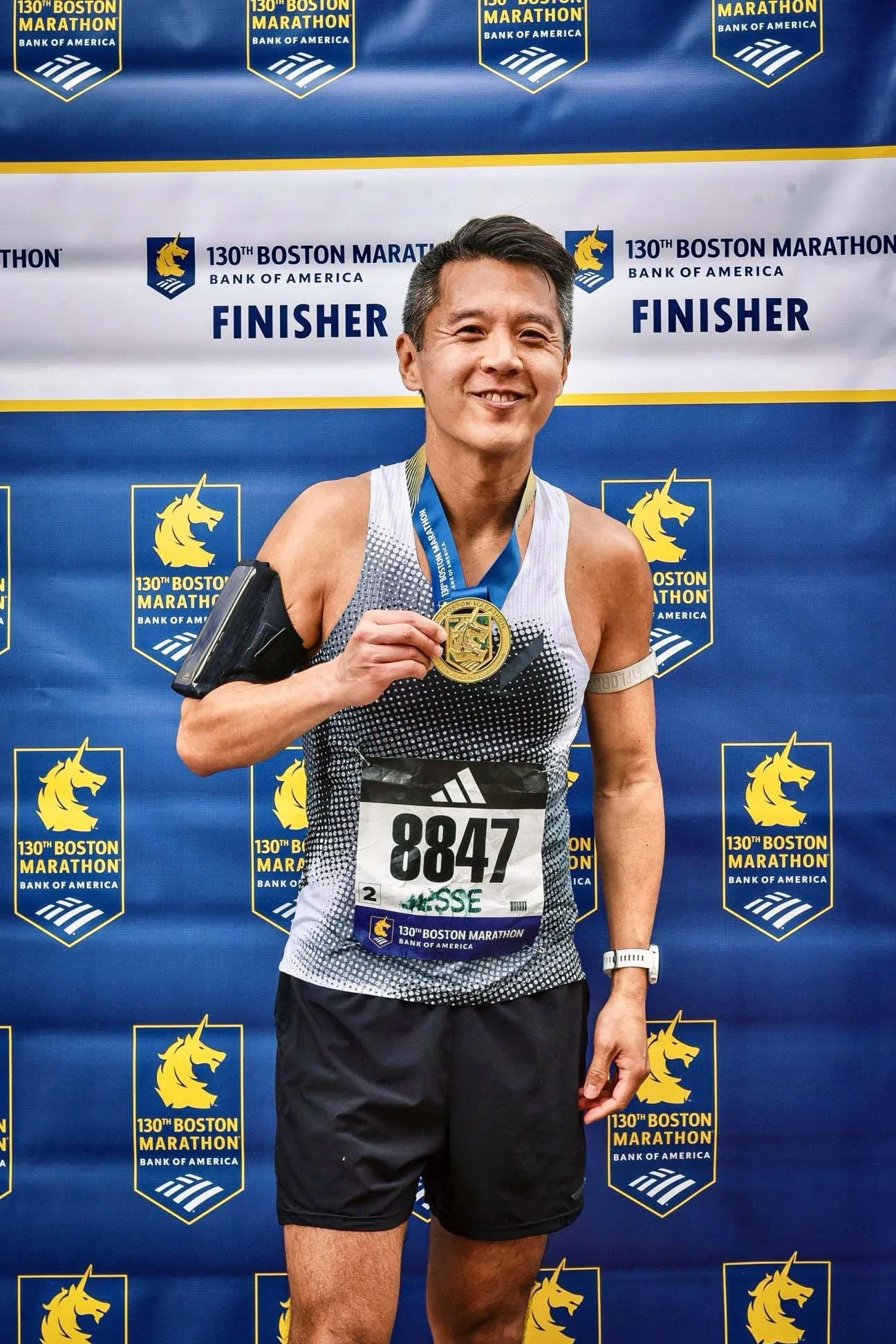
This strategy, along with stronger legs, improved fueling and hydration, and historically good weather, gave me the Boston Marathon experience I’d always hoped to have. I felt strong throughout and was actually able to enjoy racing through the streets of Boston, a city that embraces the marathon like no other. I finished in 3:02:42, a new personal course record.
3 Tips for Chasing Your Big, Scary Running Goal
Play the Long Game
People tend to overestimate what they can do in the short term, but they underestimate what they can do in the long term. I’m an advocate of steady, slow, unglamorous progress over multiple years. I’ve never tried to make any drastic changes. Instead, I’ve made small, manageable tweaks along the way.
For example, my overall mileage was too low for a long time, and it was a bottleneck preventing me from getting faster. With the help of my coach, I gradually increased my peak weekly mileage from about 40 miles a week to 50 miles a week. During another training cycle, I focused on getting more consistent with strength training. Another training cycle was all about improving my nutrition and fueling. I’ve made plenty of changes over the years, but not all at once.
Polarize Your Runs
I used to run every run at the same pace. I was skeptical of “easy running” and had trouble believing that you should do 75 to 80 percent of your runs at a relatively slow pace. I thought it would make you slow. But my coach convinced me that every run should have a purpose, and polarization, or keeping most of your running really easy with some high-intensity work sprinkled in, would actually make me faster. And it did. Now I can’t imagine training the way I used to. I think it would break me.
Maximize Your Enjoyment
Early on, I realized that registering for races in places I liked to spend time or wanted to visit, whether it was the Hamptons or New Zealand or Easter Island, kept me motivated to stick to my training. Combining running with travel increased my enjoyment. That may not work for everyone. Another runner may have fun joining a run club, whereas I like the freedom of training on my own. You have to determine your “thing” early on and figure out how to maximize it.