Ty France’s Near-Heroics Haven’t Been Enough Against Brewers
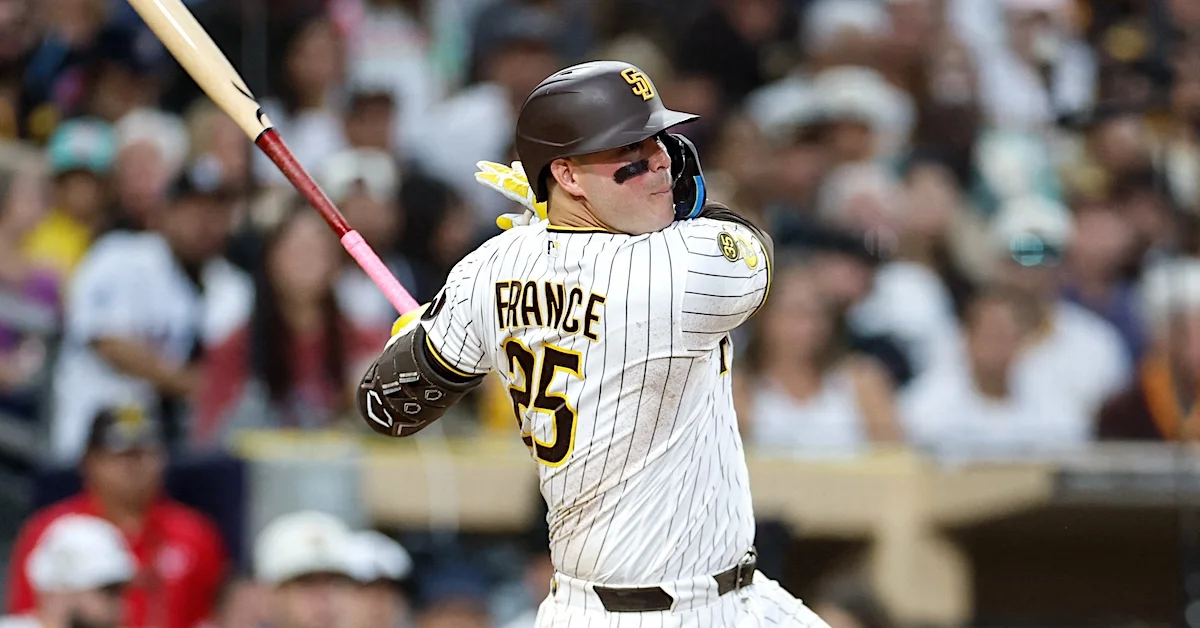
Ty France fell just short of playing the hero during the ninth inning of Saturday night’s Division Series opener between the Padres and Brewers, and his performance on Sunday at the center of the San Diego offense would have loomed larger if not for Mason Miller’s ninth-inning meltdown. The 32-year-old first baseman has been swinging a hot bat during the postseason, building on an impressive campaign in which he returned to the team that drafted him in 2015 and rediscovered his swing after two years of meandering around replacement level and through the rosters of four teams.
France collected two of the Padres’ five hits in Game 2 and drove in two of their three runs. He put them on the board in the first inning against starter Logan Henderson, ripping a 104.3-mph RBI single to right-center after Manny Machado worked a two-out walk and then took second on a wild pitch. After striking out in the third and being hit on the elbow guard by a Henderson changeup in the sixth, France faced Abner Uribe in the seventh with the Padres up 2-1 and Fernando Tatis Jr. (who had reached on an error) on second and Machado (who had walked again) on first. Ahead in the count 1-0, he smacked a 101.3-mph grounder to right field. Tatis raced home to run the score to 3-1, but Sal Frelick threw Machado out at third base to extinguish the rally.
Alas, the Padres couldn’t hold their two-run lead. The Brewers clawed back a run in the bottom of the seventh with a single, a walk, and a throwing error by second baseman Jake Cronenworth, then rallied for two in the ninth as Miller walked three before surrendering a walk-off single to Jackson Chourio.
France’s most memorable moment of the series happened with one out in the ninth inning of Game 1, with Dustin Harris at first base and Brewers closer Trevor Megill on the mound. France connected with a 98.9-mph heater over the middle of the plate, launching it 105.3 mph but with a 49-degree angle. The ball struck a cable in the American Family Field roof, but Chourio had a bead on it all the way, and alertly caught it in the left field corner. Confusion reigned momentarily as the umpiring crew huddled to sort out the ballpark’s ground rules, which say that a batted ball striking the roof, roof truss, or roof cable over fair territory is considered in play; if caught, the batter is out and the runners advance at their own risk. The FS1 broadcast cited the correct rule during the review but then suggested the ball might be a home run anyway, giving the Padres the lead. Once the umpires determined that to be the case, Padres manager Craig Stammen challenged the fair/foul call, because a foul ball striking the roof or its components is a dead ball. The call on the field was upheld; France was out.
While colleague Kiri Oler and many others pointed out that, according to Statcast, a ball hit with that combination of exit velocity and launch angle would have been a home run only in Houston’s Daikin Park, it’s not an open-and-shut case. The Hawkeye system that Statcast uses to track the ball is known to struggle with extreme launch angles, and the amount of spin on France’s drive — particularly the sidespin — isn’t publicly known. With more spin, the ball could have carried further, albeit at the risk of slicing foul. At The Athletic, old friend Eno Sarris and Spencer Nusbaum, with the help of a team quantitative analyst, illustrated a range of possible outcomes that suggested a home run was unlikely.
please do not do any discourse with this, it’s just educated guessing with very incomplete information.
yellow is the observed landing location, fuchsia and purple are two simulated continuations from before the wire collision using two estimates of ball spin pic.twitter.com/py9fzZTS80
— vivienne ? ?? ? ?? ? (@sunshinevvn) October 4, 2026
Had the ball curved foul — and eluded Chourio — France’s plate appearance would have continued, and who knows what might have happened? As it was, Megill followed France’s fly out by retiring Jackson Merrill on a loud line drive to secure the 3-2 victory for the Brewers.
“I haven’t really been able to fully process it,” France said after the game. “But it was a game-changing swing.”
France produced his share of game-changing swings for the Padres in 2026. He hit a career-high 21 homers while batting .295/.363/.502, with both his slugging percentage and 141 wRC+ leading the team, and all of those numbers besides his on-base percentage representing career highs. Signed to a minor league deal with a non-roster invitation in March, he broke camp with the Padres but initially had to compete for playing time with Nick Castellanos, who washed out in Philadelphia in spectacular fashion but received more playing time through the season’s first two months with San Diego than France did. Castellanos, who on top of diminishing offensive returns ranked as one of the worst defenders in the league in recent years, hit .191/.221/.339 (50 wRC+) with -0.9 WAR in 122 plate appearances through the end of May and also crowded the outfield corner/first base/DH portion of the roster, while France, a Gold Glove winner last year, hit .286/.318/.533 (135 wRC+) in 111 plate appearances. The Padres offense was absolutely desiccated at the time, with Machado, Merrill, and Tatis all off to dreadfully slow starts. France was one of just four Padres with a 100 wRC+ or better to that point, along with designated hitter Miguel Andujar, DH/first baseman Gavin Sheets, and backup catcher Luis Campusano. Not until Castellanos was designated for assignment in early June did France make five starts in a row.
Because of that early part-time role, France fell two plate appearances short of qualifying for the batting title; via two phantom at-bats, he officially placed seventh in the NL in batting average and ninth in slugging percentage. Among Senior Circuit players with 500 plate appearances, his wRC+ ranked fifth behind only Pete Crow-Armstrong, Jake Bauers, James Wood, and Gabriel Moreno.
That performance represented a huge jump from the meager .257/.320/.360 (92 wRC+) France hit in 490 plate appearances with the Twins and Blue Jays in 2025; he was slightly more productive but with similarly meager power in 2024 (.234/.305/.365, 95 wRC+) with the Mariners and Reds, and in ’23 (.250/.337/.366, 106 wRC+) with the Mariners. Among players with at least 300 plate appearances in both 2025 and ’26, France’s improvements in slugging percentage and wRC+ both ranked third in the majors:
| Player | Team | PA 2025 | SLG 2025 | PA 2026 | SLG 2026 | SLG Dif |
|---|---|---|---|---|---|---|
| Jordan Walker | STL | 396 | .306 | 667 | .466 | .161 |
| Joc Pederson | TEX | 306 | .328 | 432 | .487 | .158 |
| Ty France | MIN/TOR’SDP | 490 | .360 | 500 | .502 | .142 |
| Michael Conforto | LAD/CHC | 486 | .333 | 314 | .469 | .136 |
| Luis García Jr. | WSN/NYY | 526 | .412 | 543 | .521 | .109 |
| Oneil Cruz | PIT | 544 | .378 | 419 | .486 | .108 |
| Angel Martínez | CLE | 484 | .359 | 416 | .465 | .107 |
| Jacob Young | WSN | 364 | .287 | 471 | .390 | .103 |
| Nolan Arenado | STL/ARI | 436 | .377 | 599 | .475 | .098 |
| Chase Meidroth | CHW | 505 | .320 | 643 | .415 | .095 |
| Player | Team | PA 2025 | wRC+ 2025 | PA 2026 | wRC+ 2026 | wRC+ Dif |
|---|---|---|---|---|---|---|
| Jordan Walker | STL | 396 | 66 | 667 | 119 | 53 |
| Joc Pederson | TEX | 306 | 77 | 432 | 128 | 51 |
| Ty France | MIN/TOR/SDP | 490 | 92 | 500 | 141 | 48 |
| Oneil Cruz | PIT | 544 | 85 | 419 | 132 | 48 |
| Pete Crow-Armstrong | CHC | 647 | 109 | 726 | 157 | 47 |
| Josh Jung | TEX | 511 | 92 | 444 | 136 | 44 |
| Michael Harris II | ATL | 641 | 83 | 621 | 121 | 37 |
| Nolan Arenado | STL/ARI | 436 | 84 | 599 | 120 | 37 |
| Michael Conforto | LAD/CHC | 486 | 83 | 314 | 119 | 36 |
| Joey Ortiz | MIL | 506 | 67 | 415 | 103 | 36 |
In the field, France’s defense improved even after he won a Gold Glove with 9 DRS and 5 FRV in 2025. He led all first basemen with 15 DRS, and finished second only to Matt Olson with 10 FRV. Olson, who placed second to France with 11 DRS, was the NL’s Gold Glove winner last year, so it will be interesting to see which way the vote goes this year.
Boosted by that defensive performance, France set a career high with 3.6 WAR, after netting just 1.4 WAR from 2023–25, including 0.9 WAR last year. His total ranked third among Padres position players behind Tatis (5.4) and Merrill (4.2). Not too bad for a player who signed a minor league deal worth $1.35 million (plus another $650,000 in unspecified incentives) in March. Unable to find a major league deal this past winter — “No teams want a defensive-only first baseman, I guess,” he told The Athletic’s Dennis Lin in August — he chose the Padres from among his minor league offers because he played at San Diego State University under the legendary Tony Gwynn before being drafted by the Padres in the 34th round in 2015. He played 89 games for San Diego in 2019–20 before being traded to the Mariners in a seven-player deal on August 31, 2002, one that also included Andrés Muñoz, Taylor Trammell, and Austin Nola.
France’s turnaround began after the 2025 deadline deal that sent him from the Twins to the Blue Jays along with Louis Varland, in exchange for Alan Roden and Kendry Rojas. In Toronto, he connected with hitting coach David Popkins, who pointed out that when France was successful in 2020–22, he lifted his hands before his load in his swing, but as he struggled, he had been pushing his hands backwards instead, the result of a 2024 attempt to overhaul his mechanics after he “fell into a funk where I didn’t know how to pull myself out,” as he told Lin.
“I’m very grateful for [Popkins] and for that, because I would never have been able to figure that out on my own,” France told MLB.com’s AJ Cassavell in September. “Then, you’re breaking a bad habit. I needed muscle memory to get out of that bad habit. So I spent all offseason doing that.”
Indeed, France’s slash line in Toronto (.277/.320/.372 in 103 plate appearances) was pretty similar to his numbers in Minnesota (.251/.320/.357 in 387 plate appearances), so his reworking of his swing continued with Padres hitting coach Steven Souza Jr., who added an additional hint that helped him break out of a slide in June. From Lin:
France had slumped at the plate for more than a week. During the prior series, Souza observed that, while the infielder’s hands were climbing in his pre-swing load, he was not tipping his barrel quite the way he had in the early 2020s — a mechanism that allows France to ease the tension in his hands. Not yet convinced, France sought to find out for himself.
“He took, like, a thousand swings in the cage. We did a bunch of drills. None of it felt good,” Souza said. “Then, right before the start of the game, he found something…”
That something helped France go 3-for-3 with a double and a pair of homers against the Rangers’ Jacob deGrom on June 19. You can get a feel for what Popkins and Souza are referring to in this visual comparison by MLB Network’s Mark DeRosa, part of a longer segment assembled in the wake of that two-homer game.
Beyond the movement of his hands and the position of his barrel, you can see that France has opened his stance and increased the distance between his feet while crouching slightly more. As with so many players, the seasonal averages conceal a fair bit of variation, but France went from a stance that was 29 degrees open, with his feet an average of 28.7 inches apart in 2024 to 28 degrees open and 31.7 inches apart in ’25 to 34 degrees open and 31.3 inches apart in ’26. In September, his stance was 38 degrees open with an average distance of 32.2 inches between his feet.
With those changes to the positioning of his hands and feet, France’s bat speed improved from an average of 71 mph in 2024 and ’25 to 72 mph in ’26, with his fast swing rate jumping from 14.7% to 21.6%. That helped him hit the ball harder than ever:
| Season | Team | BBE | EV | LA | Barrel% | HardHit% | AVG | xBA | SLG | xSLG | wOBA | xwOBA |
|---|---|---|---|---|---|---|---|---|---|---|---|---|
| 2023 | SEA | 471 | 87.5 | 13.7 | 6.8% | 38.6% | .250 | .264 | .366 | .421 | .315 | .340 |
| 2024 | SEA/CIN | 370 | 88.7 | 12.9 | 7.3% | 40.0% | .234 | .225 | .365 | .394 | .296 | .306 |
| 2025 | MIN/TOR | 364 | 89.5 | 10.5 | 7.7% | 44.2% | .257 | .259 | .360 | .425 | .302 | .328 |
| 2026 | SDP | 341 | 91.5 | 14.6 | 9.1% | 47.2% | .295 | .248 | .502 | .421 | .373 | .327 |
France’s average exit velocity, barrel rate, and hard-hit rate all set career bests, though his expected numbers were actually quite similar to both his 2023 and ’25 marks; he went from underperforming his xSLG by 65 points to overperforming it by 81 points. Those expected numbers are somewhat weighed down by his higher strikeout rate (from 16.9% to 21.6%); his xwOBACON increased from .349 to .375, as he reduced his groundball rate from the 46% range in 2024–25 to 40% in ’26, and improved his pulled air rate from a career-low 13.2% to 19.1% (the 10th-largest year-to-year improvement).
It wouldn’t be a surprise if France regresses somewhat, but that hasn’t happened yet. He’s 7-for-15 so far in the postseason, with three two-hit games, including both games of the Padres’ Wild Card Series sweep of the Cubs. In the opener, he stroked a fifth-inning single off Javier Assad that loaded the bases and came around to score on a passed ball during a rally that helped break the game open from 4-0 to 7-0; he later added a seventh-inning single off Aaron Civale. In Game 2, he doubled off Kevin Gausman to lead off the second, then scored the game’s first run on a Xander Bogaerts single; in the eighth, he beat out an infield single that sent Dansby Swanson too far into the shortstop-third base hole to make a strong throw. With Machado on first, France added a fifth-inning single off Antonio Senzatela in the Division Series opener; both runners advanced on a wild pitch, but Aaron Ashby came on to retire Merrill and keep the game tied.
With two crushing losses to the Brewers, the Padres have their backs to the wall. France has been their most reliable hitter, but on a team that’s batting just .206/.316/.221 during this series, he’ll need more if they’re going to extend their season.