With No-Hit Bid, Dylan Cease Makes His Case for AL Cy Young
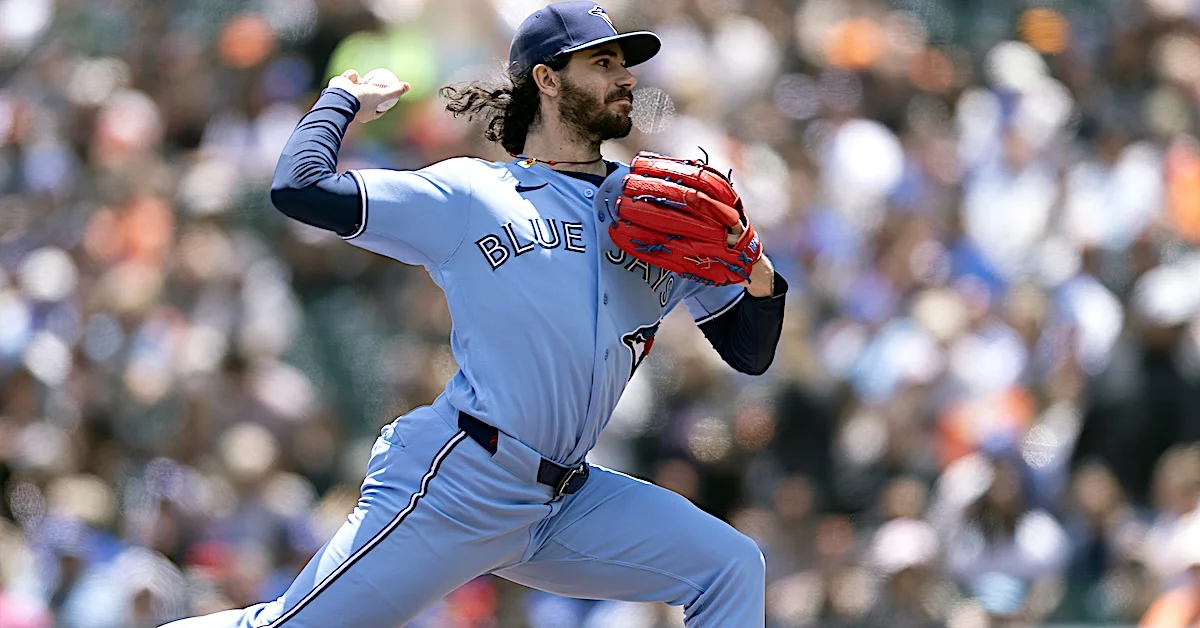
Dylan Cease came within three outs of making history on Wednesday. Only one Blue Jays pitcher has successfully thrown a no-hitter: Dave Stieb on September 2, 1990. Many others have come close since then, but none of them has finished the job. You can add Cease’s name to that list. He held the Giants hitless for eight innings before allowing a single to the first batter in the ninth. His final line: 8+ innings, one hit, three walks, and 11 strikeouts.
The game started off with a bang — Kazuma Okamoto’s grand slam in the top of the first inning gave the Blue Jays a 5-0 lead before Cease even took the mound. Once he did, it was evident he had his best stuff going. He retired the first 14 batters in order, at one point striking out five in a row. A walk to Willy Adames with two outs in the fifth broke up the perfect game, and then Cease issued another walk in each of the next two innings. This no-hit bid even had its signature defensive play, when Daulton Varsho tracked down a deep fly ball off the bat of Bryce Eldridge in the eighth inning, slamming into the wall in left-center field after making the catch. Ultimately, Cease’s effort fell short. Heliot Ramos saw two pitches from the right-hander in the ninth inning before lining the third up the middle for a single.
That Cease was in a position to complete the feat was a bit of a surprise in the first place. He had thrown a career-high 115 pitches through eight innings, and with teams doing everything they can to protect their pitchers these days, there were real questions about whether Cease would be allowed to pitch the ninth. After the game, Blue Jays manager John Schneider explained his thinking: “I’m a fan of baseball. If a guy has a chance to throw a no-hitter, you let him do it, and I think you make the adjustments after that. Dylan, he’s done it before, and he’s really durable. He’s in the category where you can be pretty aggressive with it. It’s not very often you get to see that, so if I can let a player have that opportunity, I’m going to do it every single time.”
Cease joins a long line of Blue Jays pitchers who have thrown near-no-hitters.
| Player | Date | IP | H | BB | K | Game Score v2 |
|---|---|---|---|---|---|---|
| Roy Halladay | 9/27/1998 | 9 | 1 | 0 | 8 | 93 |
| Dustin McGowan | 6/24/2007 | 9 | 1 | 1 | 7 | 98 |
| Brandon Morrow | 8/8/2010 | 9 | 1 | 2 | 17 | 104 |
| Bowden Francis | 8/24/2024 | 8 | 1 | 3 | 12 | 82 |
| Bowden Francis | 9/11/2024 | 8 | 1 | 1 | 1 | 75 |
| Dylan Cease | 7/8/2026 | 8 | 1 | 3 | 11 | 88 |
Roy Halladay, Dustin McGowan, Brandon Morrow, and Bowden Francis all had no-hit bids ended in the ninth inning since Stieb’s feat 36 years ago. By game score, Cease’s effort falls in the middle of the pack, less impressive because he didn’t complete nine innings, but better than Francis’ two outings two years ago. Of course, Cease already has a no-hitter to his name, throwing one in 2024 with the Padres. The Blue Jays still have the second-longest no-hitter drought in baseball, ahead of only the Guardians.
As a quick aside, a true no-hitter feels like it could become an increasingly rare feat in the near future. The last no-hitter thrown by a single pitcher was Blake Snell’s back on August 2, 2024, and there were none in 2025. Two combined no-hitters have been completed since Snell’s — one by the Cubs on September 4, 2024 and one most recently by the Astros on May 25, 2026 — but the solo effort now requires both dominance and efficiency. Ballclubs are much more wary of overworking their starting pitchers, so to complete nine innings, they need to keep their pitch counts under control to go the distance. Cease’s durability has been a hallmark throughout his career, and that made Schneider’s decision to let him keep going despite a career-high pitch count justifiable.
Cease’s dominant outing dropped his season ERA to 2.56 and FIP to 2.20, and pushed his WAR up to 3.7, a hair ahead of Cam Schlittler’s mark for the AL lead among qualified pitchers. For most of the first half of the season, the young Yankees starter has been the frontrunner to win the AL Cy Young award. With Tarik Skubal, Garrett Crochet, and Max Fried all dealing with various injuries, the field has been sapped of most of the preseason favorites.
| Player | IP | W-L | K% | BB% | ERA | FIP | WAR | CYP | FIP CYP |
|---|---|---|---|---|---|---|---|---|---|
| Cam Schlittler | 112 | 9-5 | 29.6% | 4.8% | 2.01 | 2.58 | 3.6 | 53.1 | 77.0 |
| Dylan Cease | 98.1 | 6-4 | 36.9% | 11.0% | 2.56 | 2.20 | 3.7 | 42.0 | 67.1 |
| Joe Ryan | 104.1 | 6-5 | 28.8% | 5.4% | 2.85 | 2.83 | 3.1 | 37.4 | 56.7 |
| Parker Messick | 106 | 7-5 | 25.8% | 7.6% | 2.80 | 3.10 | 2.9 | 37.9 | 54.4 |
| Sonny Gray | 89.2 | 10-1 | 22.8% | 6.4% | 2.61 | 3.61 | 1.6 | 37.0 | 45.9 |
While Schlittler still holds the advantage in the more traditional categories like wins and ERA, Cease leads the AL in strikeouts, FIP (among starters), and WAR — and that’s despite pitching two fewer games than Schlittler. A minor hamstring injury in late May sent Cease to the IL for just the second time in his major league career. Joe Ryan and Parker Messick are also making solid cases, and the traditionalists are bound to love Sonny Gray’s win count and low ERA. Still, it feels like, barring any big surprises, the Cy Young race will come down to Schlittler or Cease.
Getting a Cy Young-caliber season out of Cease immediately after signing him to a massive seven-year, $210 million contract is a triumph for the Blue Jays. One of the preeminent strikeout artists over the last five years, he’s pushed his strikeout rate up to 36.9% this year, a career high. His walk rate is also up slightly — he’s never had great command at any point in his career — but it’s higher than it’s been since 2020. Still, all those additional strikeouts have helped him navigate whatever traffic those free passes put on the basepaths.
While Cease technically has a six-pitch repertoire, he’s mostly known for his riding fastball and hard slider. Those two pitches made up more than 80% of his pitch mix over the previous five seasons. This year, he’s throwing those two pitches about two-thirds of the time. To make up the difference, he’s committed to throwing his changeup a lot more often to keep left-handed batters at bay. He had thrown a form of his changeup back when he debuted with the White Sox in 2019, but it quickly fell out of favor. He had used it almost like a trick pitch over the last few seasons, never throwing it more than 100 times in any given season since 2021.
He found a new changeup grip this offseason and decided to re-incorporate it into his arsenal to give him a reliable third pitch to keep batters off his fastball-slider combo.
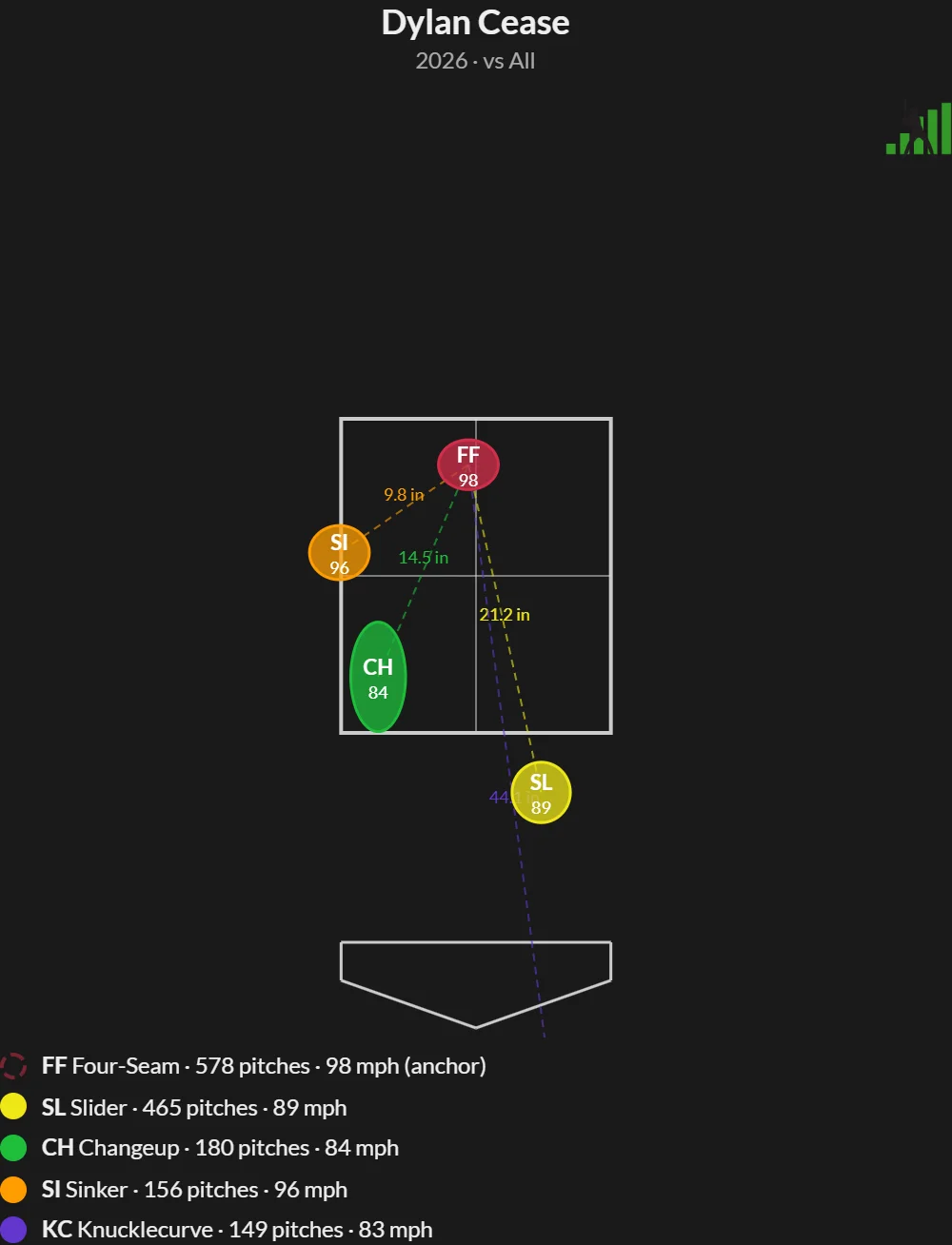
The revamped changeup has worked wonderfully so far. He’s thrown it almost exclusively to lefties, but they simply can’t hit it. The pitch has a 60% whiff rate, the highest of any pitch thrown at least 100 times this season. If batters do make contact, it’s usually weakly hit in the air; opposing batters have only managed a .185 batting average and a .215 wOBA against it.
When you think of effective changeups, you might picture Devin Williams’s airbender, dropping and fading away from opposite-handed batters. Or perhaps Edward Cabrera’s power changeup, modeled after Félix Hernández’s cambio. Based on Harry Pavlidis’ research into what makes a changeup effective, we know that a large velocity differential is beneficial for inducing swings and misses. But he also found that changeups that have a wide separation in movement profiles from the pitcher’s fastball can also be effective, particularly at generating groundball contact. Cease’s changeup is unlike any other in baseball.
The velocity differential between his fastball and his changeup is the second highest in the majors, but the pitch’s movement profile is what makes it stand out. It doesn’t fall off the table like you might expect, and it doesn’t fade away from lefty batters either. It’s a straight change. I calculated z-scores for those three characteristics — velocity differential, induced vertical break, and horizontal movement — and summed them as a rough approximation of how unique a pitcher’s changeup is compared to league average. Cease’s has the highest combined score by far.
| Player | CH Velocity | Velocity Differential | IVB | Horizontal Mov | Combined Z-Scores |
|---|---|---|---|---|---|
| Dylan Cease | 83.6 | 14.1 | 15.7 | 9.0 | 7.6 |
| Joey Cantillo | 80.6 | 11.4 | 13.2 | 9.3 | 5.7 |
| Tanner Bibee | 81.1 | 13.0 | 13.8 | 11.9 | 5.5 |
| Lucas Giolito | 79.0 | 11.8 | 13.8 | 11.6 | 5.1 |
| Ryan Feltner | 85.3 | 9.4 | 5.9 | 4.5 | 5.0 |
| Devin Williams | 84.1 | 9.7 | -1.6 | 20.9 | 4.8 |
By this crude method, Cease’s changeup is the most unique offspeed pitch in baseball. It moves a lot like a fastball, except it comes in 14 miles per hour slower. No wonder opposing batters can’t touch it.
This odd movement profile is tied to Cease’s release. He’s a natural supinator — when he releases the ball, his hand is behind it, imparting more backspin on the pitch. Supinators have a very difficult time throwing pitches with the arm-side movement that you would expect a traditional changeup to have. Cease’s change possesses a significant amount of backspin — that’s the reason why it doesn’t tumble as much as you’d think — and its spin profile closely mirrors that of his fastball. Because his offspeed looks a lot like his fastball out of the hand, the effectiveness of his heater has improved, as well. His four-seamer is running a 30.7% whiff rate, a career high for that pitch.
While he may not have made history on Wednesday, Cease is in the middle of what is shaping up to be a career year. He was just named to his first All-Star roster, and he’s pitched his way into the AL Cy Young race. In his first season in Toronto, he’s made the right adjustments to thrive.