Jake Bauers Gets to the Heart of It
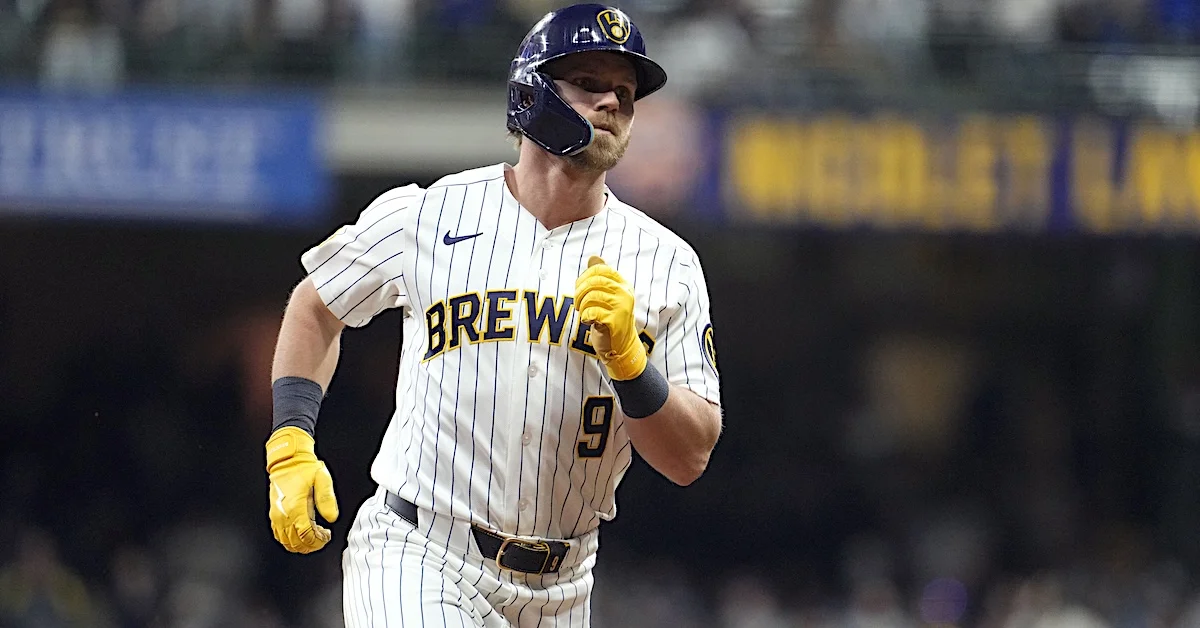
After wandering for years, Jake Bauers has found himself in Milwaukee as one of the top hitters of 2026.
I first learned about Bauers because of a stat I made up sometime in 2019, around when Baseball Savant began publishing the attack region perspective of the strike zone. Rather than labeling pitches as simply in or out of the zone, Savant drew the distinction between meatballs, borderline strikes, and various distances beyond. Analysts had made similar observations for as long as PITCHf/x had been around, of course, but this was the first time (to my knowledge) the data was easily searchable, sortable, and available to download. No longer was the concept of plate discipline limited to walks and strikeouts, or even simple chase rate, but we could now look at which players were actually swinging at the right pitches within the zone, too.
At a high level, batters should only swing at pitches in the heart region. At a more granular level, this isn’t entirely true, as things like the count, situation, and swing profile change the calculus from pitch to pitch. But as a general rule, the players who swing at the right pitches are the ones who swing at heart pitches and lay off everything else. This gives us some fairly simple math:
Heart Swings / Total Swings = Heart Swing Ratio
Taking it a step further to isolate a hitter’s heart-swing tendency, you’d then divide by the rate of heart pitches seen. I called this the Heart Swing Index, largely because I’m not creative and wasn’t quite sure what an “index” was, other than that it sounded official. Today, I’d probably call it the Heart Commitment Something Something. It doesn’t really matter, because around the same time, much smarter people were building much better metrics. You should use those instead.
Anyways, this free data and basic algebra is how I found out about Bauers, or rather, how I’d come to explain the resilience of his career in my head.
| Year | PA | Heart | Chase | SEAGER | BB% |
|---|---|---|---|---|---|
| 2018 | 388 | 94th | 89th | 93rd | 92nd |
| 2019 | 423 | 87th | 85th | 88th | 85th |
| 2021 | 315 | 47th | 55th | 20th | 64th |
| 2023 | 272 | 80th | 68th | 34th | 70th |
| 2024 | 346 | 89th | 95th | 20th | 88th |
| 2025 | 218 | 98th | 90th | 55th | 97th |
| 2026 | 292 | 94th | 95th | 58th | 89th |
Bauers was bad for a long, long time. He debuted in 2018, and by the end of 2024, he’d racked up 1,744 plate appearances with an 84 wRC+, a 29.2% strikeout rate, and plenty of negative values on defense and the bases. Only five players with at least 1,000 plate appearances over those years accumulated more negative WAR. And these weren’t just garbage-time at-bats for a tanking team. Bauers bounced from contender to contender, each hoping to unlock something that had never shown up in his box score.
Initially drafted by the Padres in the seventh round in 2013, he was quickly traded to the Rays in 2014 in the massive three-team deal that sent Wil Myers to San Diego (and eventually Trea Turner to the Nationals). Bauers made it to 43rd on our Top 100 Prospects List before his debut in 2018. But after a tepid rookie season, he was dealt to the Guardians in another three-team trade that included Carlos Santana, Yandy Díaz, and Edwin Encarnación.
Bauers got worse in 2019, posting -0.8 WAR in 117 games and 423 plate appearances. He was demoted after the season and didn’t make it back to the majors until 2021. He struggled mightily out of the gate and was designated for assignment and traded to the Mariners, where his struggles continued the rest of the year. He signed with the Reds that offseason but never made it to the majors. The Yankees picked him up in December 2022, and he struggled again over 272 plate appearances in 2023. Then he was traded to the Brewers ahead of 2024, where he got another 348 plate appearances with similar results. They cut him after the season.
Why were so many contending teams willing to let him struggle for so long?
Well, it partially goes back to the table above. The ability to consistently draw walks gave him a high floor. No, it wasn’t enough to make him even average at the plate, but it’s at least one core skill that an intrepid front office might think to build on for the 26th roster spot. And as we’d learn later, Bauers also swings very hard, ranking top 10 in bat speed this year. I’m not sure if this was always true, as he was billed as “hitterish” and not “sluggerish” in his prospect days. But anybody who can hit a ball 112.2 mph and 460 feet has some power potential.
Bauers has always been something of a leaderboard pest in that regard — every granular leaderboard has a few. It’s the guy who shows up right after the names you’d expect, but right before the meaningless middle. It’s the guy you might subtly remove from a table with sample size, or include to write a post just like this. Regardless, the ambition of each new suitor has always made sense, even if he never had any sort of track record to justify getting all those plate appearances. He swung at the hittable pitches, and he swung hard at them. As Matthew Trueblood recently wrote for Brewer Fanatic, “Once you have Bauers around for a bit, you tend to want him around longer than you’d think.”
That proved exactly the case. After the Brewers cut Bauers following the 2024 season, they quickly brought him back, only for him to make the Opening Day roster in 2025. He had some success early, but slumped again before hitting the injured list with left shoulder impingement in mid-July.
And ever since, Bauers has been one of the best hitters in baseball. He returned from the IL and finished the last month-plus of 2025 with a 166 wRC+, and he has a 140 wRC+ as we approach the All-Star break in 2026. He’s not quite an everyday player (though he’s been above average against lefties this year), but he’s top 25 in total batting run value with 14.2 runs created at the plate.
This is one of those analyses where the “what he’s doing different now” isn’t all that surprising. Bauers is making more and better contact in the zone, without sacrificing the approach that’s carried him this far. He’s also changed up his stance — if you’re a fan of a team that gave him 300 plate appearances, it’s worth looking at him now.
He’s moved back in the back in the box, narrowed his feet, and opened his body toward the pitcher. He looks more powerful, more relaxed, and more in control. And if I can bother you for another reference to that Trueblood article (which you should read), that really seems to be the point:
“I’ll be honest with you,” Bauers said. “I haven’t thought about mechanics in the box even one time since I got [to Arizona for spring training].”
“I’m just trusting myself. … It sounds simple; it’s not simple. But you have to take some of those other thoughts out of it. In the past, I would be in the box thinking about my swing, thinking about what I was trying to do physically, and it just got in the way.”
It’s interesting to compare that quote to an interview Bauers did with David Laurila for us way back in 2018, just after wrapping up his rookie year. He talked about a lot of the same things, about wanting to keep things simple and find a sense of comfort in the box and in himself. Perhaps it’s understandable that years of bouncing from club to club, majors to minors, coach to coach made “keeping it simple” not so simple — he admitted as much in 2020. Now he’s found something as close to a permanent home as he’s had, and he’s thriving.
Whether Bauers can keep it up, I’m not sure. Maybe he has another a few months of this, or another few years. But he’s justified the opportunities of the past and created more for the future. At the very least, it’s nice to see a leaderboard pest atop the ones that matter.