Could Boston, Chicago, and New York Become 2-Day Marathons?
We’re well into a global running boom, and seemingly nothing is booming more than the World Marathon Majors.
In the past two years, the London Marathon became the largest marathon ever, the World Marathon Majors added two new races—Sydney and Cape Town—to the circuit, and the U.S. majors have increased their field sizes.
The growth reached a new milestone on June 19 when the London Marathon announced it would be expanding to a two-day event in 2027, targeting a field size of 100,000 participants. The elite men and women will race on different days, but specific details on the format have not yet been announced. The race emphasized that the format is a one-time change for 2027 only.
“The 2027 TCS London Marathon Double is our most ambitious evolution to date—a once-in-a-generation one-time-only reimagining of what a marathon and city-wide celebration of activity can be,” Hugh Brasher, the CEO of London Marathon Events, said in a statement.
“By expanding to 100,000 runners across two days, we’re opening the door for more people, more charities, and more communities to take part in the world’s greatest marathon,” he continued, noting that he expects the race will raise nearly $200 million for “good causes” and bring in more than $530 million to the U.K. economy.
Could the U.S. majors—Boston, Chicago, and New York—follow suit?
They’ve certainly been growing.
Boston expanded the number of waves this year to accommodate 29,033 finishers—the most since 2014. A record 54,383 participants finished the Chicago Marathon last October. And the New York City Marathon has been battling with Berlin and London over the title of world’s largest marathon in recent years. The 2025 edition saw a then-record 59,226 finishers which was surpassed by London in April.
So will one of them follow London’s lead and experiment with a multiday event? We reached out to each marathon and asked. But first, let’s look at what could make it challenging.
Challenges of a two-day marathon weekend
A single-day marathon is a logistical jigsaw puzzle. Two days is uncharted territory. There are the obvious changes: closing roads an extra day, hiring more medical staff and police officers, and finding a way to clean (or replace) porta-potties between races. But there’s a human element as well.
Michael Clemons, the director of operations at Running USA, who helps with finish line operations at all three U.S. majors, says the emotional toll on staff for a two-day marathon would be high.
“I don’t know if the average participant knows how much mental and physical strain goes into a day of an event,” he said. “To think of having to wake back up and do that over again is asking so much of your event staff.”
An example: Clemons worked the finish line of the 2018 Boston Marathon, which was cold, windy, and relentlessly rainy.
“I cannot imagine having to go back out there the next day and do that again,” he said.
There’s also a heavy burden on the host city. Marathon weekends already put tremendous stress on hotels, public transit, and arterial roads. And some barriers won’t move. During a two-day marathon, participants are still likely to travel later in the week to pick up their bib at the expo because of work schedules. And locals who can tolerate the inconvenience for one day may be less eager to have getting around their city become a full-weekend headache, said Marcel Altenburg, a crowd scientist and consultant for major sporting events.
“The weekend is only two days, and if you have your race on Sunday, it’s understandable and logical that those affected by the road closures move their errands to Saturday. But now they can’t,” he said. “The weekend is still just two days. There are just certain things that you can’t double. You can double the marathon, yes, but you can’t double the weekend.”
Airports, for example, already experience massive demand. In 2024, the busiest day at the Berlin airport was the Friday before the city’s marathon, when nearly 100,000 passengers traveled through.
London was able to secure buy-in from the city. But it’s an uphill battle. The Guardian reported that although the race had early support from the mayor’s office, “it took longer than expected to get every stakeholder on board, with Transport for London and others expressing reservations about shutting down the capital for two consecutive days.”
Boston Marathon

This one seems the most unlikely to go to two days among the American majors. The race day—Patriots’ Day or Marathon Monday—is a state holiday and sacred among Bostonians. The course, which runs from Hopkinton, Massachusetts, to the heart of Boston, puts logistical strain on the eight municipalities it runs through.
When asked whether the race would consider a two-day format in the future, a spokesperson from the Boston Athletic Association, which organizes the race, provided the following statement:
The Boston Marathon has a tradition tied to Patriots’ Day for 130 years, and the Monday atmosphere is part of the unique fabric of our event. Next year’s race is scheduled for Monday, April 19, and we foresee the Patriots’ Day tradition continuing for the long term. Our focus remains on continuing to foster memorable experiences for participants, spectators, volunteers, and members of our community.
In other words: not likely.
Chicago Marathon
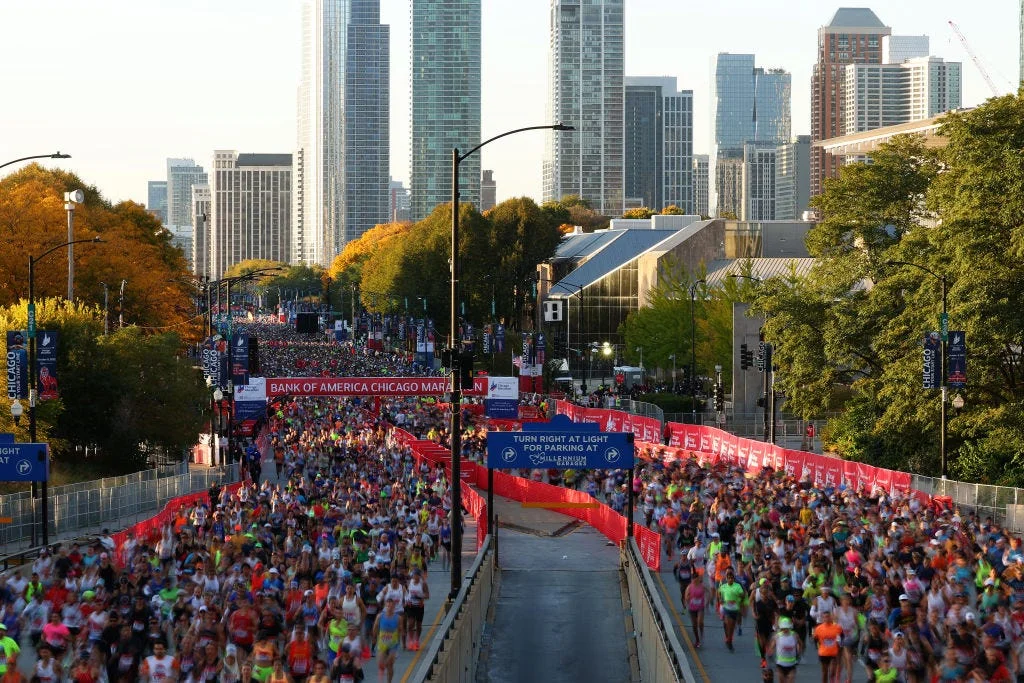
The flattest American major saw 54,383 finishers last year. While it’s not as large as New York, London, and Berlin, the race expects its largest field ever this fall, anticipating more than 55,000 participants.
However, a spokesperson told Runner’s World that a two-day event “is not a format our team is considering.”
But if Chicago did want to explore a two-day format, it has an advantage. Clemons, a Chicago resident, said its biggest asset could be Grant Park—where the start and finish are staged. It would likely be easier for the city to shut down the park than, for example, Hopkinton in Boston’s case or the heavily trafficked Verrazzano–Narrows Bridge in New York.
New York City Marathon

In fact, the Verrazzano–Narrows Bridge may be the biggest impediment for New York to host a “double.” The race stages its start village at the foot of the bridge in Staten Island, before runners crest it into Brooklyn and run over four more bridges in the city.
Shutting a New York bridge down for one day is already a sizable undertaking—two days would require unprecedented buy-in from city and transit officials. In 2024, the MTA sparred with NYRR, asking the organization to cover approximately $750,000 in lost tolls. (The demand was eventually dropped.)
If we ignore the strain on infrastructure, New York seems ripe to benefit from a two-day format. It’s one of the most sought-after marathons in the world and toughest to get into: For the 2026 event, the race received a record 240,000 applications and just 1 percent of runners were accepted via the lottery.
Plus, New York and London have traded the title of world’s largest marathon over the last two years. If all goes well during London’s “Double” in 2027, will NYRR push the envelope past 100,000 runners?
In promotional material, NYRR calls the day of the race the “best day in New York City.” For now, it seems it will stay as a singular day.
A representative from NYRR declined to comment on this piece.

Theo Kahler is the senior news editor at Runner’s World. He’s a former all-conference collegiate runner at Winthrop University, and he received his master’s degree in liberal arts studies from Wake Forest University, where he was a member of one of the top distance-running teams in the NCAA. Kahler has reported on the ground at major events such as the Paris Olympics, U.S. Olympic Trials, New York City Marathon, and Boston Marathon. He’s run 14:20 in the 5K, 1:05:37 in the half marathon, and finished 40th at the 2025 New York City Marathon. He enjoys spotting tracks from the sky on airplanes. (Look for colorful ovals around football fields.)