In Detroit, Every Hitter Is in a Pinch
A friend of mine is a Tigers fan, God help him. He’s upset about baseball quite a bit these days, and the other night he was miffed about something specific: With two outs in the ninth inning and the tying run coming to the plate, Detroit manager A.J. Hinch pinch-hit with Jake Rogers.
Whatever else the Tigers’ backup catcher has going for him, he’s not a very good hitter. He’s hitting .155/.239/.276 this season, with a 30.9% strikeout rate. (All stats in this article are current through Tuesday’s games.) That’s a wRC+ of 42. Rogers had about a season’s worth of pretty good offensive production spread from 2021 to 2023 — like, a good Mike Zunino season, with a low-.200s batting average, a bunch of home runs, and a strikeout rate in the 30s — but overall he’s a career .198/.268/.380 hitter. He hasn’t batted .200 in a season in three years.
Sure enough, Rogers struck out on four pitches to end the game.
So yeah, it’s jarring to see that guy not only at the plate with the game on the line, but to come off the bench with the game on the line. Hinch put Rogers there on purpose, which seems like the work of a madman.
Believe it or not, it was probably the right decision.
The man on the mound for the Astros was Josh Hader, who was built in a lab by a mad scientist to make life difficult for left-handed hitters. And the guy Rogers pinch-hit for, Zach McKinstry, is left-handed.
McKinstry was great last year, hitting .259/.333/.438 with 12 home runs. But he’s a career utility infielder who had hit like a utility infielder his whole career to that point. I don’t want to speak for everyone, but I treated McKinstry’s career year like an unexplained joint pain: It doesn’t make any sense, and it’s uncomfortable, but if I stop thinking about it maybe it’ll go away.
And go away it did. McKnistry is hitting .168/.258/.245, which is about the same as Rogers. Rogers had the platoon advantage and is more likely than McKinstry to run into a mistake and put it in the Crawford Boxes. Given the choice between “definitely going to lose” and “almost definitely going to lose,” there’s only one option.
As luck would have it, Rogers got his pitch right at the beginning of the at-bat, but he didn’t realize it until the ball was past him.
Ah, well, c’est la guerre.
This at-bat could not have been less consequential, but it got me thinking about why Rogers was the only bat left on the bench. Colt Keith had hurt his wrist, so the Tigers were playing a man down, but Hinch had already used his two best (or at least better) right-handed pinch-hitters: Matt Vierling and the switch-hitting Wenceel Pérez.
The Tigers’ approach to the bench is simple: We paid for the whole thing, so we might as well use it all.
Rogers was the 105th pinch-hitter used by Hinch this season, which leads the majors by 15%. Last year, Hinch called for a pinch-hitter 209 times; the Guardians and Rangers tied for second at 168. The Tigers used the second-most pinch-hitters in the league in 2024, and the fifth-most in 2023. McKinstry was the 121st starting position player Hinch pulled mid-game this year, which leads the AL. Only the Rockies have yanked their starters more.
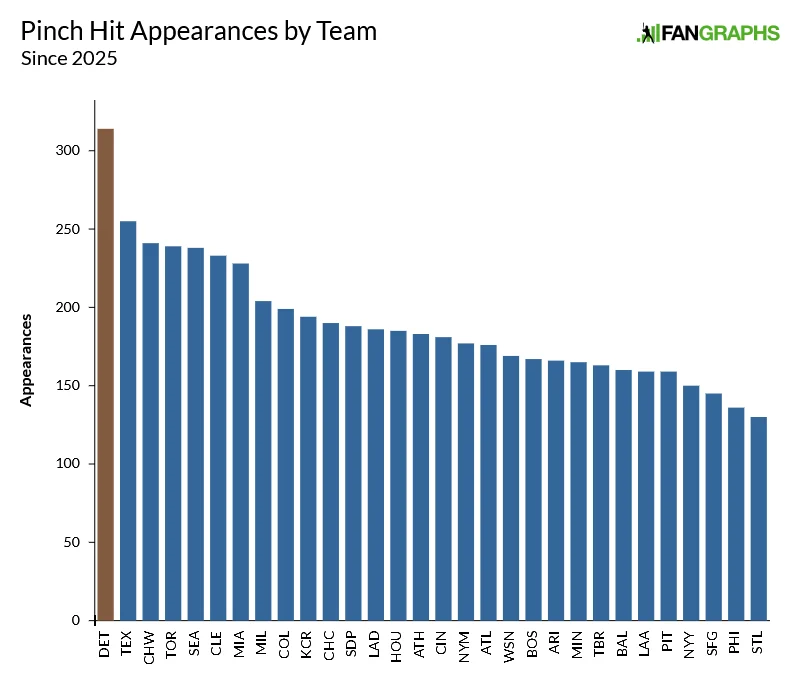
Hinch does like to manage. In his early days with the Astros, before Carlos Correa, Jose Altuve, Alex Bregman, and George Springer truly established themselves as stars, he liked to platoon, substitute, and otherwise apply Marwin Gonzalez to any problem that presented itself.
But managerial preference is of secondary importance to roster construction. As the Astros grew into their dynastic form, they dropped into the bottom half of the AL in pinch-hit appearances. Hinch might’ve been prone to fidgeting, but he’s not stupid: Nobody’s pinch-hitting for Yordan Alvarez. (Unrelated: Hinch has now been managing the Tigers longer than he managed the Astros. Time flies, man.)
In fact, it might not be fair to say Hinch has a preference one way or another, because if there’s one man driving the Tigers’ bench-happiness, it’s Kerry Carpenter. The Tigers only got up near the top of the pinch-hitting charts in 2023, which happens to be Carpenter’s first full season in the majors.
Carpenter has a massive platoon split. Since 2023, he has a .268 wOBA against left-handed pitchers, which is 354th out of the 426 hitters who have seen 2,000 or more pitches in the past four seasons. Against righties, he has a .364 wOBA, which is 24th. That gap is the 12th-largest in baseball.
Having a big platoon split isn’t necessarily a big deal, especially for a left-handed hitter. Nick Kurtz has the third-largest split since 2023, because he fares fine against lefties but hits righties 20 points of wOBA better than any other hitter in baseball. Max Muncy, Shohei Ohtani, and Corey Seager all have platoon splits of at least 70 points of wOBA.
But Carpenter hits righties like a Hall of Famer and hits lefties like a backup catcher. He needs a caddy.
Carpenter has appeared in 50 games this season, and he’s played all nine innings just 18 times. He’s been lifted mid-game in 21 of his 39 starts, and he’s come in as a pinch-hitter on 11 more occasions. And he is not the Detroit starter who’s been substituted the most: That’d be Keith, who’s finished just 24 of the 49 games he’s started. He’s also pinch-hit 15 times and come off the bench to play third base twice.
Between Keith, Carpenter, and Jahmai Jones, the Tigers have three of the 18 position players who have been pulled from a start at least 17 times this year. The Mariners are the only other team with more than one player in the top 18.
But the Tigers do have a lot of hitters with big platoon splits.
| Name | Bats | Total PA | % with Platoon Adv. | Platoon Split (wOBA) |
|---|---|---|---|---|
| Kevin McGonigle | L | 309 | 73% | -.048 |
| Riley Greene | L | 306 | 70% | .010 |
| Spencer Torkelson | R | 279 | 24% | .021 |
| Dillon Dingler | R | 275 | 31% | -.089 |
| Colt Keith | L | 209 | 95% | -.171 |
| Matt Vierling | R | 197 | 38% | .143 |
| Gleyber Torres | R | 190 | 24% | -.071 |
| Wenceel Pérez | B | 175 | 100% | .079 |
| Zach McKinstry | L | 165 | 88% | -.085 |
| Kerry Carpenter | L | 160 | 92% | -.098 |
| Hao-Yu Lee | R | 96 | 50% | -.022 |
| Jahmai Jones | R | 94 | 83% | .246 |
| Javier Báez | R | 82 | 23% | -.073 |
| Jake Rogers | R | 68 | 10% | .196 |
| Zack Short | R | 46 | 46% | .166 |
| Parker Meadows | L | 39 | 97% | -.296 |
| Gage Workman | L | 38 | 100% | -.232 |
Hinch is shielding Keith, Carpenter, McKinstry and Jones incredibly well. But he has only one switch-hitter on his roster, and his two best overall hitters — Riley Greene and Kevin McGonigle — are lefties who play no matter what. (Greene is actually hitting lefties quite well this year after struggling against them early in his career.) So on the aggregate, Tigers hitters are almost bang-average in terms of percentage of plate appearances with the platoon advantage.
| Team | % of PA with Platoon Adv. | Total PA | LHH vs. LHP | LHH vs. RHP | RHH vs. LHP | RHH vs. RHP |
|---|---|---|---|---|---|---|
| CLE | 78% | 2733 | 349 | 1619 | 515 | 250 |
| WSN | 69% | 2858 | 338 | 1544 | 441 | 535 |
| MIN | 65% | 2834 | 163 | 1136 | 706 | 830 |
| CHW | 65% | 2696 | 274 | 1274 | 471 | 677 |
| ARI | 64% | 2706 | 138 | 1115 | 628 | 825 |
| SEA | 64% | 2794 | 329 | 1322 | 466 | 677 |
| MIL | 62% | 2732 | 347 | 1249 | 457 | 679 |
| MIA | 62% | 2764 | 230 | 1212 | 505 | 817 |
| ATL | 61% | 2692 | 360 | 1028 | 616 | 688 |
| PIT | 61% | 2900 | 282 | 1253 | 517 | 848 |
| COL | 61% | 2815 | 263 | 1202 | 505 | 845 |
| TBR | 60% | 2673 | 316 | 1017 | 586 | 754 |
| DET | 60% | 2746 | 218 | 1146 | 498 | 884 |
| NYY | 59% | 2703 | 464 | 1195 | 400 | 644 |
| LAD | 59% | 2842 | 368 | 1280 | 388 | 806 |
| BAL | 58% | 2807 | 190 | 1038 | 590 | 989 |
| KCR | 57% | 2792 | 284 | 1049 | 549 | 910 |
| PHI | 56% | 2706 | 385 | 1052 | 463 | 806 |
| NYM | 56% | 2705 | 231 | 1035 | 475 | 964 |
| ATH | 55% | 2827 | 275 | 1020 | 534 | 998 |
| TOR | 55% | 2728 | 200 | 950 | 549 | 1029 |
| CHC | 54% | 2894 | 210 | 978 | 579 | 1127 |
| TEX | 53% | 2726 | 216 | 1034 | 416 | 1060 |
| STL | 52% | 2720 | 361 | 993 | 434 | 932 |
| BOS | 52% | 2626 | 233 | 956 | 412 | 1025 |
| SFG | 50% | 2729 | 324 | 929 | 432 | 1044 |
| CIN | 49% | 2740 | 95 | 780 | 549 | 1316 |
| LAA | 44% | 2816 | 114 | 611 | 639 | 1452 |
| SDP | 41% | 2617 | 143 | 603 | 481 | 1390 |
| HOU | 40% | 2840 | 158 | 556 | 576 | 1550 |
Of those 218 left-on-left plate appearances, 174 are Greene and McGonigle. Carpenter, Keith, and McKinstry have combined to face lefties just 43 times this season.
What does all that in-game substitution mean for the Tigers? Well, there’s the famous pinch-hitter penalty; 20 years ago, it was 24 points of wOBA. Ben Clemens updated that figure in 2020; he found that the pinch-hitter penalty in 2019 was just 11 points, though that was a major outlier from the previous few seasons. (I’m not going to update that figure here so Ben has something to write about in case there’s a lockout this coming offseason.)
When I was a kid, pinch-hitter was a position all its own. This was the heyday of the great pinch-hitters: Lenny Harris, John Vander Wal, Dave Hansen, and so on. Back when starting pitchers went six or seven innings as a matter of course, the nine-hole might come up for the third time in a legitimate late-and-close situation. In that case, having a genuinely dangerous bench bat could swing multiple games per year.
Now, with the universal DH and four-man benches, there’s no such thing as a dedicated pinch-hitter. Especially on a team like the Tigers, which platoons at three positions anyway. If a left-handed reliever comes in after a right-handed starter, Hinch just swaps out a third of his lineup, like a hockey coach calling for his checking line.
Last year, when the Tigers were pinch-hitting as much as two normal teams put together, their pinch-hitters posted a .243/.335/.392 slash line in 209 plate appearances. Which is pretty good, even without accounting for the pinch-hitter penalty or facing tough leverage relievers. The Tigers were the seventh-best pinch-hitting team in the majors, by wRC+.
This year, Detroit’s pinch-hitters are batting .126/.190/.253, which is a wRC+ of 22. Not that you need context for numbers that bad, but that places the Tigers 29th in the league. (The Padres have used the second-fewest pinch-hitters this season, and I understand why: They’re a collective 2-for-34 with four walks and 19 strikeouts.)
All of this might just be an extremely long-winded way of saying that the Tigers’ offense has been both bad and ravaged by injury this season. (While I was writing this, Hinch announced that Pérez had been hit in the face with a resistance band while working out after Tuesday’s game.) So if the starters aren’t hitting, why would you expect the reserves to?
It’s especially a problem for a team that likes to call in the cavalry as much as the Tigers do. With cavalry like this, you might as well just fight on foot.