Inside the $1 Ultramarathon in Times Square—the Race That Ends When Everyone Else Quits
On paper, the $1 Ultra sounds like absolute insanity. In practice, it still sounds like insanity.
It’s like someone made it up to test just how far New York runners are willing to take a bit, and the answer, apparently, is very far.
The race is formatted like a backyard ultra, so runners start a 4.167-mile lap every hour on the hour and continue until only one person can finish the final lap. In the $1 Ultra, runners also add $1 to the prize pot each time they start another lap, with the last runner standing taking the money.
The idea started as a joke between Austin Lo and Victor Zeitoune, who met through New York’s unsanctioned running scene and had been looking for a backyard ultra in the city, according to Runners of NYC. After following the BPN Last Man Standing Ultra in Texas, they began to wonder whether they could organize one themselves.
They eventually wrote the idea on a napkin at Teddy’s Bar & Grill in Williamsburg, Brooklyn, started an Instagram account, and waited to see what would happen. Lo told Runners of NYC that the race began as “a silly idea,” but also as a way to thank the New York running community and introduce more runners to ultra-endurance events.


Last year, 57 runners showed up for the first $1 Ultra on the West Side Highway. Kieran Calderwood won after 25 laps, covering 104 miles over 25 hours and taking home $397.
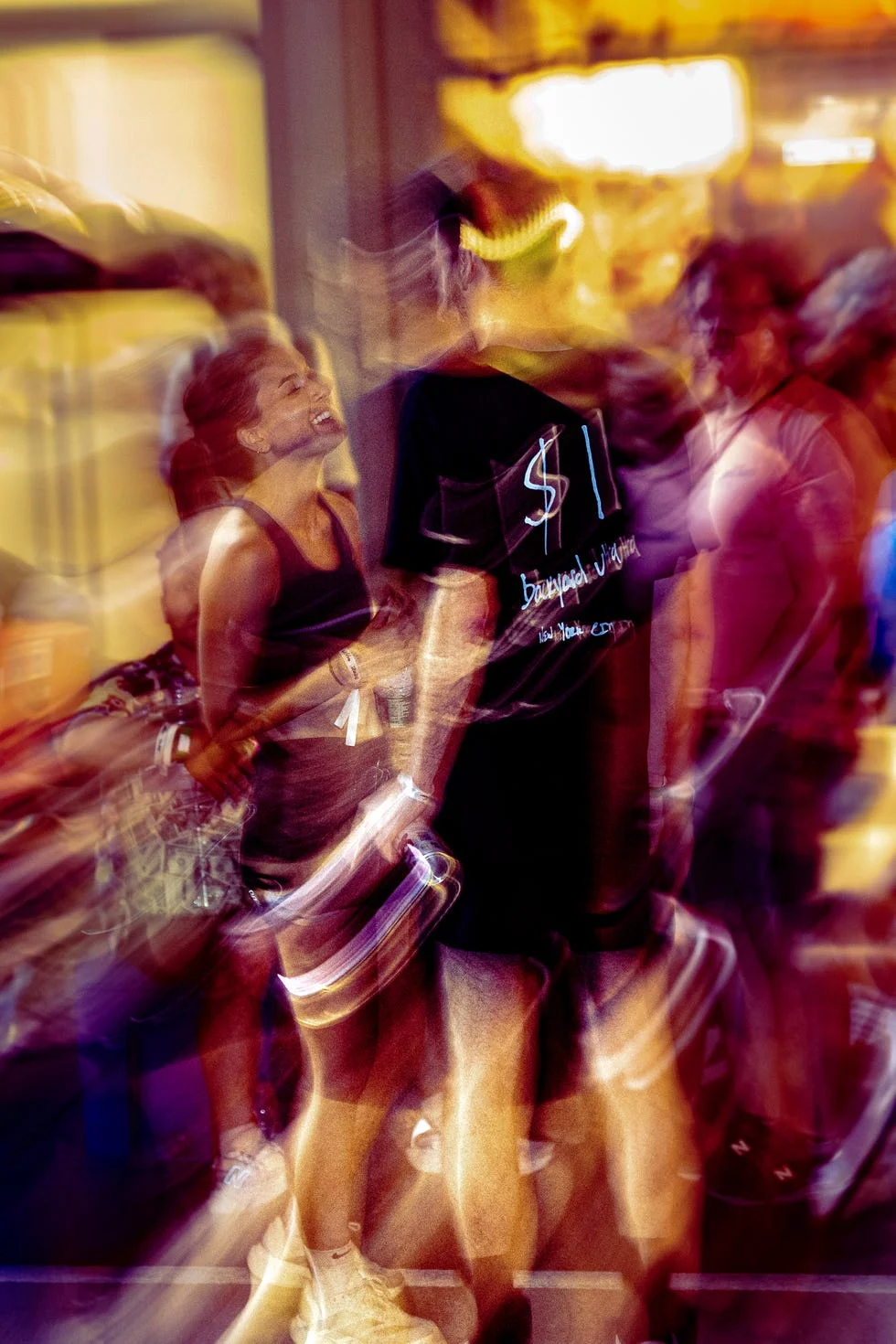
This year, the race came back a whole lot larger and a whole lot less predictable. Instead of one fixed West Side Highway route, runners started and finished at a bar called Printers Alley near Times Square and had to navigate to checkpoints announced shortly before the race, with the possibility that the route could change as the hours went on.
Conceptually, I love it. It’s so strange, yet a genuinely smart way to make an ultra feel so New York–coded. But personally, it also sounds like a nightmare. I love running the West Side Highway, but endless loops are already enough to test a person. Move that into Midtown, with Times Square, tourists who can’t walk, sloshed World Cup crowds, and whatever else the city decides to throw at you, and suddenly the hardest part might not be the mileage.
Vincent Kennedy handled it better than anyone else.
According to the official $1 Ultra results, Kennedy won after 33 laps, covering 137.61 miles. His final lap took 47:43, and he outlasted runner-up Thomas Garvey, who finished 32 laps for 133.44 miles. The official prize pot was $1,764, Garvey said, though he estimated it landed closer to $2,000 after no-shows and extra money were factored in.
Garvey told Runner’s World his experience was hard to sum up neatly. “It’s like we lived a lifetime in those 32 hours,” he said, calling the race “the most amazing kind of chaos.” He remembered dodging giant gorilla costumes, running through soccer parties on Broadway, celebrating the Knicks with the city on 40th Street, and watching the sunrise from the Hudson Greenway.
When also catching up with Kennedy after winning this year’s $1 Ultra, he described the race to Runner’s World as “an urban form of the backyard ultra,” with “its own perks but downfalls as well.”
Those downfalls for him showed up around mile 80. Kennedy said New York City was buzzing with crowds when, for safety reasons, the race had to switch to 0.20-mile repeats around the block of the bar.
“When I heard that was the new route, my mind wanted none of it,” Kennedy told Runner’s World. “I complained to my crew how this just felt silly.”
Garvey remembered the same stretch as one of the race’s strangest turns. He said police barricades blocked both sides of the street near Printers Alley, forcing runners to spend about 30 miles going up and down one block until their watches hit the full lap distance.
“As crazy as it sounds, this is when the camaraderie and friendships really started to form,” Garvey said. “We were passing each other dozens of times every hour, and every single pass got a cheer.”
Kennedy, meanwhile, found himself looking for reasons to stop. Then he called his fiancée, who asked him, “What would your tomorrow say to you today?” Kennedy said he still wasn’t fully convinced, so he listened to a 16-second motivational clip on repeat for an entire loop. After that, he put on music, one of the things he loves most about running, and the section that nearly ended his race became one of his favorite parts.


That was one of the mental loops inside the actual loops. The finish line only exists when everyone else is done, and Kennedy said that not knowing the endpoint can make runners feel “trapped,” because “you don’t know what you’re working towards.”
Garvey felt that uncertainty in a different way. He told Runner’s World he made one rule for himself before the race: “Never quit in the chair.” If he finished a lap, he was going to start the next one. That rule carried him into the final hours, even when his body was falling apart.
“I didn’t want to break mentally,” Garvey said. “I couldn’t decide to stop. That would have been a failure. My body had to leave me no choice.”
As for Kennedy, physically, he said his legs held up because he trains with a lot of volume and is used to running tired. His stomach turned around 100 miles, but he was able to settle it with lighter nutrition. Mentally, he said he had only five or six bad hours out of 33, which is probably about as good as anyone can hope for when a race runs straight through one day and into the next.
Strategy still mattered more than people might think. Kennedy said fueling is the biggest thing he has to keep working on, because “if you are not hydrated and eating, you will burn out.” Pacing mattered, too, and he said he usually came back with 10 to 20 minutes before the next lap.
But Kennedy said the best thing runners can do in this format is not get too caught up in what everyone else looks like.
“You have no idea what’s going on in someone else’s head,” he said.
That became especially clear late in the race. Kennedy said people may have seen him around mile 80 and had no idea he was at one of his lowest points. In a last-runner-standing race, he said, the people around you are less and less just your competition.
“You gotta have fun and make friends,” Kennedy said. “It helps the time pass, plus who doesn’t want new running friends?”
As for the prize money, Kennedy said that wasn’t what drove him most. “I love the work,” he said. “Running is a huge part of my life and who I am, so being able to have a big achievement in something I care about so much means a lot.”
Kennedy said he knows talking openly about wanting to win can sometimes come across the wrong way, but for him, it’s just part of the mindset.
“If you want to win, you have to believe you can,” he said. “You can’t be afraid to win or fail.”
Garvey said he wanted to win, too, but his real goal was to find his limit. He said he knew late in the race that Kennedy might be able to keep going far beyond him, but he still wanted his own body to be the thing that ended it over anything else.
Some people were there to hit a new distance. Some were there to win. Some were there to see what would finally make them stop.
Kennedy just kept going the longest.
Sean Abrams was the Senior Editor, Growth and Engagement at Men’s Health. He’s a former hip hop dancer who likes long walks on the beach and large glasses of tequila. You can find his previous work at Maxim, Elite Daily, and AskMen.