The Brewers and Padres Made the Entire Game Out of High-Leverage Innings
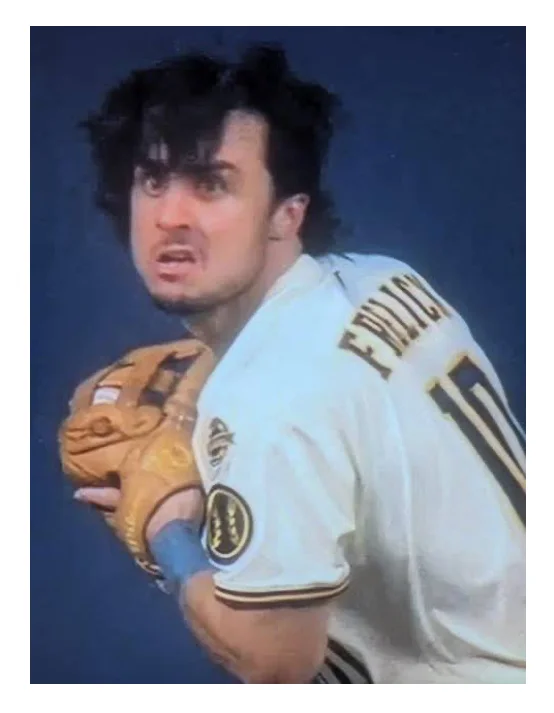
The Brewers earned a 3-2 victory over the Padres in Game 1 of the NLDS on Saturday. With this year’s presumptive Cy Young winner starting for the Brewers and a former Cy Young winner (and still an above-average starter) going for the Padres, a low-scoring affair was not a surprising outcome. Still, the game script didn’t exactly play out as anticipated. Instead, the contest took on a late-inning feel almost from the beginning, and with both emotions and the leverage index consistently running high, perhaps the best way to tell the story of Game 1 is via reactions sourced from one of the most emotive players in either dugout — Milwaukee outfielder Sal Frelick.
The Frelick shown above was struggling to process an unusual double play that he initiated during last year’s NLCS, but that confused sentiment also applies to the experience of watching Brewers starter Jacob Misiorowski allow three consecutive singles during the second inning on Saturday. In over half of Misiorowski’s 30 starts this season, he allowed three or fewer hits across the entire outing, making three hits over three plate appearances feel fairly baffling. The trouble began with a one-out, infield single off the bat of shortstop Xander Bogaerts. The hit was the culmination of a six-pitch skirmish. Bogaerts took the first four pitches he saw (two four-seamers were called balls, while another four-seamer and a cutter were called strikes). He fouled off a 2-2 fastball, then rolled over a slider for a groundball that forced shortstop Cooper Pratt to range far enough to his right that by the time he made the diving stop, he couldn’t get the throw to first in time to beat Bogaerts to the bag.
Though Misiorowski got the type of batted ball that pitchers are usually pleased with, the whole interaction with Bogaerts highlighted a burgeoning problem for the Milwaukee righty. For the flamethrower’s fastball to function, he needs hitters to swing through it, and relatedly, he needs hitters to be willing to offer at it, even when it’s a touch out of the zone. On the season, his four-seamer averaged a 40.2% whiff rate and a 34.3% chase rate. But on Saturday night, it was generating whiffs only 14.3% of the time and getting hitters to chase just 24.1% of the time. Bogaerts was content to watch three heaters from The Miz and then fouled off the fourth. Since the San Diego batters were often fouling off fastballs in the zone and laying off the pitch when it missed the zone, Misiorowski pivoted to his 96-mph cutter as a pitch he could more reliably throw in the zone for called strikes in order to counter the obnoxiously patient Padres.
It wasn’t very effective. The next batter — catcher Ethan Salas — whiffed at a four-seamer for strike one, then took a cutter below the zone and scooped it into center for a single. Padres DH Luis Campusano followed with a very similar sequence, first taking a fastball near the top of the zone for a called strike before inside-outing a low cutter, driving it down the line in right field. Bogaerts scored from second and the play finished with runners on the corners and second baseman Jake Cronenworth due up.
But before Cronenworth dug in, Misiorowski got a mound visit from a member of Milwaukee’s coaching staff (the broadcast only showed an obscure side view, but we’re probably safe to assume it was pitching coach Chris Hook). Following the conversation, Misiorowski threw Cronenworth five consecutive four-seamers, but after touching 104.8 mph (and sitting 102-103) in the first inning, he had dialed back the velo to the 99-101 range. It’s as if his pitching coach had reminded him that a 100-mph fastball is still a very good fastball, and perhaps, one that he might be able to command more consistently. Hook may have also noted that even if the Padres continued to foul off the pitch (which they had done on 11 of his 23 four-seamers to that point), taking a little off would allow Misiorowski to preserve a little juice to make up for the lack of efficiency. At this point in the game, there was activity in Milwaukee’s bullpen, and though manager Pat Murphy was undoubtedly prepared to make a move if necessary, there’s no way he and his pitching coaches had moved on from the possibility of getting another couple of innings from their ace.
Following the slightly less-spicy heaters, Cronenworth fouled off a curveball, then did the same to a 101.2-mph fastball up and away. After that Misiorowski finally caved and went back to the cutter, with the hope that after all those four-seamers, the pitch would be enough of a surprise to be successful. It crossed the plate on the inner black, and as Cronenworth made contact, his bat snapped, sending an oversized shard of wood careening toward first base along with the groundball. First baseman Jake Bauers fielded it and chose to throw home rather than taking the out at first. Catcher William Contreras bobbled the throw from Bauers and wasn’t able to tag Salas as he slid into home, but Salas was running on contact and likely would have been safe anyway. The Padres were unable to add to their 2-0 lead despite the extra out gifted to them, so the only real consequence of Bauers’ poor judgement on the throw home was that Misiorowski needed to throw another seven pitches to retire the side after getting the next batter for what should have been the third out of the inning.
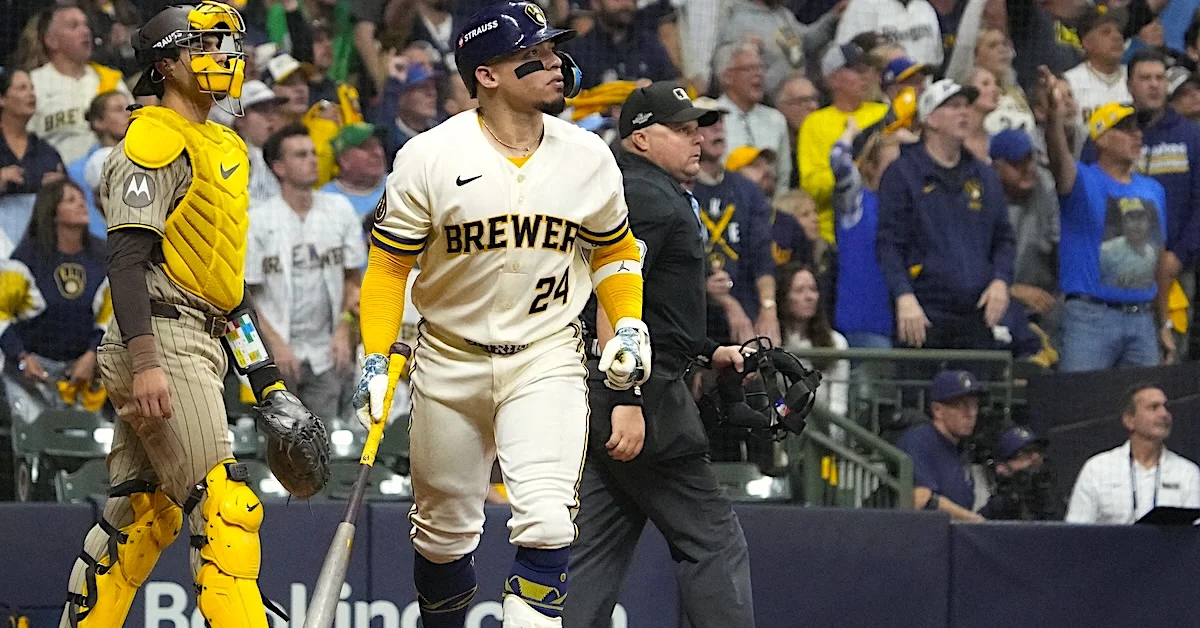
And before long, the Brewers would benefit from a bat-breaking batted ball of their own. Leading off the bottom of the third, center fielder Garrett Mitchell spliced his bat on an inside sinker from Padres starter Robbie Ray. The result was a grounder to short with an exit velocity of 53.2 mph — slow enough to allow Mitchell to reach without a throw. Ray got an out on a Joey Ortiz grounder, but then left fielder Jackson Chourio came to the plate and took a low, first-pitch slider and scooped it up and out over the fence in left-center field. With the game tied and Chourio circling the bases, here’s how Frelick was processing his emotions.
Chourio hadn’t even reached first yet and Frelick had one leg over the railing as he aggressively yelled, “Atta boy!”
After allowing the home run, Ray walked the next two batters and then Bauers lined a single to right to load the bases. Ray recorded one more out on a liner off the bat of DH Christian Yelich before his day was done. He left with a final line of 2 2/3 innings, two runs (both earned), four hits, two walks, and one strikeout, but the more notable statistical artifact from the start lies in his pitch usage. Ray threw 64% sinkers, up from his season average of just 15%. Going so sinker-heavy was an especially odd choice given that he shelved the pitch after the 2022 season and only began throwing it again this year. A sinker is a more obvious choice to set up his changeup, but setting aside the benefit to the rest of his arsenal, the pitch didn’t perform very well. Of the five pitch types he threw in 2026, the sinker yielded the highest wOBA and xwOBA, at .381 and .391, respectively.
But regardless of what was driving the changes in his pitch usage, Ray wound up exiting a tie game after throwing only 45 pitches. Padres manager Craig Stammen might have let Ray continue pitching even after the Chourio homer if he hadn’t immediately loaded the bases. Pulling a starter in the third inning of a game early in a postseason series only makes sense if he was desperate to avoid falling behind because he was convinced runs would be hard to come by with Misiorowski on the mound and Milwaukee’s best relievers lurking. That desperation was especially obvious given that Stammen brought in right-hander Bradgley Rodriguez to face Pratt. This season Pratt has posted reverse-platoon splits, with a 117 wRC+ against righties and a 60 wRC+ against lefties. Pratt had already struck out against Ray earlier in the game, and even if Stammen had felt Ray didn’t have his best stuff, the southpaw was still a better matchup against Pratt than Rodriguez, since for his part, Rodriguez has been slightly worse against right-handed hitters this year. But clearly Stammen got antsy about the potential for a big inning and opted to go to the bullpen, regardless of whether it made logical sense to do so.
As it turned out, Stammen only delayed the lead change. Rodriguez worked a clean four-out appearance, and both Yuki Matsui and Jason Adam pitched scoreless frames after Rodriguez departed. But then Adrian Morejon and his 99-mph sinker took over on the mound for the Padres to start the seventh. He secured two outs on just two pitches, when Cronenworth made a diving play on a grounder from Chourio and Brice Turang lined out to left. Contreras, on the other hand, saw four sinkers and a changeup from Morejon before connecting with a yet another sinker on the outer half and muscling it out to right-center field.
Frelick was not in the dugout when the go-ahead homer left the ballpark. Instead, he was in the batting cage, preparing in case he was called upon to pinch-hit. Even from there, his celebration was deemed broadcast worthy.
Bauers and Andrew Vaughn (pinch-hitting for Yelich) both reached base, but Pratt struck out to end the inning, limiting the Brewers’ lead to just that one run.
The Padres weren’t able to make anything of a pair of walks in the eighth, but then left fielder Dustin Harris led off the ninth with a single on a low liner through the right side. Brewers closer Trevor Megill followed that up by striking out Manny Machado on three pitches (all fastballs touching 99 mph). But then Ty France sent one of Megill’s fastballs on a high-arcing trajectory to left field. The ball left France’s bat with an exit velocity of 105.3 mph and a launch angle of 49 degrees. As all eyes on the field, off the field, and watching from home attempted to finish the ball’s flight path in their mind’s eye, wondering if it had a chance to get out, that dream abruptly died as the ball ricocheted off one of the structural components of the closed roof at American Family Field. The ball’s new path sent it plummeting toward the warning track just inside the foul pole and into the waiting glove of Chourio, who had managed to make the snap adjustment as the ball changed course. Launch angle and exit velocity projections suggest that it’s unlikely the ball would have been a home run, but for those few seconds of hang time, it looked as though the Padres might have captured a narrow one-run lead of their own. Instead, because any ball that hits part of the closed roof at American Family Field over fair territory is playable, Chourio’s catch marked the second out of the inning.
Nevertheless, Milwaukee’s relievers held on to close out the win, handling five innings, facing 23 batters and throwing 87 pitches, while San Diego’s bullpen covered 5 2/3 innings, facing 22 batters and throwing 81 pitches. Aside from Mason Miller, every high-leverage reliever on these two rosters was called upon in Game 1. Collectively, the pitching staffs allowed 26 batters to reach base, but just five total runs to score. It was as if both teams were attempting a Death By a Thousand Cuts strategy, but very few of the cuts actually drew blood. However, that doesn’t mean they weren’t painful or that they won’t leave a mark that will be felt throughout the remainder of the series, especially if, say, Logan Henderson or Michael King gets knocked out of Game 2 early.