Dana Brown Is Out in Houston as the Astros Sputter
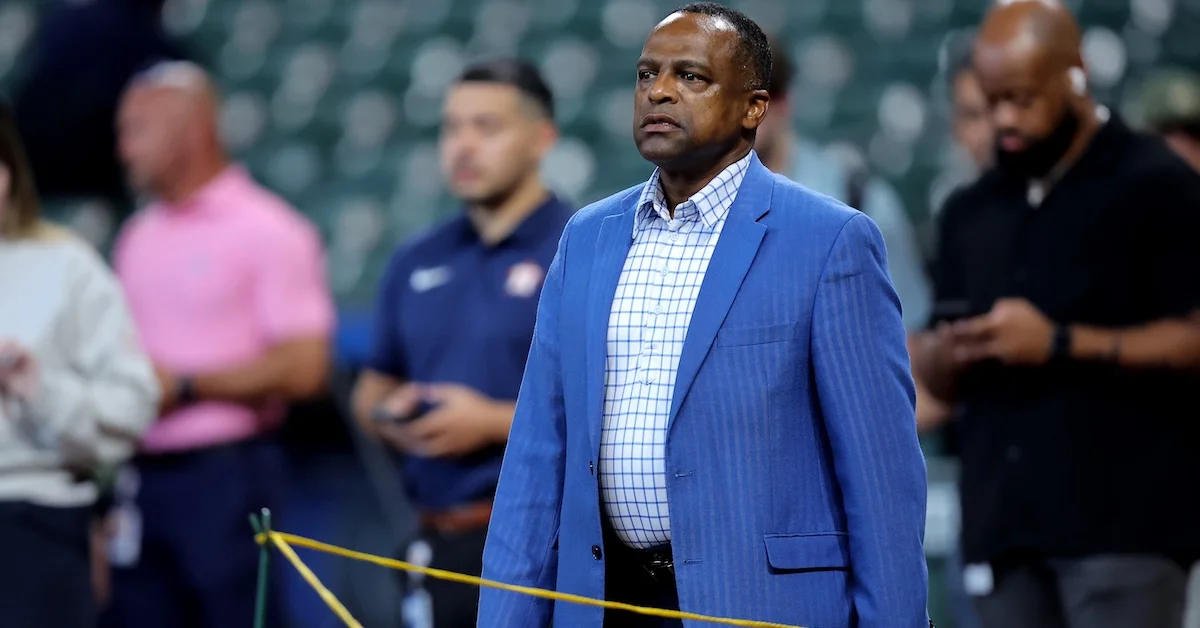
Sunday afternoon, the Astros gave up seven unanswered runs to lose to the A’s 7-6. That loss, against the team with the worst record in the American League, dropped Houston below .500 for the first time this month, and into a tie with the Texas Rangers for the AL West division lead. That was the last game of a 3-9 homestand. The capper to this bummer of a fortnight in Houston followed promptly; the team and GM Dana Brown mutually agreed to part ways Sunday evening, which is team-and-manager speak for firing him.
Boy, am I bummed that I’ve already made an Apollo 13 reference about the Astros this year. Two in the same season would just be too many. So allow me to use some Shakespeare instead: Something is rotten in the state of Texas. While a 12-game stretch of poor play is a strange reason to change GMs, this move wasn’t about a couple of poor weeks of play. Instead, it’s about the last couple of years of poor play; the once-dominant Astros missed the playoffs in 2025, and this year they’re on track for their worst record since 2014 (excluding the pandemic-shortened 2020 season, when they went 29-31 but still made the playoffs). The farm system is one of the worst in baseball – 29th in our farm system rankings. The big league team has been outscored by 44 runs this year, and BaseRuns suggests Houston has played even a bit worse than that. Things really have deteriorated in Space City.
What’s meaningfully less clear is how much of that blame should be apportioned to Brown. He joined the Astros immediately after their 2022 World Series victory, replacing the departing James Click. Not many incoming GMs inherit a roster that just won the whole ball of yarn, but that cuts both ways. Brown inherited a great roster as well as the kind of dysfunction that leads a team and its GM to split up while simultaneously reaching the peak of the sport.
The first offseason of Brown’s tenure was basically a wash, with one blemish. He joined a World Series winner without a ton of expiring contracts – Justin Verlander was the only key contributor to depart – and inherited one signing, that of José Abreu, from owner Jim Crane’s brief time running baseball ops after Click departed. Abreu was coming off a solid season in Chicago, but he fell off a cliff upon reaching Houston; he was two wins below replacement level over one-plus year in town before the team released him.
That failed signing, though Brown wasn’t around when it was made, was the prelude to a poor record in free agency. The best signing of Brown’s tenure was Josh Hader, who signed a record-setting deal for a closer before the 2024 season and has been quite good when healthy since then. That’s been the only big hit, though, and there are plenty of misses to set against it. Abreu was a lemon. Christian Walker, the team’s big addition before the 2025 season, has been just OK. Tatsuya Imai came over from NPB this winter with plenty of hype, but he washed out of the Houston rotation in short order. (To be fair, he’s looked good out of the bullpen.)
That’s not great, but the bigger problem has been the other side of the ledger. The Astros were awash in stars when Brown arrived, but age and free agency have thinned the ranks considerably. They agreed to only two extensions in his tenure – five years and $64 million for Cristian Javier, who hasn’t eclipsed 50 innings pitched in a season since 2023, and five years and $125 million for team legend Jose Altuve, a deal that I feel comfortable in saying was as much about what Altuve had already meant to the team as it was how much he might contribute in the future.
In the meantime, the team’s core has whittled away by attrition. Alex Bregman left for Boston. Brown traded Kyle Tucker to the Cubs. Framber Valdez is a Tiger now. Jeremy Peña and Hunter Brown looked like prime extension candidates a few years ago, but both are rapidly headed for free agency without a deal in place. Yordan Alvarez continues to be one of the best hitters in baseball, but the roster around him simply doesn’t look as good as the Houston teams of a half-decade ago.
Attributing all of this to Brown misses important context, though. There’s nothing unusual about Houston mostly sitting out the free agency market; Michael Brantley, Josh Reddick, and Charlie Morton were the only big signings of the prime Astros era, and Reddick was the only one of that group to get a guaranteed contract of $50 million or more. Though the Astros have frequently run large payrolls, the well-paid stars on those teams were generally either homegrown guys with extensions or trade acquisitions.
The two players Brown extended have been disappointments on the field, no doubt. But which of the former Astros do you wish he’d signed? He did very well in trading one year of Tucker for multiple years of Cam Smith, Hayden Wesneski, and Isaac Paredes. The deal Bregman signed in Boston, and the subsequent one he signed in Chicago, were both larger than any free agency signing in team history; it’s unclear whether Crane would’ve signed off on either contract if Brown had wanted to make Bregman the same offer. Valdez has been mediocre since leaving.
The biggest problem with the Astros in the Brown era wasn’t their inability to sign someone good in free agency or to extend their best players, though both factors have contributed to their recent struggles. Rather, it was the lack of new impact performers from the minor leagues. Houston has gotten just one season of two-plus WAR from a rookie in the last four years — Yainer Diaz in 2023. Diaz and Hunter Brown were the team’s top two prospects when Dana Brown arrived, both top 100 prospects. Six other Houston minor leaguers hit our Top 100 list during Brown’s tenure. Korey Lee, Drew Gilbert, Jacob Melton, and Jake Bloss were all traded away. Kevin Alvarez hit our 2026 Top 100 midseason update, but he’s a ways off; he’s 18 and playing in his first year of full-season ball. The last of the six is Smith, who was a Cubs prospect and has never played a minor league game for the Astros. In other words, the farm system is just completely bare.
That’s not a new thing. The Astros had a bottom-10 farm system when they hired Brown, and then they promptly graduated their two top prospects and traded the next two best. They draft late. They buy at every deadline. They lost multiple draft picks as a penalty for the banging scheme. The last first-round pick to make a big impact for the team? That’d be Bregman and Tucker, both drafted in the first round in 2015. The fruits of the Jeff Luhnow era were huge – but Houston’s been trending downwards on the drafting and development standpoint ever since.
Truthfully, this looks like a very difficult situation to step into. Jeff Bagwell famously has Crane’s ear, and appears to be heavily involved in baseball operations decisions. Crane himself is no stranger to meddling, and in fact has named himself the interim head of baseball operations with Brown out. It’s never easy to understand organizational dynamics from the outside, but again, the Astros fired their GM directly after winning a World Series. It’s safe to say that things are at least a little dysfunctional there.
The Astros find themselves at a competitive crossroads, too. Their current roster is thin; all those years of missed draft picks and deadline trades have caught up to them. Many of their best players are due to reach free agency after the 2027 or 2028 seasons. Smith is the only regular contributor younger than 27. (Mike Burrows might have a case here, but “regular” and “contributor” are still open for debate there.) A lot of organizations might look at this roster and start planning for the distant future.
To Houston’s credit, it hasn’t operated like that since Luhnow’s initial tanking spree set the franchise on this course more than a decade ago. The Astros consistently look to compete, and they made the playoffs in eight straight years before last year’s miss. But if I were a GM stepping into this job today, I’d be trying to figure out how long I could keep all the balls in the air before everything falls.
The Astros have a top-10 payroll this year, the largest in franchise history. They have the ninth-highest committed payroll in the majors for 2027. They don’t take big swings in free agency. They don’t have reinforcements in the wings; we give ETAs to prospects, and only two of their top 10 are expected to reach the majors before 2028. The odds are good that if this Houston team makes the playoffs in 2027, it’ll be doing so with its current major leaguers, plus some bit-part roles from prospects and waiver claims.
For me, that means 2027 is a good time to keep trying to win, under the argument of “if not now, when?” Surely, the plan of running high-but-not-overwhelming payrolls and trying to avoid free agency can’t keep going now that almost the entirety of the original World Series core has departed or aged out. The moment of reckoning is coming at some point. I’m not saying that a long trip to the cellar is inevitable, but there just isn’t much to work with on the farm at the moment. A few years of higher draft picks and fewer deadline deals would do wonders.
On the other hand, good luck pitching that to Crane. Like I said, the Astros haven’t operated like that in a while. Crane has some Jerry Jones in him, too; he wants to win so badly, and thinks of himself so highly, that he can’t help putting his thumb on the scales for major decisions. Heck, he reportedly instructed Brown not to sell at this deadline. I think there’s a decent chance that Bagwell ends up with this job, in fact; there’s been no formal reporting on whether he wants the responsibility, but given his position as Crane’s most trusted baseball advisor, he seems like a natural pick.
Whoever Houston chooses as its next GM will be stepping into an exceedingly tricky situation. They’ll have to get Crane and Bagwell behind their plan for the team. They’ll have to do so with a lockout looming, and then effect whatever changes they’ve planned in an abbreviated offseason. If things go wrong, they’ll be operating with very little margin for error, because there aren’t enough prospects knocking on the door to fill in any gaps. I think that a lot of people who look at baseball through a mathematical, probabilistic lens would blow the team up this offseason if they were in charge. I don’t think that’s an option here, though. Based on how they’ve acted for the past several years, and based on the continuity in baseball thinking between Crane and Bagwell, I think it’s a near certainty that the next GM is coming in with a mandate to win now.
Luckily for Houston fans, that won’t come into play until the winter. In the short run, the plan is simpler, because the front office doesn’t have many levers to pull in late August. Either the current team will be good enough, or it won’t be, and it doesn’t much matter whether Dana Brown, Jeff Bagwell, or some yet-to-be-determined option is sitting in the team suite watching the games. It might feel weird to fire your GM in the middle of August, after they’ve already lasted through the draft and the trade deadline, but the upside is that the Astros will have plenty of time to get their ducks in a row when it comes to future plans before the interview process begins in earnest this offseason. As wild as this news sounds, I don’t expect it to have any impact on the 2026 team’s fortunes.
Still, this whole situation is a mess, and at some point, the mess becomes the message. The Astros have been phenomenally successful in the 2020s, but they’ve done so with a backdrop of extreme volatility in the front office, and it looks to me as though that’s affected their drafting and development. There’s more upheaval to come, surely; manager Joe Espada’s contract is up after this year, and the next GM will likely want to bring in either their own skipper or Crane’s hand-picked guy. The future is unknown and unknowable – but it’s hard for me to imagine a smooth transition to a new leadership group given how bumpy the road has been in Houston of late. The end of the current Astros era looms, and this most recent drama is just a symptom.