FanGraphs Weekly Mailbag: August 22, 2026
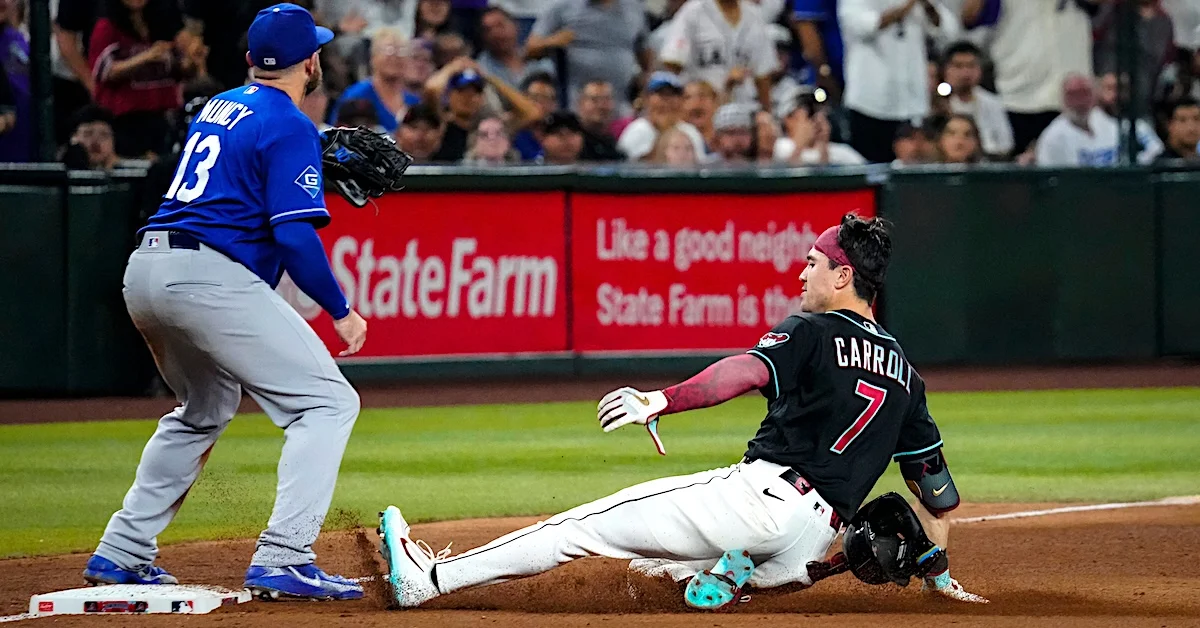
As you all probably know, at the start of every season, the FanGraphs staff puts together our bold predictions for the coming year. Each is, to varying degrees, plausible but unlikely, which is what makes it such a fun exercise. Anyway, entering the 2025 season, my bold prediction was: Corbin Carroll will become the fifth-ever 20/20/20/20 player — 20 doubles, 20 triples, 20 home runs, and 20 stolen bases in a single season — joining Frank Schulte in 1911, Willie Mays in 1957, and Curtis Granderson and Jimmy Rollins, who both did it in 2007. Carroll ultimately fell just three triples short of the threshold, while tallying 32 doubles, 31 homers, and 32 steals.
I decided not to run it back this year, figuring that wouldn’t be as fun, though I am very much still rooting for it to happen. The 20/20/20/20 Club is one of the most exclusive baseball has to offer. Pulling it off requires a precise combination of power, speed and instincts, and it has to happen at the exact right moment in a player’s career. As I wrote in my bold prediction: “A player needs to have enough pop to hit 20 homers, but not so much that the majority of his extra-base hits land in the seats. He also needs the speed to steal bases and stretch singles into doubles and doubles into triples. His instincts must be sharp, so he can know when to attempt the extra base without running into outs.”
Last Saturday, when I saw that Carroll had doubled and tripled in a 10-3 Diamondbacks win over the Braves, I pulled up his player page to check on his progress. He was up to 26 doubles, 15 triples, 18 homers, and 16 steals. He stole a base the next day, and after going without an extra-base hit in Arizona’s three-game series against the Red Sox, Carroll entered play Friday at 26 doubles, 15 triples, 18 homers, and 17 steals with 34 games left to play. This prompted my own question for this week’s mailbag, which I will get to momentarily. We’ll also answer your questions on the worst player to ever hit three home runs in a game, the biggest drop-off for a player in the season after finishing second in the MVP voting, and teams missing the playoffs despite leading the league in run differential. But first, I’d like to remind you that this mailbag is exclusive to FanGraphs Members. If you aren’t yet a Member and would like to keep reading, you can sign up for a Membership here. It’s the best way to both experience the site and support our staff, and it comes with a bunch of other great benefits. Also, if you’d like to ask a question for an upcoming mailbag, send me an email at mailbag@fangraphs.com.
__
How likely is it that Corbin Carroll records the fifth-ever 20/20/20/20 season?
I asked Dan Szymborski to fire up ZiPS to project the probability that Carroll would reach all four of the 20/20/20/20 thresholds this season. As of Friday afternoon, those odds are, poetically, 20% — a one-in-five shot to become one of the five 20/20/20/20 players is so perfect that I now think that it’s definitely going to happen.
__
Question regarding Joshua Báez’s three-homer debut: Who is the worst player ever to hit three home runs in a major league game? I guess what I’m really asking is: How much should we raise our estimate of how good Joshua Báez is based on his first game? — Jeremy
Michael Baumann: You’ve come to the right place, Jeremy. I’m fascinated by the idea that a player can do so well in his major league debut that whatever follows is a letdown. I wrote about this on Opening Day, when a bunch of highly touted rookies had big days. Kevin McGonigle, for instance, is having a terrific rookie season, and looks like he’s going to have a terrific career. But his lifetime batting average is never going to be higher than .800, which is where it stood after his first game in the majors.
And McGonigle didn’t hit even one home run in his first big league game. What an underachiever. So that sentiment goes double for Báez.
I also spent every free moment from age 6 to age 13 poring over random books about baseball history. I remember vividly coming across a book about the players who’d hit four home runs in a game, expecting to see nothing but a list of the greatest power hitters ever. Indeed those hitters were present — Lou Gehrig, Willie Mays, Mike Schmidt — but so was some joker named Pat Seerey, whom I’d never heard of.
Since 1901, 496 players have at least one game of three home runs or more in AL/NL play. Johnny Mize, Mookie Betts, and Sammy Sosa have done it six times each, which is the career record.
If you want to find guys who could absolutely rake, “Has this person ever hit three homers in a game?” is a terrific weed-out question. Those 496 players include 68 of the 165 Hall of Fame position players who have appeared in a game since 1901, as well as 77 of the 145 position players and two-way guys who have been named MVP of the AL or NL. That’s 108 distinct players, once you account for the considerable overlap between the two populations.
So in his first big league game, Báez joined a club in which 21.8% of members are either MVPs or Hall of Famers. Those criteria are so strict that a lot of all-time great hitters don’t make the cut: Manny Ramirez, Juan Soto, Albert Belle, Lance Berkman, Mark McGwire, and Yordan Alvarez (at least for another two and a half months), just to name a few.
| Value | G | PA | HR | R | RBI | AVG | OBP | SLG | wOBA | wRC+ | WAR |
|---|---|---|---|---|---|---|---|---|---|---|---|
| Mean | 1413 | 5603 | 214 | 744 | 783 | .268 | .344 | .458 | .351 | 114 | 29.7 |
| Median | 1419 | 5398 | 188 | 707 | 726 | .268 | .342 | .455 | .350 | 114 | 22.8 |
The large number of active players on this list of 496 players complicates the pursuit of an average hitter with a three-homer game. No one who hits 200 homers with a 114 wRC+ calls it quits after 1,400 career games and a career WAR total in the mid-20s. Imagine a hybrid of Bryan Reynolds and Byron Buxton and you’re in the right ballpark.
That’s a really good player! Turns out that most guys with even one three-homer game have quite a bit of juice.
But Jeremy asked what happens when you turn the leaderboard upside-down. I expected Báez, with six career games as of this writing, to be at the bottom of the career WAR leaderboard. Not so.
Báez does have the lowest positive WAR total among three-homer hitters, at least for now. The Cardinals play twice between when I’m writing this and when the mailbag is getting published, and Báez is about one five-thousandth of a win behind Liover Peguero for 478th all-time. In other words, Báez is probably going to move up the leaderboard a bit by the time you read this.
No matter, because 17 of the 496 players with a three-homer game in the majors have contrived to post a negative career WAR total. WAR is a blunt instrument rather than a precision tool, and if you go back into the 20th Century, that reputation only gets more true. WAR says Babe Ruth is the best player ever, followed by Barry Bonds, Mays, Ty Cobb, and Honus Wagner. If you put that forward as a list of the five greatest position players of all time (not counting active players like Shohei Ohtani), I don’t think any serious baseball fan would give you much grief.
But back in the 1900s, before baseball found out about math, GMs and managers were flying blind when it came to filling out a lineup. They didn’t know (or care) about a lot of factors that end up having a pretty big impact on WAR. And even if they had known, they didn’t have the tools to measure it accurately.
So occasionally in history you get guys with comically bad WAR totals because no one figured out they were playing the wrong position, or that chasing productive outs is a much worse tactic in the long run than just trying to hit the ball hard. I’m disinclined to rip on a replacement-level guy from antiquity (read: the 1970s) who was considered a useful player at the time.
Only one of those 17 negative-WAR players is currently in the majors: Michael Toglia. He’s dead last in career WAR on the three-homer list, almost a full win out of 495th place. Toglia is 493rd in batting average, 490th in on-base percentage, and 458th in slugging, despite playing his home games at Coors Field for most of his career. Toglia is 494th, or third from the bottom, in career wRC+, ahead of two players with careers half as long as his.
Reasonable people can disagree; journeyman catcher Michael Pérez is one of the two players who trails Toglia as a hitter, with a wRC+ of 52 in 599 career plate appearances. But I find the whole body of work for Toglia pretty persuasive.
What does this mean for Báez? Well, I think it’d be pretty glib to pencil him in for Cooperstown on the strength of one game, impressive though it was. Our prospect guys gave him a 45+ FV grade in his last two trips through the rankings, which is one grade short of the global top 100(ish) list. That grade reflects some extremely encouraging gains in approach for the young Cardinals slugger, and you have to be impressed by the manner in which he went about his record-setting debut. But power was never the issue for Báez. A single three-homer game isn’t going to shift the paradigm the way a long strikeout-less streak would have, for instance.
Nevertheless, the mean and median career WAR totals for players with a three-homer game are better than the equivalents for players who were drafted first overall. It’s not that hitting three home runs in a game makes you a middle-of-the-order threat on its own, but doing so — especially as a rookie — is evidence of impressive underlying skills.
In short, the Michael Toglia or Pat Seerey path is still wide open for Báez. But a week ago I wouldn’t have given him a second thought, and he’s got my attention now.
__
Has anybody who finished number two in the MVP voting like Cal Raleigh did last year had such a big fall-off in the subsequent season? — David
Ben Clemens: There’s a really clean answer to this question. One player finished second in MVP voting and then lost double-digit WAR the next year. That player? Ted Williams, naturally; he got absolutely robbed in the 1942 AL MVP voting, finishing in second place to Joe Gordon despite an outrageous .356/.499/.648 batting line. Williams led the AL in homers, walks, runs, RBI, and each triple slash category. That season was worth 11.5 WAR. The next year, he was one of the best in his field again – but that field was naval aviation, because he enlisted in the military during World War II.
That might be the right technical answer, but I don’t think it gets at what you’re asking for. Neither does the case of Sandy Koufax, who finished second for NL MVP in 1966 (1.73 ERA, 9.1 WAR in 323 innings) and then retired after the season. We probably shouldn’t count 1943 AL runner-up Luke Appling or 1942 NL runner-up Enos Slaughter, either, because they also joined the military during World War II. And it’s kind of harsh to put 2019 Alex Bregman in here; he put up 8.3 WAR in that season and a mere 1.3 WAR the next, but that’s at least partially because COVID cut the 2020 season to a mere 60 games.
If you’re looking for comparisons to Raleigh, the cleanest one is Jacoby Ellsbury, who had a huge 2011 season (9.5 WAR, 150 wRC+) and finished second to Justin Verlander in the AL MVP voting. The following year, Ellsbury had a complete bummer season; he got hurt and also hit poorly, and managed only 0.8 WAR in 74 games. But that’s not quite the same as Raleigh, either; sure, he’s been hurt, but he’s already managed nearly 100 more plate appearances than Ellsbury in 2012, and there’s plenty of year left too.
Raleigh, who as of Friday afternoon was slashing .156/.273/.296 with 13 home runs, a 71 wRC+, and 0.8 WAR in 94 games, almost stands alone in terms of big downswing from a second-place MVP finish, when he slashed .247/.359/.589 with 60 homers, a 161 wRC+, and 9.1 WAR in 159 games. But there are a few at least rough comparables. There’s Adrian Beltré, who nearly won the 2004 NL MVP with the best year of his career (9.7 WAR) before signing with the Mariners after the season and scuffling to a 90 wRC+ and 2.4 WAR the next year. Or what about Victor Martinez? A surprise second-place finisher in the 2014 AL MVP voting, he managed only 4.6 WAR that year, so he’s not in the same stratosphere as Raleigh for quality of season, but Martinez posted a shocking -2.0 WAR – yes, negative two – the next year. Oof.
Those are the two closest matches in terms of a player putting up a career-best year and then falling back to Earth with a crash in the next one. But I’ll also submit one other player who lost six or more WAR after nearly winning MVP and might be a close Raleigh comp. Magglio Ordonez had a spectacular 2007 season (8.0 WAR, 169 wRC+) and then a meh 2008 season (1.7 WAR, 130 wRC+) thanks to some of the worst baserunning and defense of his career, which is saying something for a guy who was a combined 150 runs below average in those phases of the game when he retired.
The path from near-MVP to near-replacement-level is not a commonly walked one. Almost everyone who has done it has done so in the context of a global conflagration of one sort or another, or a massive loss of playing time due to injury or retirement. But seasons like Raleigh’s do happen every once in a while. Sometimes a career year at the plate is just that, and some cruel twist of variance follows that career-best season with a career-worst one. And hey, maybe Martinez and Ordonez never really recovered from their pratfalls, but the bulk of Beltré’s best years were still ahead of him when he had his own big swoon. But ouch, Mariners fans; the closest comp to Raleigh is a guy Mariners fans do not have fond memories of, because Beltré didn’t truly return to form until he left Seattle. In any case, what a great question, and a fun trip down memory lane.
__
Since the expanded playoffs, has there ever been a team that led its league in run differential and didn’t make the playoffs? — Jason
Davy Andrews: No Jason, that has not happened since the expanded playoffs. A handful of run differential leaders have made it into the playoffs with a Wild Card berth — the 2023 Rangers, 2004 Red Sox, and 2002 Angels being the most notable among them — but even if you’re really unlucky, it’s hard to lead the league in run differential while missing out on the playoffs. The only time it’s happened in the Wild Card era was 2005. Cleveland led the AL with a differential of 1.1 runs per game, but, at 93-69, finished a whopping six games behind the White Sox for the AL Central lead and two games behind the Red Sox for the sole Wild Card spot. Sometimes the Sox just have your number.
That Cleveland team was great. It went 34-14 in blowouts for a .708 winning percentage. But in one-run games, it went just 22-36, a .379 winning percentage that crushed those playoff hopes. The White Sox, on the other hand, went 35-19 in one-run games, and then those lucky ducks went on to win the World Series.